
- COMMUNITIES
- PUBLICATIONS
TMCnet Magazines
 Internet Telephony Magazine
Click here to read latest issue
Internet Telephony Magazine
Click here to read latest issue
Subscribe for FREE - Click Here CUSTOMER
Click here to read latest issue
Subscribe for FREE - Click Here Cloud Computing Magazine
Click here to read latest issue
Cloud Computing Magazine
Click here to read latest issue
Subscribe for FREE - Click Here IoT EVOLUTION MAGAZINE
Click here to read latest issue
Subscribe for FREE - Click Here - EVENTS
- AWARDS
- TECHNOLOGIES
TMCnet's Technology Sites
- MORE NEWS
Browse News by Topics
- BLOGS
- MORE
TMCnet Resources
About TMCnet
Subscriptions


 March 2010 | Volume 13 / Number 3
VoIPeering
Voice Was a Business
There were many fantastic slides of data, but this is the one that captured the moment best in my opinion. International voice phone traffic growth has slowed sharply and with it goes the cost to terminate, so it is a double negative. Alternatively, international Skype to Skype traffic is increasing at an amazing rate, and this is all peered VoIP traffic. VoIP peering has come alive, and it is wreaking havoc on a business model and companies that have been built on it for more than 100 years. Looking at the data, it is no wonder that AT&T recently declared the PSTN and POTS relics of the past and asked the FCC (News - Alert) for a timeline to shut-down. Aside from several obvious ironies in AT&T making this request -- not the least of which is the fact that they and the other RBOCs have FCC protection for their investment in fiber, which they do not have to share with anyone -- it is quite interesting to see them have to run fast to keep up with Skype and peered voice. They have no choice but to kill their own old model as fast as possible, and that means killing the old copper, design, operations, maintenance, everything and start new. That is a major undertaking for companies that never had to move fast for anything, or anyone. It is not just about new fiber to the home, of course. It is also very much about the AT&T and Verizon (News - Alert) wireless networks that will connect to and use their fiber to the home for backhaul to increase speeds and coverage. It may very well be that AT&T and Verizon do not care what VoIP app people use on their mobile devices in the not-too-distant future. This is a major change in strategy from just a few short months ago where AT&T blocked Skype and Google (News - Alert) Talk on its wireless network. Now they allow those VoIP apps, but it comes with a price – the user must still pay for a traditional voice plan, even if they do not use it. This will change as competition heats up and one of them allows access to the apps without this catch. Then the others will follow. But that may take a while. It will all depend on how many wireless providers have data networks robust enough to support the apps. If there are only two, it will not be that competitive.
Those, like Telegeography, that continue to collect data on voice traffic and revenues will have to change their collection and analysis process going forward. No longer will it be necessary, or meaningful, to track the monetary value of a minute. This will necessarily change the psychology of those who believe the word voice implies a business model. Clearly that way of thinking is as much of a relic as the PSTN and POTS itself. IT Hunter Newby is CEO of Allied Fiber (News - Alert) (www.alliedfiber.com). Today @ TMC
Headlines
Upcoming Events
MSPWorld
The World's Premier Managed Services and Cloud Computing Event Click for Dates and Locations Corporate News
|
|
 I recently sat in on presentation given by Stephan Beckert (
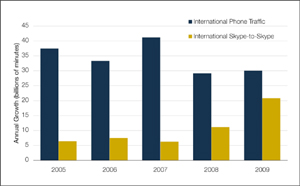 It may also make sense for the major wireless providers to create their own VoIP apps like Skype, but at the rate Skype is growing it may not make sense to try and duplicate it, but rather just provide access to it. In a sense Skype is a large private Internet for individual VoIP users, so the wireless providers are basically selling access to the VoIP Internet – and isn’t that what it is all about anyway, paying for access. I have never seen a toll on a bridge, or tunnel ever decrease in price, have you?
The World's Largest Communications And Technology Community
2 Trap Falls Road Suite 106, Shelton, CT 06484
Ph: 800-243-6002, 203-852-6800; Fx: 203-866-3326
General comments: [email protected]. Comments about this site: [email protected]. Technology Marketing Corp. 1997-2017 Copyright . Privacy Policy Sitemap
