
- COMMUNITIES
- PUBLICATIONS
TMCnet Magazines
 Internet Telephony Magazine
Click here to read latest issue
Internet Telephony Magazine
Click here to read latest issue
Subscribe for FREE - Click Here CUSTOMER
Click here to read latest issue
Subscribe for FREE - Click Here Cloud Computing Magazine
Click here to read latest issue
Cloud Computing Magazine
Click here to read latest issue
Subscribe for FREE - Click Here IoT EVOLUTION MAGAZINE
Click here to read latest issue
Subscribe for FREE - Click Here - EVENTS
- AWARDS
- TECHNOLOGIES
TMCnet's Technology Sites
- MORE NEWS
Browse News by Topics
- BLOGS
- MORE
TMCnet Resources
About TMCnet
Subscriptions


 February 2010 | Volume 13 / Number 2
Case Study
Are We Alone? Armed with Fujitsu Switches, SETI Program Aims to Answer the Age-Old QuestionBy: Paula Bernier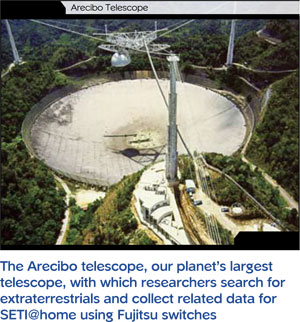
If you believe there’s intelligent life beyond Earth, you might be interested to learn about the Search for Extraterrestrial Intelligence program at UC Berkeley. And if you’re an ET junkie, you may already know about, and maybe even participate in, SETI@home. THE SETI program, explains its director Dan Werthimer, is a worldwide effort to pull data out of the heavens and comb through it, seeking evidence of intelligent life on other planets. The project employs Fujitsu (News - Alert) XG Ethernet switches to transport information collected by telescopes around the world, sending that data to millions of computers for analysis. “The idea in SETI is that earthlings are sending off a lot of radio and television signals,” says Werthimer. “I Love Lucy left the Earth about 50 years ago. So these television signals, even though they’re meant to go down to Earth, they go out into the atmosphere and go traveling out in space at the speed of light. I Love Lucy’s gone past about 10,000 stars already.” Between TV, FM radio and RADAR signals, earthlings send a lot of signals out into space, he says, so perhaps other civilizations are doing the same thing. “So we’re looking for those signals,” Werthimer explains. “The problem is it’s a huge amount of data that we need to record and then send out to volunteers. It turns out that to analyze the data we have the biggest supercomputer on the planet, and it’s made out of millions of volunteers with their computers at home or at school. We call it the SETI@Home project.” About 8 million people in 226 countries have downloaded the SETI@Home screensaver, which enables them to donate the spare computing cycles on their computers to UC Berkeley for this effort. After downloading the screensaver, volunteers are assigned a part of the sky to work on and when the work is done, they send results back to UC Berkeley for further analysis. The army of volunteers involved in SETI@Home is diverse, including everybody from school children, teachers, computer scientists and anybody else with an interest in what’s out there. “People have been asking this question for thousands of years: ‘Are we alone?’” says Werthimer. “I’ve been working on it for about 30 years and still haven’t bagged any aliens.” Werthimer says the search for life is a difficult one because researchers don’t know where to point their telescopes, what frequencies to look at, or what kind of signals to seek. “There could be radio signals all over the place coming from civilizations,” he says. “Earthlings are very primitive in our searching capabilities right now. I think we’d be lucky to find ET using today’s technology. But I’m optimistic in the long run. The technology keeps improving. We’re starting to think about 100gigabit switches, and handling more and more data. The capabilities are doubling almost every year.” Indeed, UC Berkeley started its SETI project using Fujitsu’s XG700 10gbps switches about four years ago. Today, UC Berkeley has about 10 of Fujitsu’s newer 20-port 10gbps Fujitsu switches. And the university’s partners have another 15 of those switches, which also are part of the worldwide project. “Not a big sales value for Fujitsu,” says Werthimer. “But it would be cool if Fujitsu switches were the first to discover extraterrestrials. We would share the Nobel (News - Alert) Prize with our colleagues at Fujitsu.” Such accolades would probably be well deserved, indicates Werthimer, who says UC Berkeley uses every port on all of the Fujitsu switches at the full 10gigabit rate, full duplex. “No other switch we tested can do that,” he says. “We use [the Fujitsu switches] at the world’s largest telescope in Puerto Rico,” Werthimer adds. “It’s a thousand feet across. It holds 10 billion bowls of Corn Flakes.” Each telescope puts out 100gbps, he continues, and some of the telescopes are arranged in arrays of forty. That adds up to huge data loads that the program needs to transfer, analyze, and use to make images of the sky and look for potential signals from other civilizations. “That’s where the 10gigabit switches are important,” he says. While the effort has yet to meet its primary goal of finding intelligent life beyond Earth, the SETI@Home program has led to some important discoveries, Werthimer says. It has used the technology described above to make the first images of the black hole at the center of Milky Way galaxy and to search for primordial black holes. The program also has lead to the discovery of several new pulsars that provide clues about the early universe and the Big Bang (News - Alert). Beyond that, Werthimer continues, SETI@Home was a pioneering effort in using volunteers in scientific endeavors that involve supercomputing requirements. Now, he says, there are similar peer-to-peer initiatives in which the general public can volunteer their spare computing cycles to discover new types of medicines, for example, or participate in other important global research efforts. IT Today @ TMC
Headlines
Upcoming Events
MSPWorld
The World's Premier Managed Services and Cloud Computing Event Click for Dates and Locations Corporate News
|
|

The World's Largest Communications And Technology Community
2 Trap Falls Road Suite 106, Shelton, CT 06484
Ph: 800-243-6002, 203-852-6800; Fx: 203-866-3326
General comments: [email protected]. Comments about this site: [email protected]. Technology Marketing Corp. 1997-2017 Copyright . Privacy Policy Sitemap
