| Fat Or Thin? Choosing The Best Client For Cable
Telephony BY LINDEN DeCARMO
[Go to a glossary for this article.]
The cable industry is agonizing over whether its telephony clients should be fat or
thin. Distributed Call Signaling (DCS) proponents feel that the smarts should be placed in
an intelligent -- or fat -- client. By contrast, Network Call Signaling (NCS) supporters
believe that all intelligence should be placed in network servers.
Network Centric
A DCS network contains two core elements: intelligent endpoints and network helpers. DCS
endpoints are typically either a cable modem or a Multimedia Terminal Adapter (MTA). Their
primary responsibility is translating packet-based audio streams into a format
understandable by conventional phones.
A DCS endpoint is dramatically different from a simple analog phone. Not only is it
likely to have a powerful microprocessor, but it also contains a plethora of programmable
software services (features) such as call forwarding and voice mail. Besides these
software features, DCS endpoints are responsible for both call signaling and resource
management.
Call signaling refers to the messages that are exchanged between endpoints when a call
is being connected. Because DCS is an extension of the Internet Engineering Task Force's
(IETF) Session Initiation Protocol (SIP), it is compatible with emerging industry call
signaling standards.
Resource management is necessary to ensure the smooth flow of audio content during a
multimedia session. Typically, the calling and destination endpoints negotiate the data
rate at which they will be streaming and reserve the appropriate network bandwidth for
this data. If these resources are not reserved, random traffic may cause choppy audio or
jerky video.
Network Helpers
Although a DCS endpoint is intelligent, it is ignorant of network resources or the
location of other endpoints. Thus, it must rely on helpers to navigate the cable telephony
network.
For instance, the endpoint obtains packet routing services from a Cable Modem Terminal
Server (CMTS).
Another helper is the Call Management Server (CMS). The CMS provides an endpoint with
bandwidth management, authentication, and privacy features. The first responsibility of
the CMS is to authenticate the person using the endpoint and authorize service.

Figure 1. DCS architectural diagram.
Authentication involves verifying that the endpoint is legitimate (i.e. the user's bill
is paid and the endpoint is using a valid IP address). Once it is authorized, the CMS
screens the features that can be executed on the endpoint. For instance, the endpoint may
contain the software for call waiting. However, the user may not have paid for that
service. In this scenario, the CMS would not permit call waiting on that endpoint.
A second function provided by a CMS is bandwidth management. Each CMTS contains virtual
"bandwidth gates" that control the flow of multimedia packets between endpoints.
Once both endpoints are authorized, the CMS instructs the bandwidth gates about the types
of content that may be exchanged between endpoints. For instance, the bandwidth gates may
be authorized by the CMS to permit voice calls but refuse video calls.
The final duty of the CMS is to ensure privacy. Recipients can interrogate conventional
SIP packets and retrieve the IP address of the sender. Hackers may attempt to exploit this
loophole to wreak havoc in a network. Consequently, the CMS scrambles the packets so that
both the calling and receiving parties are secure from hacking.
Network Scalability Is Essential
Since each endpoint maintains call status, CMS's are responsible only for translation,
authentication and privacy transactions. Therefore, the designers of DCS feel that it will
scale better on larger networks since each additional endpoint provides negligible
increases in the responsibilities of the CMS.
Another theoretical strength of DCS is its ability to perform selective service
upgrades without affecting the entire network. For instance, a limited number of endpoints
can be used to test new features or services. If the new feature fails, only the test
endpoints are affected.
The Push For Simplicity
As voice over IP (VoIP) evolves, protocols are modified to address the limitations in
their predecessors. For example, H.323 was the first standardized VoIP protocol.
Unfortunately, it is a complex protocol that is vague in crucial areas. These weaknesses
limit H.323's usefulness in consumer telephony devices.
VoIP vendors realized they needed a simpler, more robust protocol in order to penetrate
consumer markets. Consequently, the concept of a Device Control Protocol (DCP) was
created. DCPs remove all the call signaling, resource management, authentication, and
service execution responsibilities from the endpoint and focus only on the minimum
features necessary to enable telephony. This reduction in complexity should result in more
stable endpoints.
Over the past year, several DCPs have been refined by the IETF to form the Media
Gateway Control Protocol (MGCP). PacketCable,
the organization charted by CableLabs to establish cable telephony standards, has
sanitized MGCP for cable usage and folded it into Network Call Signaling. However, NCS is
more than a simple DCP. It defines the billing, authorization and security features that
are required in a cable telephony environment.
Unlike DCS, NCS endpoints (commonly referred to as Residential Gateways or RGWs)
contain minimal intelligence. They are responsible only for detecting events (such as
off-hook or a key press), reporting these events to a server and transporting media
streams to or from the destination endpoint. Each RGW connects to a Media Gateway
Controller (MGC). MGCs are sometimes referred to as Call Agents when they act as agents on
behalf of the RGW to complete calls and provide custom calling features.
The MGC is a superset of a DCS CMS. Not only does it perform translation,
authentication, and security services, but it is also responsible for executing features
on behalf of the RGW. Thus, services such as call forwarding are implemented on the server
rather than the endpoint as in DCS.
The Fruits of Simplicity
MGCP's simplicity should enable Residential Gateway vendors to dramatically improve
quality and decrease development time. Furthermore, selective service upgrades are
possible with NCS by placing the new services on a dedicated MGC specifically for beta
testing. Test RGWs connect with the MGC that is running the new service. If problems
arise, the damage is limited to a few RGWs and a test MGC.
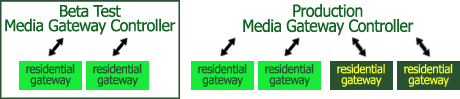
Figure 2. NCS selective service
rollout.
Another significant advantage to NCS is that all endpoints can be instantly upgraded by
updating software on the MGC. To illustrate, once the call forwarding feature is added to
a MGC, all RGWs that attach to that MGC can automatically take advantage of the call
forwarding functionality.
Which is Better?
As we discovered, DCS is less burdensome to servers and therefore may potentially scale
better on large networks. Unfortunately, the industry's H.323 experience indicates that
intelligent endpoints are difficult to build and even harder to interoperate. Furthermore,
intelligent devices in consumers' homes are likely to require considerably more tech
support hand-holding should hardware or software problems arise.
By contrast, NCS's simplicity encourages interoperability, stability, and superior
service features. However, it places significantly more strain on the network server and
requires more intelligence in order to scale correctly.
Neither solution is architecturally superior and both involve tradeoffs. Currently,
there are more vendors claiming NCS and MGCP compatibility, but deployment is in the very
early stages and this ratio may change as cable telephony networks mature. It is likely
that DCS and NCS will continue to evolve and co-exist for a significant period of time
before one is declared a winner.
Linden deCarmo is a senior software engineer at NetSpeak
Corporation where he develops advanced call agent software. He is the author of
technical articles and a book entitled Core Java Media Framework. You can reach
him at [email protected].
NetSpeak is a leading developer of Advanced Intelligent Network (AIN) technologies
for Internet Protocol (IP) telephony. NetSpeak solutions enable today's market leaders to
build next generation communications networks by providing the market's premier
intelligent software products that enable solutions for concurrent, real-time interactive
voice, video and data communications over packet networks. NetSpeak's products provide
service providers and enterprises with the flexibility they need to cost-effectively add
advanced communications capabilities - enabling an easy transition into the rapidly
growing Internet telephony market.
|

 Internet Telephony Magazine
Click here to read latest issue
Internet Telephony Magazine
Click here to read latest issue CUSTOMER
  Cloud Computing Magazine
Click here to read latest issue
Cloud Computing Magazine
Click here to read latest issue IoT EVOLUTION MAGAZINE


