From their inception, broadband data services have been a driver
for many technological and cultural changes. Through the past several years, significant developments in
broadband access technology for both DSL and cable markets have turned
high-speed Internet access from a concept to a standard, which led to the
deployment of massive, multi-gigabyte networks. Development of the broadband access technology and higher
throughput of core networks has led to the symbiotic growth of broadband
users and applications (P2P, interactive gaming, VoD).
The deployment of IP broadband services occurs in
three phases:
- Phase 1: Connecting.
In this phase, network providers build advanced networks that bring
raw IP connectivity to subscribers. This phase is complete in many
markets.
- Phase 2: Services.
In this phase, network providers will begin delivering value-added
services (from VPNs for enterprises to video-on-demand for homes), and
will begin investing in the systems to enable and control these
services.
- Phase 3: Service
Control. In this phase, service providers will use service control
systems and more sophisticated networks to further personalize and
optimize high-margin IP services. Phase 3 will lead to compelling
bundled service offerings that will deliver unprecedented value and
convenience to the consumer, preserving customer loyalty while driving
new revenues.
The fundamental challenge for broadband service
providers today is to add the service awareness and control capabilities
they need for phases 2 and 3 while leveraging their existing
infrastructure investments.
While the growth of broadband data services has been
impressive in the last seven years, the industry is facing various
operational issues stemming from its very success. Bandwidth use per
subscriber is growing rapidly and the character of that use is shifting.
Meanwhile, providers are functioning without the operational information
they need to make informed policy decisions, or to accurately capture
revenues from subscribers whose applications and usage levels vary widely.
These new requirements are coupled with the
realization that flat-fee �one-size-fits-all� broadband access is
appealing to early adopters but not necessarily so to the mass-market �
the financial feasibility of this offering is unacceptable for most
service providers. As a result of heavy discounting, prices for broadband Internet
access have dropped to commodity levels, with decreasing margins left for
service-providers. With the current
prices of broadband Internet access, it is clear that providers need to
extract additional value from each broadband access line to increase ARPU
as well as create targeted service offerings that appeal to a large
subscriber-base.
SERVICE CONTROL -- THE NETWORK INTELLIGENCE TO ANALYZE, OPTIMIZE
& DIFFERENTIATE
Service Control, the IN-equivalent for data networks, fills the gap
between transport infrastructure and network intelligence needed for
broadband services. A Service
Control Platform (SCP) is a programmable network device with a purpose
built hardware architecture, specifically optimized to analyze and control
network traffic based on application and subscriber criteria.
The SCP�s unsurpassed abilities to perform deep
packet inspection and stateful traffic tracking enable the system to:

-
Analyze:
Generate usage statistics and information on application and service
usage at individual subscribers' granularity.
-
Optimize:
Optimize network traffic by prioritizing and controlling how
bandwidth is distributed between applications, according to type,
origin/destination and content.
-
Differentiate:
Policy based control and reporting on network traffic. Assignment of
those policies to network activities of individual subscribers
dynamically.
The SCP�s carefully
crafted APIs and integration tools provide a convenient and simple
methodology to integrate policies into the network�s OSS and back-office
systems, creating a robust framework for the delivery of tiered service
plans and premium IP services.
Analyze
The SCP generates usage information and statistics on the
network activities of subscribers according to the applica tions, protocols and services consumed. The platform�s ability to
statefully track network traffic and classify it according to actual
application usage provides visibility into network activities that is
unavailable using traditional transport infrastructure. This insight is valuable for the design
and creation of new service plans, and also provides the usage metering
information from which these services can be billed:
-
Trend
And Usage Analysis: Through the collection of usage
information and the generation of detailed reports, the service
provider obtains a better understanding of which applications are
being used. Reports detailing
the volume of bandwidth consumed used by different applications and
the subscribers responsible for it allow the provider to segment and
profile the subscriber behavior and by extracting trends from this
data, determine the most appropriate service plans.
-
Traffic
Optimization Monitoring: Usage statistics are critical for
the design and creation of traffic optimization policies that ensure
network operations are streamlined and provider network capacity costs
are controlled.
-
Usage-Based
Billing: Usage information collected at subscriber level
granularity is a fundamental part of per-use billing plans. While market conditions will
not allow for usage-based billing in general Internet access plans,
some advanced services and tiered pricing plans can. For example, volume limits and
quotas for bandwidth intensive applications such as peer-to-peer (P2P)
or video conferencing can be offered in combination with service plans
that offer a low fixed monthly cost.
As subscribers exceed the limits for these specific
applications, their plan allows them to continue to use the
applications on a pay-per-use basis.
Optimize
Broadband data service usage levels increase 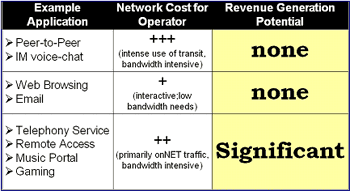 due to the explosive popularity of
"broadband ready" applications such as P2P file sharing and
video chat. When the provider
offers a premium service, the provider is responsible for delivery at
specific performance levels in order to justify the higher cost of service
to the end user. Premium
applications and user traffic must be prioritized such that sufficient
bandwidth is dedicated to the service and its performance remains at the
promised level.
Network optimization is of particular importance for
the service provider when applications that can potentially cannibalize
all available bandwidth are present (P2P client applications for example). Large amounts of P2P network
traffic have a negative effect on the performance of "premium
services," and often can leave the whole network starved for
bandwidth. The SCP�s bandwidth
shaping mechanisms enable service providers to control network resource
allocation and improve network performance for critical applications and
users. This ensures profitability from data services by improving network
performance for all applications and improving the broadband experience
for the end users
Differentiate
Service providers offering customized subscription plans
can use the SCP as both the bandwidth control enforcement point and
the consolidated usage metering system for billing and the OSS. The bandwidth control policies that can
be enforced by the SCP include application/content specific criteria a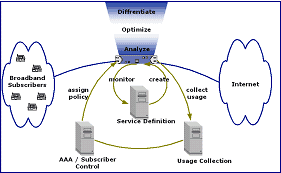 nd others such as time-of-day,
origin/destination, usage-quotas etc.
Multiple policies can be defined and applied in real time on
network traffic flows. The simple
yet robust APIs provided by the platform offer dynamic service policy
provisioning as well as a real-time collection methodology of network
metering information. With
these facilities the platform is well suited to provide the network
control point of dynamic environments supporting usage-based billing and
subscriber self-care. Using
self-care Web portals, subscribers can select new service plans or elect
to upgrade their existing subscription for a given period of time (the
�Turbo Button� concept).
CONCLUSION
With broadband access technology at the point of maturity and the
majority of the access and transport networks in place, service providers
are trying to increase their revenue streams and drive profitability. While bandwidth intensive applications
like P2P pose a technical and �economy of scale� challenge, they also
present opportunities to develop new service plans and expand the
subscriber base.
Service Control gives service providers the means to
harness these opportunities by optimizing the way network resources are
allocated between users and applications, and to create new service
offerings and service tiers.
Oren Raboy is Sr. Product Marketing Manager with P-Cube, Inc. P -Cube is the
pioneer of programmable IP Service Control Platforms that enable service
providers to create profitable new revenue streams while capitalizing on
their existing infrastructures. With the power of P-Cube�s Service
Control Platform, service providers have the ability to analyze, charge
for and control IP network traffic at multi-Gigabit wireline speeds. The
P-Cube solution also gives service providers the tools they need to
identify and target high-margin, content-based services.
Respond to this
article in our forums! |

 Internet Telephony Magazine
Click here to read latest issue
 CUSTOMER
 Cloud Computing Magazine
Click here to read latest issue
 IoT EVOLUTION MAGAZINE