Questions about IMS Remain

By Gary Kim
If you lived through an earlier time when Integrated Services Digital Network (ISDN), Advanced Intelligent Network (AIN) and then Asynchronous Transfer Mode (ATM) represented the “network of the future,” you will understand why some remain skeptical about IP Multimedia Subsystem (IMS) in its grander permutations, even though IMS adoption is inevitable, for prosaic reasons.
In fact, history suggests healthy skepticism about confusing “next generation networks” as a technology with NGNs as the foundation for business models and revenue streams. Too often, we all fall into the trap of thinking the former for the latter.
To some extent, IMS — as an NGN platform — represents a choice of network architecture. But it also represents a philosophy about what services might require, in terms of network capabilities. IMS also is a service creation platform, allowing service providers to create new services fast, prototype them fast and deploy them faster.
But IMS is not a business model, though there are business model implications. Is IMS about retaining control of a walled garden? Yes, it can be used that way. Is IMS also a way to open up networks to third-party applications? Yes, it can be used that way as well.
Should IMS allow service providers to create low-volume applications affordably enough to make a business out of those applications? Yes. Is IMS better suited to development of low-volume, niche applications? Yes.
Is IMS a way to incorporate more “web” and HTTP applications as part of a “managed” service? Probably. Will IMS allow service providers to control all HTTP applications that are web-based? No.
IMS will not allow service providers to “capture” applications using a web browser. But IMS will allow them to incorporate web experiences with other features provided as “services.”
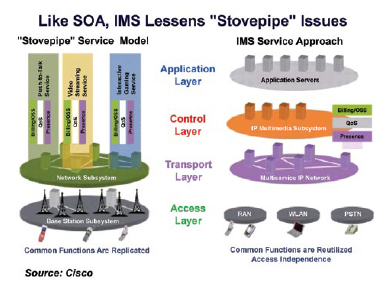
Beyond that grand level, IMS in principle will allow service providers to create applications more rapidly, especially applications that must invoke multiple media types and operate over all sorts of devices, independent of the underlying network.
The danger lies in believing that IMS successfully will provide value if it is implemented “top down,” starting with the architecture and only later figuring out what actual services and applications are feasible. The better approach is to experiment with services and let the architecture evolve.
In other words, create applications that use SIP, or cross wireless and wired network boundaries, or incorporate video into “non-video” experiences. Use presence, location, instant messaging, texting and voice in ways people haven’t had use of in the past.
In other words, stay focused on applications and let IMS evolve.
Will IMS eventually become a standard part of service provider architecture? Yes, for really simple reasons. At some point, one will not be able to conveniently buy a Class 5 switch, a TDM-based business phone system or other network element that runs SONET rather than IP.
IMS is inevitable because IP is inevitable, because Session Initiation Protocol (SIP) is inevitable, as well as services that span mobile and fixed networks.
“The term IMS is losing its luster in the market,” says Keith Nissen, In-Stat analyst. “It’s now entering its deployment phase where it is being marketed as more of a service such as VoIP or video sharing. The term ‘IMS’ never comes up.”
In fact, some would argue that it is business model immaturity that accounts for cautiousness about full-bore IMS adoption.
“Do it when you need, if you need it” then emerges as the deployment driver. To be sure, faster application development and delivery, plus the ability to capture revenue and value within the “service” revenue model, are important.
For many service providers, though, many of those advantages can be gained by building on session initiation protocol and open interfaces, at least for the moment. In fact, APIs and SIP are building blocks for full-blown IMS.
Part of the reason is the addition of connectionless and locally-assembled services to the traditional connection-oriented and monolithic services model. To be sure, there are clear limits to the utility of enabling connectionless services.
One can enable text chat on a TV screen, but what is the revenue model for the service provider?
More promising perhaps is the offering a wider range of services reaching across access and device types, leading to a greater share of the end user’s communication and information wallet.
Using IMS or SIP to add voice, video, instant messaging, presence, directory access and other real-time features to social applications or online and mobile applications are possible examples.
Also valuable are applications have the same look and feel, regardless of how they are connected to the network, including automatic propagation of a single address book across devices, networks and applications.

Presence-enabled business services, push-to-talk, push-to-view, push-to-video, group chat, instant messaging, multi-party online gaming, audio conferencing, web conferencing or videoconferencing as well as Interactive Voice Response (IVR) are possible applications using IMS-style capabilities.
Some correctly will note that these functions often can be enabled without using IMS, and that is precisely the point. IMS might not be necessary to create features, but IMS or something similar might be needed so there is a way to scale features across many new applications and devices, rather than recreating those features on a case by case basis.
In fact, what is true of all next-generation networks also is true for IMS: it is a waste of time and capital if all they provide are existing services.
The value of any NGN or IMS is new value-added services for incremental revenue at a lower cost per subscriber. Proponents of completely-open applications accessed over transparent pipes will not be so enthralled with IMS, but that isn’t the intent.
IMS is a service provider’s way of creating and delivering valuable and differentiated services that create new revenue. In that sense, it is about walled gardens, to a greater or lesser degree. There are all sorts of ways this can develop. Apple uses a more closed approach while Android offers a more open approach, but both are part of a service provider’s revenue model.
To be sure, NGNs and IMS platforms likely will be widely used by service providers to open up their walled to applications created third-party providers. For some, this is an unacceptable alternative to a fully-open applications environment. For service providers, the IMS approach is a rational and necessary adjustment to new business models not built on voice services or simple transport and access.
IMS also is envisioned, logically enough, as a way to maintain end user quality of experience, a fundamental requirement for a successful subscription-based service.
It isn’t that users shun applications that “mostly” work. It’s just that they tend not to want to pay for using such applications. But there is interest in “federated” models, where access networks partner with third parties who offer applications and services the access provider participates in, on a revenue-sharing basis.
Though some will not completely approve, this new approach is a sharp and distinctive break with historic service provider thinking. Traditionally, “not invented here” was reason enough not to adopt a new service and provide it. In the past, service providers have assumed they must control all elements of a proposition. Now, they want to ensure quality of experience, but there is no insistence on purely internal development or operation.
That is one reason for the insistence that IMS and NGN are mostly about new business models, applications and services, not the details of the platform.
IMS will enable network operators to retain or in some cases increase their revenue while offering their subscribers greater variety and choice, while third-party providers will have greater access to subscribers as well as the opportunity to continue creating new services consumers want and will pay for.
That doesn’t mean everyone would agree about how open the garden ought to be, though the advantages are clear enough. Among them: quality control, consistency of end-user interface and experience; optimization of applications for the chosen devices; exclusive content serving as a competitive advantage; customer control and revenue control.
Still, there are some potential downsides: less end user choice, possible higher cost, less customization than some might prefer, says Svetlana Issaeva, Pyramid Research analyst.
“Ultimately, IMS will only fulfill its true promise once telcos start thinking beyond closed models,” Issaeva argues.
Some might argue there is more of a semantic difference here than anything else. Partnerships are an almost-essential part of new thinking on NGNs or IMS services. So it might make more sense to speak about NGNs as offering services created to greater or lesser extent with third-party support, but in all cases offered as a completed service.
The issue is not “closed” or “open;” rather it is “packaged using third parties” rather than “packaged using internal resources.” IMS should help by allowing creation of new apps at a lower cash cost per user and higher service revenue from new customer segments in the long term, says P.K. Prasanna, an inCode analyst.
That said, IMS does allow the possibility of monetizing applications that might otherwise occur as over-the-top Internet apps, says Dr. Jerry Lucas, TeleStrategies CEO. Fixed mobile convergence, though touted as an obvious IMS application, might not be, says Lucas.
One of the key claims to fame of IMS is that it merges wired and wireless networks using a single architecture that relies heavily on existing standards. The problem is that there are serious differences of business perspective, Lucas argues.
At least some in the wireless community see the IMS-based NGN movement merely as an attempt to save the dying wired networks business model, for example. One doesn’t have to agree with that perspective to argue that without massive new amounts of revenue from new services, it is hard to see the relevance of wired networks in a decade or so. So IMS and similar strategies likely are quite necessary if wired networks are to remain key parts of the end user communications and entertainment environment.
However one assesses the relevance of FMC as a key IMS application, there is no question but that some providers, including AT&T and Verizon Communications, among others, do have high incentives to unify all services across their network platforms, even if many other providers will not have the same possibilities.
Then there is the argument that if users have unlimited use of mobile voice, texting and web access, they don’t actually need FMC.
IMS is an architecture that provides a signaling and control plane over an all-IP network that lies under a server and application plane. IMS assumes an all-IP network underneath and end-to-end SIP signaling. So how much of the value comes from SIP, as opposed to full IMS, some skeptics ask.
Lee S. Dryburgh, ss7.net founder, is among those who are somewhat skeptical about IMS, which promises the ability to create new services.
“Just what these IMS-powered services are, nobody seems to know,” Dryburgh says. Whatever its operational advantages, it does not yet seem that IMS is fulfilling some unseen subscriber need, he argues.
And to the extent new needs are arising, they are just as likely to be satisfied by over the top applications accessed over a broadband connection.
“For the most part, IMS represents the antithesis of this by clinging to a command-and-control intelligent core and vertical market,” he argues.
It also appears that IMS attempts to reinvigorate a business model that is based on scarcity, and scarcity increasingly does not exist, he argues. That applies to bandwidth, end user processing power and most other important inputs.
A business model based on scarcity makes no sense as we go into an era with an abundance of processing, bandwidth, and storage, Dryburgh tends to argue.
Service providers will disagree, arguing that packaged services will coexist well with over-the-top applications for any number of reasons. For every argument that open networks and over-the-top applications will be dominant, one has to contend with the Apple iPhone model, which shows that a managed, packaged and controlled ecosystem is not incompatible with innovation.
The other argument is that, although some users want unlimited control, most end users simply want attractive services that work well, and do not seem opposed to buying them “as a service.”
In all likelihood, service providers ultimately will leverage IMS and similar mechanisms to harness innovation in ways not possible in the past, even if over-the-top applications also grow.
Perhaps the bigger danger is too much focus on IMS the platform rather than compelling new applications that IMS can help facilitate.
Gary Kim has been a journalist, industry analyst and commentator since 1983. Among many other things, he is a founder pf Dagda Mor Media and its COO.
NGN Magazine Table of Contents

 Internet Telephony Magazine
Click here to read latest issue
Internet Telephony Magazine
Click here to read latest issue CUSTOMER
  Cloud Computing Magazine
Click here to read latest issue
Cloud Computing Magazine
Click here to read latest issue IoT EVOLUTION MAGAZINE