October 1999
Fax And The Internet: An Unlikely Marriage?
BY JOSHUA ADELSON
For several years, Internet fax has been touted as one of IP telephony’s
“killer applications.” Routing faxes on the Internet was cheap or free, and
faxes were more tolerant of network delays that hindered the use of the Internet for
real-time voice, so the argument went. Everything was poised for an explosion.
But it didn’t explode. With the exception of a few pioneering service providers,
most people have continued sending faxes the old familiar way, and continue using the
Internet for e-mail and Web browsing.
Now, Internet fax appears to have passed a huge milestone. Using a variety of business
models, service providers are offering Internet fax capabilities, often in conjunction
with major ISPs and Web portals.
If you are an Internet service provider, you should examine Internet faxing as an
opportunity for increased service revenues from your customer base. If you are an
IS/telecom manager, Internet fax services merit examination as a means to boost
productivity, and control the still-increasing fax telephone bill.
FROM APPREHENSION TO ADDED VALUE
Early attempts to provide Internet fax were mostly based on cost savings, using
the Internet or private IP networks as a low-cost or no-cost long-distance transport
vehicle. However, in reality, with the exception of a few high-volume users, the rates
these services offered were not significantly lower than PSTN rates. The PSTN’s
higher long-distance cost component was offset by its much larger economies of scale.
Individual users, for whom faxing was occasional, did not see a compelling reason to
switch away from familiar methods. Businesses, whose aggregate fax traffic might have been
sufficient to cost-justify a switch, were concerned about the privacy and reliability
associated with placing important business communications on the Internet.
Now, service providers and system vendors have gone beyond the simple “it costs
less” pitch to offer innovative Internet fax products and services that are
attracting the attention of individuals and businesses alike. Companies such as eFax.com, jfax.com , and onebox.com all offer services oriented toward
individuals, while companies such as Fax2Net, FaxNet, iService, LANSource, NetMoves
(formerly FaxSav) and others are more oriented toward business organizations or
service-provider franchising. (For a more complete listing of Internet fax products and
services, see our Fax Roundup in the September issue of Internet
Telephony�).
These companies each offer unique service combinations, and prospective users are
advised to visit the companies’ Web sites to determine which offering is most
appropriate for them. Here is a sampling of the capabilities offered:
- A personal faxes number for incoming faxes that is forwarded to the subscriber as an
e-mail attachment.
- Outbound faxing via standard e-mail and groupware packages. Among other things, this
eliminates the need to disconnect from the Internet in order to send a fax.
- Internet-based fax storage, for retrieval from any location.
- Web-based unified messaging, including fax, along with voice mail and e-mail.
- Broadcast services for internal or external business communications. Broadcasting can be
integrated with sales automation or financial software to leverage the valuable databases
within such applications.
- Fallback capabilities whereby faxes directed to a traditional fax machine are
automatically routed to a secure mailbox when the fax machine is busy.
- Notifications of new messages via pager or cell phone, and delivery confirmations.
No single provider offers all of these services — and few single
users need all of them — but clearly, value-added services have achieved critical
mass in the marketplace. (Table 1 highlights typical fax services.)
NEW BUSINESS MODELS
As often as not, the Internet’s impact on a business is to change the
buying-and-selling business model as much as the actual product being delivered. The new
breed of Internet fax service and system vendors have been quick to adapt to, and
capitalize on, this reality. Here are some examples of the variety of business models that
have emerged:
- Completely free “light” services offered to individuals, with the opportunity
to upgrade to higher-functionality, pay-for packages.
- Large-distribution (10,000+) broadcasts charged on an event basis.
- Replacement of incoming fax machine “pools,” for a monthly and per-fax fee.
- Services that are operated by the fax provider but sold on a franchised basis through
ISPs. Franchised services can be customized and private-labeled by the ISP.
- Clearinghouse billing services that allow faxes to be originated and terminated by
different providers.
MAKING SURE IT WORKS
One of the reasons faxing continues to proliferate even in the face of e-mail is
that it is perceived — rightfully so — to have higher reliability and document
integrity for critical business communications. To be successful, Internet faxing must
achieve equal or better reliability and performance than traditional PSTN faxing.
Most ISPs have an investment in dial-up access concentrator hardware that,
theoretically, can transmit faxes. However, these devices have really been designed for
data modem operation, with less attention focused on fax performance or interoperability.
In cases where the fax is sent as an e-mail attachment, the “fax” capability of
the access device is not really an issue. But where access devices must communicate
directly with a fax machine, that access device becomes a critical link in the success or
failure of the service.
Savvy Internet fax companies are quickly coming to the same conclusion that
“traditional” fax service providers and LAN fax vendors reached long ago: Fax
services should be deployed on intelligent fax boards. Unlike the data modem chipsets that
are used in typical Internet access concentrators, intelligent fax boards are designed
specifically for robust interoperability with the 100+ million fax machines installed
around the world today. In addition to superior call completion, intelligent fax boards
often connect at higher transmission rates, and perform maximum on-board compression;
together these capabilities reduce transmission times and, as a result, last-mile toll
charges.
Applying the “Internet business model” to fax services raises the stakes for
reliability and interoperability. Free upfront services mean rapid growth in volumes, and
this in turn can lead to enormous operational costs if the system does not operate
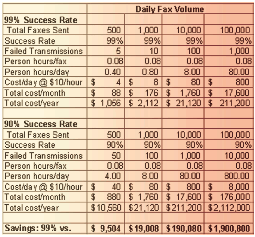
reliably. Inability to complete a fax transmission is usually solved by manual
intervention. If a $10/hour employee spends just five minutes resending a fax
transmission, that will cost the company nearly a dollar — not a very profitable way
to deliver a free fax! Imagine millions of faxes being sent daily, and the difference
between 99 percent versus 95 percent transmission success rates can mean the difference
between a lean operations staff versus a small army of customer service representatives.
And, companies that are attempting to lure users from free to paid services
will have little success doing so if their free trial services are not consistently
reliable. (Table 2 shows how costly failed fax connections can be.)
In addition to overall higher reliability, intelligent fax boards tend to be more
developer-friendly by offering extensive and consistent application programming interfaces
(APIs) under widely supported operating systems such as Windows NT and UNIX. Since the
value-added capabilities have spurred the growth of this business in the first place, it
is critical that system vendors and service providers continue to be able to innovate and
rapidly deploy new applications.
After a slow start, faxing and the Internet have converged to create a proliferation of
useful services and exciting business opportunities. This is still a recent phenomenon, so
we will no doubt continue to see innovations in the months to come. Quality operational
deployments will be a key factor in the ongoing success of these services.
Joshua Adelson is market development manager, IP telephony, for the Fax & IP
Technologies Division of Brooktrout Technology. Brooktrout Technology, a Brooktrout
Comp-any, provides enabling technologies for customers to deliver voice, fax, and data
solutions for the electronic communications market. For more information, visit the
company’s Web site at www.brooktrout.com, or
contact the author at [email protected]
|

 Internet Telephony Magazine
Click here to read latest issue
Internet Telephony Magazine
Click here to read latest issue CUSTOMER
  Cloud Computing Magazine
Click here to read latest issue
Cloud Computing Magazine
Click here to read latest issue IoT EVOLUTION MAGAZINE