Who will end users rely on to deliver and maintain CTI solutions? Computer VARs are
certainly in the running. Coming out of the fast-changing computer industry, accustomed to
frequent software upgrades and knotty systems integration projects, VARs would seem poised
to jump all over CTI. But what about Interconnects? They’ve got advantages of their
own. Like equanimity. For example, Interconnects, who already accept the idea that each
PBX works differently, aren’t easily frustrated. Further, Interconnects, with their
telephony mindset, don’t wait — not even overnight — before responding to
an emergency. The phones must always work!
Thus, the impending “mainstreaming” of CTI is shaping up as a kind of
tortoise and-hare contest. VARs and Interconnects, who once had little or nothing in
common, now find themselves selling similar solutions and competing for the same
customers. And while VARs have some of the flash and freewheeling feel of the computer
industry, Interconnects have the solidity and doggedness that marks telephony. Who would
you feel comfortable betting on?
THE PRIZE BEYOND THE POST
For years, computer reseller magazines have emphasized the importance of CTI. They’ve
made the point, again and again, that CTI will give VARs what they crave most: high
margins. Unlike the LAN business, which has razor-thin margins, CTI is a cash cow waiting
to be harnessed. It has margins 10 times higher than those in the traditional computer
networking business.
On the telephony side, PBX and ACD manufacturers patiently cultivate networks of
Interconnects. These vendors devote a lot of effort to training, so that Interconnects can
take advantage of CTI to sell more products and make even more money. In addition, many
vendors that sell CTI systems, such as PC-PBXs or unified messaging systems, have networks
of both Interconnects and computer VARs.
THE COURSE’S TWISTS AND TURNS
The most difficult part about CTI is integration — making the new products part of
existing systems. For example, a unified messaging product needs to be connected to many
types of PBXs. Also, it must tie into the corporate database to access customer records
based on caller ID information. TAPI, TSAPI, LAN topologies, as well as ODBC and DDE
issues, all come into play in CTI installations.
To handle the integration issues, VARs and Interconnects need to educate themselves.
VARs need to understand the principals of telephony. They must learn the terminology
associated with telephony such as DID lines, trunks, and station cards. In addition, since
every PBX vendor has its own way of doing things, VARs should be familiar with offerings
from all the industry’s leading vendors, such as Nortel, Lucent, Rockwell, and
Siemens.
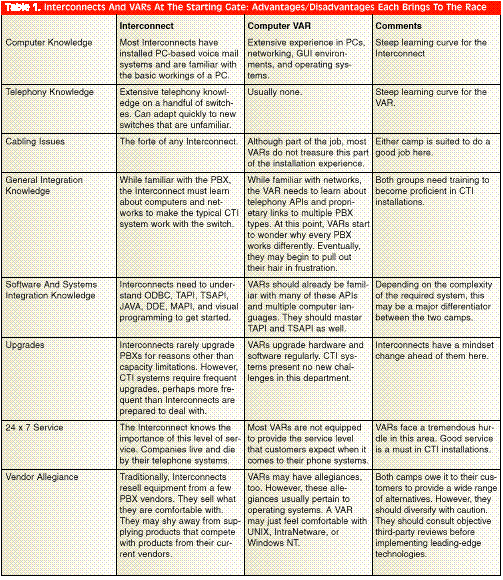
At a minimum, Interconnects must learn networking protocols, operating systems, and
database access. It would also help them to learn about visual programming and API calls
such as MAPI. Many vendors tell me that Interconnects have a much steeper learning curve
than VARs. These vendors explain that once a VAR is proficient in 10BaseT, Ethernet, hubs,
and routers, a PBX is just another device that they can quickly hook up to the network
(Table 1).
PLODDING WINS THE RACE?
Another vendor I met had a different point of view. This vendor, which sold a unified
messaging system, and which relied on both Interconnects and VARS, acknowledged that VARs
had a relatively shallow learning curve. However, this vendor also pointed out that the
Interconnects had a powerful advantage: a telephony mindset.
Thanks to their telephony mindset, Interconnects respond with a sense of urgency
whenever a CTI system has a problem. An Interconnect knows enough to send a technician out
immediately if, for example, a company’s unified messaging server fails. A VAR, on
the other hand, has a different mindset. A VAR might keep the company waiting overnight
before it gets around to fixing the problem.
The Interconnect’s willingness to provide round-the-clock service might just make
the difference. That is, the Interconnect, though it may not appear to be “built for
speed,” may, like the tortoise, emerge the winner. The Interconnect’s attitude
toward its business compliments the end user’s attitude toward its phone system.
Although an end user may regard a computer network crash as being routine, the same end
user will panic when the phone system fails. For VARs to succeed at delivering and
maintaining CTI systems, they will have to appreciate this difference in attitude, and
modify their own behavior accordingly. Since developing new attitudes can be more
difficult than acquiring expertise, VARs may in fact face the biggest challenge when it
comes to keeping customers happy.
Sincerely,
Rich Tehrani
Publisher, CTI magazine |
| CTI Expo: A Boost Up The
Learning Curve Interconnects and VARs aren’t the only ones
who need to learn more about CTI. Developers, systems integrators, and MIS and
telecommunications staff, as well as end users, need objective, unbiased information
sources. One place to find these sources is at CTI expo. At the upcoming CTI Expo
conference in Baltimore, Maryland (May 19–22, 1998), you can take advantage of full
conference tracks that will teach all the essentials. Consider this sampling of
educational opportunities from the conference program:
Reseller, Integrator, And Developer Opportunities
(includes such sessions as Profitable International Callback Systems, Prepaid Cellular
Development And Deployment, Creating Calling Card Applications, and Choosing Profitable
Products For Resale).
Application Development And Programming
(includes such sessions as Development Using H.100/S.100 Specifications, Building An
Interface To Unified Messaging, Application Generators: The Purchase Decision, Selecting
An Industrial-Grade Computer). CTI Expo will also stage preconference clinics. Samples
include:
Principles Of Telephony
(includes such sessions as Telephony Overview, The PBX And ACD, Customized Service Via The
Intelligent Network, High Bandwidth Communications, Wireless Alternatives).
Voice, Video, And Data Convergence
(includes such sessions as Videoconferencing, Collaborative Computing, Fax Routing, and
Voice Over Data Networks). Other tracks of interest include Internet Telephony and Network
Telephony, Introduction To CTI Technology, and CTI In The Call Center. Make sure to see
our Web site (www.ctiexpo.com/tccs/tccs.htm) for
more information.
|
| What's in an
"Un?" Usually, I’m not one to look too
closely into the naming of things. But one term of recent coinage — the Un-PBX —
got me thinking. “Un” in what sense? A functional sense? Certainly not. The
Un-PBX is supposed to switch calls, just like a PBX. So, something else has to account for
that “Un.”
My best guess is that the “Un” is meant to signal opposition to the idea of
proprietary technology, which the PBX supposedly exemplifies. If that’s the case,
I’d have to say that the new name, despite its cheekiness, reveals an old-fashioned
point of view. To appreciate the almost mocking flavor of the term Un-PBX, you would have
to know something about the history of the PBX. But then again, many of us who know about
PBXs wouldn’t be so quick to slight them.
Perhaps the term Un-PBX is meant to appeal to computeroriented people, who are
supposedly committed to openness. But if computer people were so ready to “dis”
the PBX, wouldn’t they just as soon take over telephony without ever learning what
the letters PBX stood for? And if they didn’t care what a PBX was, why would they
care about what wasn’t a PBX?
It’s clear to me that neither tele-phony--oriented people nor computeroriented
people have much use for “Un-PBX.” As an alternative, I’d recommend that we
use “PC-PBX” or “PC-based telephony server.” (John Clayton recommends
“serverbased PBX”; see his article on pages XXXX.) These terms are, at the
least, affirmative. They don’t dwell on opinions of what shouldn’t be (or
shouldn’t have been). That is, they don’t perpetuate old prejudices into what is
supposed to be a new era. And, perhaps most important, they explicitly name what’s
new in the mix, the PC or server. Thus, a term like PC-PBX should appeal to both camps.
The PBX part, unmaligned, acknowledges the contributions of the telephony side, and the PC
part alerts the computer side that it, too, has a role in telephony’s evolution. |

 Internet Telephony Magazine
Click here to read latest issue
Internet Telephony Magazine
Click here to read latest issue CUSTOMER
  Cloud Computing Magazine
Click here to read latest issue
Cloud Computing Magazine
Click here to read latest issue IoT EVOLUTION MAGAZINE





