Upcoming Battles Over Internet Access
BY BROUGH TURNER
Last month, I argued that IP telephony — the use of Internet
technology for telephony applications — will supplant traditional telephony,
revamping the telecommunications infrastructure in the process. The time frame for this
transition? A decade or two. Yet the outstanding technical issues and standards work
should (as I suggested) occupy us for only another three years. Why should IP telephony
take any longer? The delay depends on how quickly we can get the raw bandwidth and the
local connectivity we need to support IP telephony.
The Internet backbone is growing dramatically — both in capacity and
in traffic handled. In North America in 1996, data bits exceeded telephone network voice
traffic for the first time. So, backbone capacity will be there when needed for IP
telephony. Local access, however, is another story.
With respect to local access, today’s big debate is over which
technology is better: cable modems or some kind of digital subscriber line technology
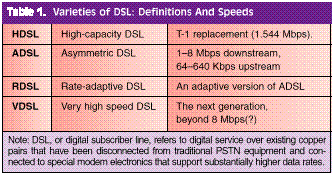
(xDSL). (See Table 1 for xDSL definitions.) The current debate neglects the long-term
impact of wireless. Worse, as a technology debate, it misses the point. “Local
access” is a political and regulatory issue. Local access is dominated by the
politics of the current telephone companies, cable companies, wireless operators, and (to
a lesser extent) other utility companies. The rest of this article focuses on the local
access methods that will win out as feeders for tomorrow’s Internet.
CHOICES WE’D CONSIDER WERE WE TO IGNORE THE USUAL CONSTRAINTS
Decisions over how to implement local access aren’t strictly technical. As just
mentioned, our choices can be constrained by politics and regulations. Another key issue
is the existing infrastructure. This issue is particularly important in developed
countries, where there is a lot of existing infrastructure — dialup connectivity,
telephone loops, cable TV, broadcast TV, cellular phones, satellites, electric power
wiring, and so forth. But let’s put all that aside for a moment and assume we could
start from scratch. Let’s imagine what our choices would be were we to bring
high-technology to an undeveloped country.
All communications networks get economies of scale by multiplexing the communications
requirements of multiple users — that is, combining many users’ communications
onto a shared infrastructure. The closer the multiplexing is to the users, the more money
you can save when building the infrastructure. So, access methods with inherent
multiplexing are more costeffective. One important advantage of the packet-based Internet
is that it multiplexes traffic from many users more efficiently than the PSTN.
Another consideration is the ever increasing performance of electronics. As a result of
this progress, wireless technologies are gradually overtaking wireline technologies. And,
note that with wireless technology, multiplexing is inherent in the local access
infrastructure.
If we could ignore political considerations and issues over existing infrastructure,
the choice of access method would vary based on population density. In the long term,
however, the infrastructure is likely to use wireless technology locally and fiber in the
backbone. This trend is already in place for voice communications in developing countries.
Internet access will not be far behind.
Satellite-Based Radio
For extremely low-density, widely spaced populations (for example, ships at sea), the most
cost-effective solution is satellite-based radio. This approach is already in use for
telephony at sea or in remote locations.
Land-Based Radio
As population density goes up — say, a rural farming area — the best solution
shifts to land-based radio, using cellular principles. This makes far more efficient use
of the available bandwidth than satellite-based radio, as a small block of radio bandwidth
is used repeatedly, in adjacent communities. As the population density increases, more and
more radios are added (more “cells” in the cellular jargon). But the power
requirements of individual radios go down due to shorter distances (so the radios cost
less). Thus, while there is more total equipment, the cost per subscriber goes down.
Fiber To The Building
At some point, it becomes more economical to run fiber directly to each apartment complex
or office building and then use either wired or wireless LAN technology within the
building. Using radio, infrared or other wireless technology for the last 30–100 feet
will become more competitive as the cost of the electronics continues to drop.
OUR CHOICES IN THE LIGHT OF CONSTRAINTS
Of course, decisions over local access are not strictly technical. If we are to review the
real options for a developed country such as the United States, we need to account for the
existing infrastructure and the role of politics.
Dialup Access
Currently, dialup access via a modem is the most popular method for subscribers in their
homes to get connected to the Internet. The modems are typically 28.8 Kbps modems,
evolving perhaps to a maximum of 56 Kbps. IP Telephony is possible at these speeds, but
when you add the hassle of making the dialup connection, it’s not a compelling
service. A “permanent” connection at higher speeds would certainly help
accelerate deployment of IP telephony.
The 28.8–56 Kbps dialup limits are set by the equipment used to terminate the
twisted-pair copper wire from each home at the central office — equipment that is
based on what was state-oftheart voice telephony in 1963. The copper wire itself could
carry more bandwidth, but the rest of the PSTN infrastructure restricts the achievable
bandwidth. Luckily, there are better bandwidth alternatives that will eliminate dialup
access as the predominant way to access the Internet.
ISDN
Basic Rate ISDN (BRI) changes the termination at the central office and supports 144 Kbps
over the copper wire. BRI was defined based on 1980s technology. In the late 80s, it began
to make economic sense, and people tried to roll it out. There was an expectation that by
the early 90s, ISDN would be everywhere. However, due to the regulatory and bureaucratic
issues, that did not happen. Today, a few European countries have fairly broad ISDN
deployment, but there is still virtually no deployment in the United States or elsewhere.
ISDN, in my own experience, has been less than inspiring. ISDN connectivity to the
Internet from the home is fairly expensive (over $80 per month), certainly more expensive
than other options. Also, service is sometimes unreliable. Basic rate ISDN is a technology
whose time has passed — not the ultimate solution for Internet access.
xDSL
Currently all of the major telephone companies are looking at xDSL. xDSL uses advanced
modem electronics at each end of an existing copper pair to increase its capacity from 56
Kbps up into the 1–8 Mbps range, depending on the condition and length of the copper
wire. Globally, the telephone companies have a window of opportunity to reuse their wire,
but whether or not this will happen is a political question. If xDSL deployment is left to
the monopoly telephone providers, like the RBOCs in the United States, then it will happen
just about as fast as ISDN happened, that is, hardly at all and in only a few countries.
All of the problems of deploying ISDN technology apply to deploying xDSL technology. In
addition, xDSL would cut into existing revenues. Who would pay $1,000–$2,000 per
month for a T-1 line if they could get xDSL for $50 per month? So, don’t expect
competitive xDSL from your local RBOC any time soon.
In the United States, the FCC is a wild card. They would like to leverage the
Telecommunications Act of 1996 to give third parties access to existing copper facilities.
In other words, third parties could lease bare copper wires from the existing RBOCs and
connect xDSL or other equipment of their choosing. This is currently being fought in the
courts because it would put a big dent in the telephone companies’ monopoly. If it
became possible to lease a twisted-pair copper wire to a subscriber’s home for a
reasonable price — say, no more than it currently costs for that copper pair with
basic telephone service on it — then xDSL deployments will occur. Multimegabit
downloads will be available at much less than $100 per month. But this is not a technology
or business issue — it’s purely political.
Cable Modems
Another existing infrastructure in developed countries, particularly in the United States,
is the coax cable used for cable TV. Cable TV networks were originally designed to be
one-way only — broadcasting TV towards the home. Making a two-way infrastructure out
of this requires that the cable manufacturers retrofit many components in their network.
Then they need to place cable modems in each home that subscribes. That’s a
significant investment, but it’s not as bad as laying new cable. In addition, the
cable TV coax has more potential capacity than the twisted-pair cable used by telephone
companies. It is also more efficient because data is multiplexed closer to the user. In
cable TV, multiplexing happens within 100 feet of the house, while in a telephone network
it could be miles away.
Cable modems providing 1.5 Mbps of bandwidth are being deployed in a half dozen major
U.S. cities today, with Internet service included, for $40–50 per month. Note that
this is incremental revenue for the cable companies, so there is a strong incentive to
deploy the service! Personal experience and anecdotal evidence is that cable modem
Internet service costs less and is more reliable than ISDN-based Internet service, at
least in New England.
Can xDSL compete with cable modem service? Perhaps, but only if third-party economic
interests gain access to the raw copper wires in the near future. Cable modem technology
already has a cost advantage, and a two- to four-year lead, at least in our area. Cable
modem Internet service is here today, while the RBOCs are still talking about trials and
fighting thirdparty access to their copper.
CONCLUSIONS
Serious alternatives to dialup access are appearing today. In the next few years, we can
expect major deploy ment of cable modems. xDSL will be deployed if third-parties gain
access to the installed base of copper wires. If that happens, there will be a few years
of exciting competition! Either way, we will see local access bandwidth and connectivity
more than adequate for IP telephony.
Brough Turner is senior vice president of technology at Natural MicroSystems, a
leading provider of hardware and software technologies for developers of high-value
telecommunications solutions. For more information, call Natural MicroSystems at
508-650-1300 or visit the company’s Web site at www.nmss.com.
|

 Internet Telephony Magazine
Click here to read latest issue
Internet Telephony Magazine
Click here to read latest issue CUSTOMER
  Cloud Computing Magazine
Click here to read latest issue
Cloud Computing Magazine
Click here to read latest issue IoT EVOLUTION MAGAZINE




