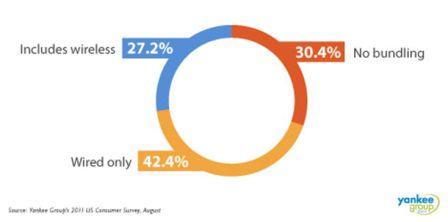
According to researchers at the Yankee Group, about 27 percent of U.S. consumer product bundles now include wireless services.
Strategic Analytics, on the other hand, estimates that just 13 percent of U.S. households will subscribe to “quad-play” telecomm packages by 2016. U.S. quad play forecast
13 percent, says Strategy Analytics, would represent an increase of 400 percent over the current level of U.S. household quad play adoption. That implies late-2011 adoption of perhaps three percent.
“Today, 57 percent of American households are classified as ‘multi-play,’ meaning that they take more than one entertainment or communication service from the same provider, Strategy Analytics says.
“While the quad play will make strides in the U.S. market over the next five years, the voice-video-data ‘Triple Play’ will be the dominant bundle type,” Strategy Analytics predicts.
“Quad Play bundling has had a slow start in the United States,” says Ben Piper, Strategy Analytics director.
The current leader in bundled packaging is AT&T, reporting 75 percent of its U-verse TV subscribers are also signed on to triple-play or quad-play packages.
By 2016, about 67 percent of U.K. households will buy a quad play service, Strategy Analytics also projects. In the U.K., slightly less than 50 percent of U.K. households currently are "multiplay," and go for more than one entertainment or communication service from the same provider. U.K. multi-play
Forecasts such as these are one reason why U.S. cable operators might have decided they really had to make a bigger move into wireless, even working with Verizon Wireless (News - Alert), a key competitor in some markets, to create the foundation for a viable quad play.
Leading cable operators have been investing since at least 1994 to get into the wireless business with paltry results. Cox Communications recently decided to shut down its owned mobile operation, for example. Apparently, the decision was made for several reasons, including the lack of wireless scale necessary to compete in the marketplace, company officials said. Cox Communications abandons wireless
That would be, and has been, an issue for lots of other service providers as well. Wireless really is a scale business, and is brutally competitive. Many other service providers have looked at the business case and found they could not compete effectively, including firms as large as Qwest.
Cable TV operators have been spending money to get into the wireless business for decades, with little success. In 1994 Sprint, Tele-Communications, Comcast (News  - Alert) and Cox Cable formed a joint venture to build a nationwide network to provide wireless service. However in 1998, Sprint assumed control of the business and bought the cable companies' interest in the company. Long history, little success
In 2005 Comcast, Cox, Time Warner (News - Alert) and Advance/Newhouse formed a joint venture with Sprint Nextel to provide a quad-play cable TV, high-speed data, landline and wireless service to their customers. But the quad-play idea never panned out and Pivot never grew beyond the initial 33 markets Sprint launched in November 2007.
Sprint said that Pivot was being hindered by provisioning issues. Time Warner later said that demand for Pivot services was "tepid." Pivot users eventually were given the option of switching to Sprint's regular service.
In 2008, Sprint and Clearwire announced that they would combine their WiMAX businesses and create a new company that would include a $3.2 billion investment from Intel, Google, Comcast, Time Warner Cable, Bright House Networks and Trilogy Equity Partners.
The new company was named Clearwire and Comcast, Time Warner, and Sprint decided to operate as MVNOs selling Clearwire's WiMAX service. Clearwire announced Aug. 3 that it will deploy TDD-LTE (News - Alert) equipment in addition to its WiMAX network but the company admitted it needs $600 million more in capital to do that. Cable's wireless history is mixed
But if the quadruple play displaces the triple play as the dominant consumer bundle, it is pretty obvious why leading cable operators might conclude they have no time to delay in putting together the foundation for future quad-play efforts.
Gary Kim (News - Alert) is a contributing editor for TMCnet. To read more of Gary’s articles, please visit his columnist page.
Edited by Rich Steeves
