Mobile service providers that are public companies face core issues as financial entities. As there is a key difference between a “growth” company and a “yield” or “dividend” company, so mobile service providers now generally are seen as “dividend” vehicles, where within the last decade mobile companies might have been seen as “growth” vehicles.
That means a heightened emphasis on the ability to generate cash flow that can be returned to investors in the form of dividends. It is therefore a simple fact that declining revenues are a sure recipe for investor devaluation.
Conversely, high rates of revenue growth could, at minimum, maintain the equity value of a public mobile company, and might at some point cause some investors to change their view of such companies.
To the extent that a “growth” company benefits from revenue multiple benefits in its stock price, there are advantages for any mobile service provider beyond “mere” revenue growth.
In 2004, for example, Vodafone’s (News  - Alert) dividend yield was around one percent at a time when the bank base rate (virtually risk-free) in the UK was around 4.5 percent. By 2010, Vodafone was yielding around five percent and the bank base rate had dropped to only 0.5 percent.
Vodafone’s dividend, therefore, is supporting the share price, notes Chris Barraclough, STL Partners/Telco 2.0 managing director, as part of an analysis sponsored by Tellabs (News - Alert). Smart Pipe return on invested capital
At the moment, most telecom companies are valued as other “utility” companies, meaning the size and consistency of the dividend is key to the investing thesis.
There is a long-standing concern within the communications business about the shift of value from “service provider” applications to “over the top,” loosely-coupled alternatives in voice, messaging and content. Frequently referred to as the danger of “dumb pipe” business models, the logical counterpoint is a “smart pipe,” though there often is disagreement about what precisely that means.
As Telco 2.0 consistently has argued, a smart pipe strategy does not everywhere and always mean that a service provider is not a central player in providing simple bandwidth transport and access. In fact, it is hard to see any future role that does not involve service providers providing basic access services.
But a “smart pipe” strategy could include development of partner services that add value to transport and access (content delivery networks provide one obvious example, as do quality of service mechanisms).
In most cases, third party partners also are seen as key partners for “smart pipe” strategies where network services are integrated in some new way with third party applications to provide obvious end user value and revenue.
As simple and logical as that sounds, future moves to separate business structurally, creating separate access and transport wholesale networks and independent retail service providers, would upset the whole notion of retail “smart pipe” strategies.
Since services and the network are becoming disconnected, there is a case to be made that the existing organizations that combine both network operations and product development and delivery may be split in the future, Barraclough says.
So one obvious caveat is that any “smart pipe” strategy largely assumes integrated retail and network operations. In Asia, there are examples of both strategies. NTT (News - Alert) is pursuing the “smart pipe” approach, integrating new value-added services wherever it can.
In Australia and New Zealand we will see the opposite approach, with structural separation of network operations, which will be a wholesale service provided to third-party retail providers.
In Europe, Telefonica (News - Alert), Vodafone and Yota best exemplify the “smart pipe” approach, says Barraclough.
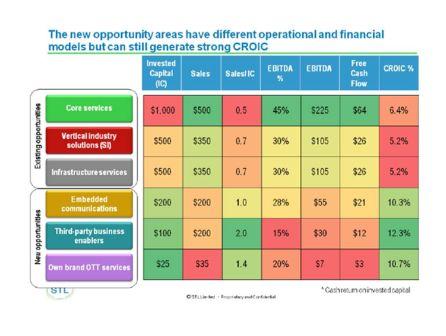
Simply put, Barraclough argues that were a conventional approach might yield a 5.8 percent return on capital, a full “smart pipe” strategy might yield 13.3 percent returns on invested capital.
But it would be fair to note that service providers themselves, and investors, think the odds of success for “smart pipe” strategies are not especially favorable. It is not just the capital markets that seem to give MNOs only a slim chance of delivering “smart” networks and services.
Some 28 percent of service provider executives also think mobile service providers will fail at smart services. About 52 percent of service provider executives believe that only a few tier-one operators would succeed at creating new “smart pipe” businesses. The other issue is that the amount of capital likely to be deployed in support of the smart pipe initiatives will be dwarfed by investment in the base business.
That also implies the higher return will be generated on a relatively modest revenue base.
Gary Kim (News - Alert) is a contributing editor for TMCnet. To read more of Gary’s articles, please visit his columnist page.
Edited by Rich Steeves
