| Real-Time Or Store-And-Forward: Consider Both IP
Faxing Options BY DENNIS MIGA
As the feasibility of real-time fax over IP emerges, many are questioning the need for
store-and-forward fax over IP. When asked which method is preferred, most will respond in
favor of real-time fax because it is just that, real-time. However, when it's pointed out
that store-and-forward fax costs 30 percent less and is delayed less than a minute, the
response may be a bit different. In all likelihood there will be a market for both
technologies for some time to come.
When considering real-time vs. store-and-forward IP fax, the most relevant issues to
consider are customer expectations and quality of service, which translates to cost
differences (i.e. the incremental cost of transporting a faxed document as well as the
capital cost of the necessary infrastructure).
Customer Expectations
When sending a fax over the Internet, customers expect the fax to be delivered instantly
or be notified if the fax is not transmitted. This attitude is what has lead many people
to choose real-time fax technology over store-and-forward. However, when the benefits of
store-and-forward fax technology are weighed against the benefit of real-time faxing,
store-and-forward becomes more attractive.
For one, store-and-forward fax, whether IP-based or not, has the ability to work around
a busy destination fax machine. By capturing an image of the sent document, a
store-and-forward system can repeatedly attempt delivery when encountering a busy signal,
thereby saving the sender a sizable amount of effort while simultaneously freeing up the
sender's fax machine to deal with other faxes.
Another benefit of a store-and-forward system is the ability to automatically resend
the failed portion of a lengthy fax that may have had its earlier transmission
interrupted. Should the remote fax machine be temporarily disabled, the document can be
redirected to another fax station altogether. Relying on these basic distinguishing
features, some marketers of store-and-forward fax services actually boast of guaranteed
deliveries, something no real-time fax service can advertise. Additionally, sophisticated
store-and-forward delivery systems can alternatively deliver a faxed document to both fax
machines and e-mail addresses. Again, this option is not available in a real-time
environment.
Quality Of Service Issues
There are a few quality of service issues that differentiate the costs of IP-based
store-and-forward vs. real-time fax. First, assume the IP fax application is one designed
to serve international faxing requirements since that is often the source for rate
arbitrage against the incumbent telco.
The primary consideration is infrastructure cost and the capital risk therein. Any IP
real-time application, whether fax, voice, video, etc., requires a tightly controlled and
managed transmission path. Latency and jitter (slow or erratic timing of transmission) are
factors that especially affect fax and other data applications. To achieve a managed
bandwidth state requires bandwidth be allocated for this purpose. Any way you slice it,
allocation equals expense. Whether obtained on a private line or "tunneled"
basis, the service provider must finance the path between the originating and terminating
point.
A real-time IP fax scheme designed to service intra-corporate requirements makes
tremendous sense. If there is a reasonable degree of fax traffic between any two points,
the financial risk may be minimal or non-existent, especially if the bandwidth between
those two points already exists for other applications and can now be shared with fax
transport. For example, if a corporation already leases a private line between two of
their manufacturing plants used for daily swapping, that same line could be utilized to
send faxes as well, at no additional cost.
If the environment is a resale or service provider where faxing habits of users cannot
be controlled (for example, faxes are sent globally to many locations), the easy allocated
bandwidth solution above doesn't work. You'd either need to make a significant financial
commitment for reserved bandwidth to many locations, or acquire bandwidth to a central
switching point where the fax can be delivered over the final leg on the international
switched voice network. By contrast, a store-and-forward arrangement calls for no managed
bandwidth with only the public Internet being employed to transport the fax -- at no
incremental transport cost. So, what does the network topology look like for a real-time
IP fax application?
In the diagram below Country A represents the country of originating
traffic. Country B is the switching hub that connects the managed
bandwidth (X) between Country A and B with the international switched voice network (Y)
that can reach the world.
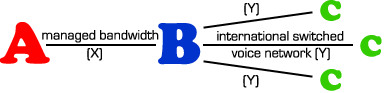
While the cost of transport between points A and B is the overhead burden of the
monthly bandwidth expense, the second cost to get to points C via Y is a
transport charge paid to a telecom carrier that owns the connection to country C. Those
combined costs (X+Y) will usually be higher than the cost of sending a fax from point A to
C over the public Internet.
To illustrate, assume there are two faxes originating in Capetown, South Africa, one
destined for Zurich, Switzerland the other destined for Cairo, Egypt. A real-time fax
network might have leased capacity from South Africa to the U.S. where the fax would be
handed off to a carrier to transport the faxes to Zurich and Cairo. The cost of the
bandwidth is probably in the $5,000 to $7,000 per month range for a 64 Kbps line. This
effectively brings the per minute charge for the cost of transport to the U.S. to about
$.08, at full capacity. The leg Y charge to Zurich from the U.S. is about $.06, and about
$.65 to Cairo based on average calling costs. That's a total of $.14 to Zurich and $.73 to
Cairo. By contrast, the cost on a store-and-forward fax network (from Capetown to Zurich
or Cairo) will be about $.02 to Zurich and $.03 to Cairo assuming network nodes exist in
those locations. In highly-competitive, high-volume routes, (between the U.K. and U.S. for
example) there may be little or no distinction in incremental cost although there is a
significant difference in the capital at risk.
Conclusion
If the needs of the client call for a real-time fax solution, a store-and-forward fax
service will not be acceptable. However, the cost of providing a real-time faxing network
architecture may or may not be economically feasible depending upon the competitive
environment. On the other hand, if the client is price- and/or value- conscious, a
store-and-forward solution may be the best alternative. In any event, both orientations
exist in the marketplace, which means that both real-time and store-and-forward fax
services will most likely continue to flourish, side by side.
Dennis Miga is chief executive officer of INTERFAX LP. Founded in 1995, INTERFAX is
a privately-held provider of international network services via the Internet. Through its
proprietary, UNIX-based network, INTERFAX offers quality fax services at discount rates on
a worldwide basis. More information on INTERFAX can be found at www.interfax.uk.com. |

 Internet Telephony Magazine
Click here to read latest issue
Internet Telephony Magazine
Click here to read latest issue CUSTOMER
  Cloud Computing Magazine
Click here to read latest issue
Cloud Computing Magazine
Click here to read latest issue IoT EVOLUTION MAGAZINE


