Metro
Ethernet has recently been the �buzz� of the telecom industry. Emerging
out of this is a technology that will expand its penetration to beyond
the metro rings of cities into the backbone as well. This is
Virtual Private LAN Service (VPLS) (news
�
alert). As multiple protocol options are being worked, it is
important to understand their differences in design and purpose.
Early
entrants to this industry have had difficulty getting out of the
starting gate. Cogent Communications, Yipes
Enterprise Services (news
�
alert) and XO Communications (news
�
alert) have all met tough economic conditions. As the market
improves in 2004, the time has come for Public Ethernet Services and
technologies like Virtual Private LAN Service (VPLS) to shine.
Ethernet carrier revenue is expected to grow at annual rates of more
then 50 percent and exceed $4 billion by 2005, as reported by Gartner
Dataquest. Services such as VPLS will start to emerge in the coming
year. VPLS offers a multipoint form of a Layer 2 Virtual Private
Network (VPN).
VPNs
provide a private virtual network over a public network.
They are now a hot commodity for frame-relay replacement. MultiProtocol
Label Switching (MPLS)-based IP VPNs are also becoming quite popular.
Since they leverage existing devices and offer multiple services. IP
VPNs are offered in two major types: Layer 2(L2) VPNs and Layer 3(L3)
VPNs. The Internet Engineering Task Force
(IETF) (news
�
update) has been working on standardizing the two major types within
the l2VPN and l3VPN working groups, respectively.
The l3VPN
working group is tasked with standardizing three types of Layer 3 VPNs;
2547bis, Virtual Routers, and CPE-IPSec-based. BGP/MPLS IP VPNs (draft
rfc2547bis) define a method that allows service providers to use their
IP backbone to provide VPN services to their customers. Draft
Muthukrishnan defines a method that allows the creation of VPNs via
virtual routers as opposed to virtual routing function (VRFs). Lastly,
the task of standardizing CE-based VPN using IPSec has fallen on the
l3VPN working group. Virtual routers, which had early success with
vendors such as CoSine, Shasta, and Springtide, have met with resistance
in North America. CE-based VPNs using IPSec and 2547bis-based VPN have
become the dominate method for VPN implementation.
The l2VPN
working group is tasked with standardizing Virtual Private Wire Service
(VPWS), Virtual Private Local Area Network Services (VPLS) and Internet
Protocol LAN Service (IPLS). VPWS is a L2 service that provides L2
point-to-point connectivity (e.g. Frame Relay DLCI, ATM VPI/VCI,
point-to-point Ethernet) across an MPLS-enabled IP network.
The two
main competing drafts for VPWS are Draft Kompella (K. Kompella) and
Draft Martini. Both drafts use the encapsulation method as defined by
PWE3 (Pseudo Wire Emulation Edge to Edge) Working Group known in the
industry as Martini encapsulation (named after the author of the
draft). The main difference in the two drafts is the technique for
signaling the psuedowires: Draft Kompella uses BGP and Draft Martini
uses LDP. VPLS is a L2 service that provides L2 Multipoint Ethernet
connectivity across an MPLS-enabled IP network. VPLS appears in all
respects as a LAN to customers of a service provider. However, in a
VPLS environment the customers are not all connected to a single LAN,
therefore they can be spread across a metro or wide area. In essence, a
VPLS glues several individual LANs across a packet-switched network to
appear and function as a single LAN. Lastly, IPLS is a solution for a
specific topology where MAC learning capabilities are not required for
VPLS service. In this specific topology, IP host or IP routers are in
place instead of LAN switches, as is the case with VPLS.
Virtual
Private LAN Service, also known as Transparent LAN Service (TLS) and
Virtual Private Switched Network Service (VPSNS), serve to extend an
enterprise�s network over a service provider�s wide area network in a
layer 2 fashion. The two competing drafts, which are currently both
hotly debated within the standards committees, are the Lasserre-V
Kompella draft and the K.Kompella draft.
Before
looking at the debated differences between the two drafts, the
functional components of VPLS and how they work will be addressed:
CE- This is
the Customer Edge device. The CE devices that belong to a VPLS instance
interact through the SP (service provider) network as if they were
contacted by a LAN. Most often this is a LAN switch, which can send
either tagged or untagged Ethernet traffic.
-
PE-
This is the Provider Edge device. The PE device has many duties
that include:
-
Martini
(PWE3-Ethernet) encapsulation
-
LAN
switching functions like MAC learning, flooding, aging and switching
on a per VPLS instance basis.
-
PE
Discovery � PEs discovering other PEs that are apart of the VPLS.
This function is a point of debate and contention between the
drafts.
-
SP
Cloud - This is the Service Provider Cloud. The SP Cloud is
responsible for control plane signaling using Label Distribution
Protocol (LDP) or Border Gateway Protocol (BGP).
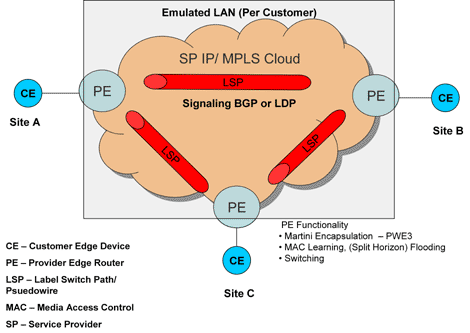
The above
diagram shows an example of a customer of a service provider with three
geographically distinct sites. The service provider�s IP/MPLS cloud has
already been provisioned with a full mesh of LSPs for each site. The PE
learns of remote hosts by associating source MAC addresses of packets
with the ports on which they arrive. When the PE receives a packet to a
destination that is not in its Forwarding Information Bases (FIB), it
will flood the unknown destination packet to all other PEs in the VPLS.
Upon receiving the frame, the other PEs further flood the frame to the
CEs, if the PE did not know the destination MAC. VPLS uses split
horizon flooding to prevent loops from forming due to the full mesh for
LSPs. Once the unknown destination MAC is learned it will be a part of
the FIB for that VPLS instance.

To
understand the debate, the between the two drafts, the differences in
concept must first be understood. Both drafts utilize Draft Martini
(PWE3-Ethernet) for the encapsulation for the data plane. The mechanism
for Pseudowire (refers to a tunnel) signaling, which performs the setup
and distribution of labels, is a point of great contention. Draft K.
Kompella advocates the use of BGP and Draft Lasserre-V Kompella
advocates using LDP to accomplish pseudowire signaling. The argument
against using BGP mainly centers on the complexity of the BGP protocol.
On the other hand, the arguments against LDP are that LDP does not have
auto-discovery. Draft Lasserre-V Kompella does not specify any
mechanism for auto-discovery. Proponents of Draft Lasserre-V Kompella
say that a centralized approach is better such as using DNS, Radius, or
even Directory- based is more effective.
While the
conflicting drafts may appear to represent a roadblock to a viable
solution, the resulting contention may actually present the path to an
optimal solution. Quite often in the telecommunications industry, drafts
are adopted and finalized without recognition of and significant debate
on all of the relevant issues. This results frequently from political
issues that sometimes supersede the more relevant technological points
of contention. For example, a more powerful and influential vendor may
drive a solution that is not necessarily technically-superior to that of
a vendor of lesser influence. Consequently, a final IETF draft does not
always represent the most optimal technological solution. Therefore, the
healthy technical debate reflected by the competing drafts bodes well in
terms of arriving at the optimal technical solution. From the point of
view of the service provider, they are locked into supporting the
technology of their existing multi service routers or, as an
alternative, will be facing significant initial capital investment for
equipment upgrades.
The primary
question has to do with the opportunity cost of waiting until the
standards debates are settled. Clearly, in the case of the VPLS there
is a fertile market, given the popularity of Metro Ethernet
deployments. This could result in late adopters to VPLS to compete for
remains of a largely captured market segment. Services Providers that
can effectively leverage this technology are those that have a large
national Metro Ethernet deployment, such as Time Warner Telecom with 44
Metro Markets throughout the United States.
The future
of VPLS looks very promising. The technology offers the perfect
extension to the service provider�s existing Metro Ethernet portfolio.
The focus of most the vendors should be the Operations and Management
(O&M) of this technology. Sending Layer 2 frames across a Layer 3
infrastructure offers a lot of new challenges for diagnosing and
troubleshooting customer issues. As far as the technology is concerned,
there are several avenues over which VPLS can travel such as
Inter-Autonomous System VPLS, TDM (EoTDM) into VPLS and even encrypted
layer 2 tunneling over IP from another provider into the VPLS Cloud. One
of the strengths of Ethernet throughout the years has been its
overwhelming ease of use. Everyone knows how to plug in a hub. Now we
are extending the success of Ethernet to sites thousands of miles away.
Watch for VPLS to make it happen.
Henry Yu
is a Lead IP Architect for Time Warner Telecom.
Purchase
reprints of this article by calling (800) 290-5460 or buy them directly
online at www.reprintbuyer.com.
Respond to this
article in our forums!

 Internet Telephony Magazine
Click here to read latest issue
Internet Telephony Magazine
Click here to read latest issue CUSTOMER
  Cloud Computing Magazine
Click here to read latest issue
Cloud Computing Magazine
Click here to read latest issue IoT EVOLUTION MAGAZINE



 [August 11, 2004]

