So far, speech-enabling
technology is starting to be utilized in contact center applications.
VoiceXML (news
-alert)
and SALT (Speech Applications
Language Tag) (news
-
alert) are both markup languages for implementing the speech
interface as industry opens standards, allowing the developer to create
a basic voice/speech application without having to know or learn
anything about the voice hardware on which the application will run.
They both have been creating wide opportunities in the marketplace. This
article describes VoiceXML, SALT and how both works as well as how to
implement a speech-enabled contact center application.
VoiceXML
VoiceXML tends to focus
around the development of telephony-based applications and brings the
advantages of Web-based development and content delivery to
IVR (define
-
news -
alert) applications. The specification allows developers to create
audio dialogs that feature synthesized speech, digitized audio,
recognition of spoken and DTMF
(touch-tone) (news
-
alert) key input, recording of spoken input, telephony, and mixed
initiative conversations. VoiceXML is designed to be
platform-independent around the same server logic pull model used for
HTML (define
-
news -
alert) applications. In fact, VoiceXML applications can and often
run in conjunction with traditional web applications, accessing the same
data and performing the same essential tasks, even residing on the same
machines.
SALT
SALT, Speech Application
Language Tags, is actually a small set of XML elements and their
associated attributes, events, and methods. These elements can be
applied to existing markup languages such as HTML, XHTML, and WML to add
speech and telephony interfaces to web applications.
The important concept in SALT
is multimodal. As we have known about IVR, the majority of the
application works using Speech/touch tone DTMF input and pre-recorded or
synthesized speech TTS (define
-
news -
alert) output. What we are really using here is a single modality
"speech". Multimodality is where we can utilize more than one mode of
the user interface with the application similar to our normal human
communications with each other.
VoiceXML vs. SALT
Firstly, VoiceXML and SALT
have different technical goals. Whereas VoiceXML is intended to focus
around the development of telephony-based applications, it was developed
to allow the specification of IVR applications in a markup language that
leveraged the benefits of the World Wide Web. VoiceXML is a simple,
high-level dialog markup language.
Secondly, SALT, a set of
light-weight extensions to existing markup languages, tends to add
speech-enabled telephony to web-based applications and turning them into
multimodal model. SALT targets speech-enabled applications across whole
devices including telephones, PDAs,
(news
-
alert) tablet computers, and desktop PCs. However, VoiceXML focuses
on telephony application development while SALT is focused on multimodal
speech applications that can be accessed by a whole device. These points
will help you to choose which one will be used in your contact center
with speech-enabled technology.
The Weaknesses of VoiceXML
and SALT In Building Contact Center
As the preceding description
states, VoiceXML and SALT are both excellent standards for implementing
speech-based applications. However, call control lacks in VoiceXML and
SALT when using them to develop contact center applications, even if
they have a couple of basic telephony functions, such as call transfer.
As we have known in contact center applications, complex call control
features would be used. There are two solutions: one is to utilize CCXML
and another is to use CTI software.
CCXML Implements Call Control Features
CCXML, The Call Control
eXtensible Markup Language, provides telephony call control that can be
used in speech-enabled applications. CCXML can provide the call
management, event processing, and conferencing capabilities that
VoiceXML and SALT lacked. The following list represents some call
controls features that CCXML can provide:
-
Bridging: Connects a call between two call
legs
-
Routing: Routes inbound calls to the next
available line in a group
-
Conferencing: Multiple callers to join a
voice conference
-
Coaching: A third party to connect to a
call, but only have one of the participants hear what is spoken
-
Outbound Calling: Initiates a call and
starts one or more dialogs once a connection is created
-
Selective Call Answering: Decides whether
or not to answer a call based upon caller�s information
-
Implementing Extra Call
Controls Using Third Party�s CTI
If your contact center
application requires complex call control functions, you can also
implement them using third party�s CTI products by integrating speech
platform with CTI software, such as Intel NetMerge CPS (formerly CT
Connect), Genesys CTI and Cisco ICM CTI. You can customize many of the
CTI features such as call routing, softphone, callback, screen pop, web
chat, outbound, and conference.
How the VoiceXML and
SALT-based Speech System Works
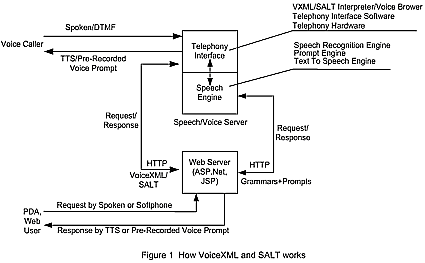
The speech system
can be accessible by either voice caller or web user. The telephony
interface containing telephony boards and interface software acts as a
connector between voice caller and speech system. It is also responsible
for detecting an incoming call, acquiring the initial VoiceXML/SALT
document, and answering the call while the VoiceXML/SALT
interpreter or voice browser conducts the dialog after answer. The web
user visits speech system by web server that has deployed VoiceXML/SALT
documents. Normally the web server processes requests from a client
application and produces reply by VoiceXML/SALT documents over
http. Also, the web server reponses the requests of interpreter or voice
browser and speech engine which processes the TTS, prompts and grammars
events. See Figure 1.
Microsoft Speech Server and
IBM WebSphere Voice Server
There are a couple of
VoiceXML and SALT based speech-enabling products in the
marketplace.Obviously, the Microsoft Speech Server (MSS) 2004 and IBM
WebSphere are leading providers in this field.
The Microsoft Speech Server
(MSS) 2004 is based on SALT 1.0 and has been launched in March of this
year. The MSS 2004 can be deployed as telephony (voice-only) and
multimodal (voice/visual) applications that can be accessed by
telephone, cell phone, desktop PCs, Pocket PC, Tablet PC and other
devices. The tool MS Speech Application Software Development Kit (SASDK)
is seamlessly integrated into Microsoft Visual Studio� .NET 2003 and
provides a powerful set of ASP.NET speech controls, a Speech Add-in for
Microsoft Internet Explorer, debugging tools, a speech application
deployment service, tools for speech application log analysis, sample
and reference applications, and a broad set of grammar library.
IBM WebSphere Voice Server
4.2 is VoixeXML-based speech platform. IBM WebSphere Voice Toolkit is a
complete integrated VoiceXML application development environment. Voice
Toolkit includes an integrated set of tools including application
generating wizards, VoiceXML Editor, grammar development, CCXML Editor,
testing and debugging tools, and a rich reusable dialog component. The
IBM WebShpere Voice SDK and Toolkit are incorporated into WebSphere
J2EE-based development environment.
The following table shows you
a simple comparison between MS Speech Server 2004 and IBM WebSphere
Voice Server V4.2.
|
Items |
Microsoft Speech Server 2004 |
IBM WebSphere Voice Server V4.2 |
|
Markup Language |
SALT 1.0 |
VoiceXML 2.0 |
|
Framework |
MS .Net |
J2EE |
|
Programming |
ASP.Net, C#.Net, VB.Net, Assembly |
Java2, JSP, Servlet, CGI, JavaBean |
|
Telephony Hardware |
Intel DM/V480/960, D41JCT |
Intel D/120/240/480/D300/D600JCT, Cisco/Siemens
VoIP Gateway(H.323) |
|
Speech Engine |
Recognition/TTS/Prompt Engine
Supported third party engine |
Recognition/TTS/Prompt Engine
Supported third party engine |
|
SDK Toolkits |
Yes |
Yes |
|
Telephony Simulator |
Yes |
Yes |
|
Telephony Interface Software |
Intel NetMerge Call Manager
Intervoice TIM(Telephony Interface Manager) |
C API provided for third party telephony
platforms |
|
Extra Call Controls |
CSTA data extension |
CCXML |
|
Deployment in enterprise environment |
Yes |
Yes |
|
OS Platform |
Windows |
Windows, AIX, Linux(Limited in features) |
|
Speech recognition Language |
US English, Beta for Multilanguage |
US English/French/Germen/Spanish, etc. depending
on platform |
|
CTI(Computer Telephony Integration) |
Not supported directly, but be able to integrate
with third party |
Not supported directly, but be able to integrate
with third party |
Implementing Speech-enabling
Contact Center Application

Figure 2 is a typical
architecture of VoiceXML, or SALT speech-enabling contact center. As we
have seen, the speech server is able to integrate with PBX/ACD, CTI,
CallRouting application (such as Genesys and Cisco ICM, etc.), CRM (such
as Siebel, PeopleSoft, MS CRM, etc), desktop application, and data base.
By using speech development tools to make available a speech application
and perform unit testing in development server, you can deploy your
speech application exactly as a web application, either J2EE or ASP.Net,
in the web server.
The customers can access your
speech application from a phone, cell phone, PDA and web. When a voice
call comes in, the call is answered by speech
server. At same time, the caller�s information, such as ANI, DNIS, CED,
and channel of telephony boards will be retrieved by the CTI server and
speech server. The customer interacts
with the speech application by either spoken or DTMF by dynamic VoiceXML
or SALT documents on the web server. Ultimately, the customer may need
to talk to a live agent. The current call will then be transferred to an
appropriate agent extension. According to the customer�s information
retrieved and in conjunction with the business logics set, the
CallRouting application runs a suitable routing script and instructs CTI
and/or speech server to route the current call to an ACD queue. As soon
as the extension of agent is available, the current call rings on the
agent desktop. The CRM application pops up the customer�s messages and
interacts with the database server.
Conclusion
According to
your real requirements of contact center, you should choose VoiceXML or
SALT and development an environment. You can also integrate a speech
server with CTI, CallRouting application, and CRM into your real
speech-enabling contact center application.
Xiaole Song is a professional on designing, integrating and consulting
CTI, Contact Center, IVR, IP Telephony, CRM and Speech applications. He
has performed various roles for Dialogic, Intel and Minacs Inc., etc.
Feel free to email any comments about article or consulting services at
[email protected]
Purchase
reprints of this article by calling (800) 290-5460 or buy them directly
online at www.reprintbuyer.com.
Respond to this
article in our forums!

 Internet Telephony Magazine
Click here to read latest issue
Internet Telephony Magazine
Click here to read latest issue CUSTOMER
  Cloud Computing Magazine
Click here to read latest issue
Cloud Computing Magazine
Click here to read latest issue IoT EVOLUTION MAGAZINE




