|

[March 14, 2001]
Bringing It Home: Taking Converged
Voice/Data Networks Wireless
BY JOHN STEPHENS
The convergence of voice and data in the public networks has become a
fact of life we already take for granted. Large enterprises, too, are well
on their way to unifying voice and data over their own networks. With
these dragons seemingly slain, our industry has begun to address the
formidable challenge of uniting voice and data services within the small
office/home office (SOHO).
While almost everyone today accepts the idea that local networks that
link computers, phones, TVs, and stereos will soon be available at a price
point acceptable to the SOHO marketplace, exactly how this will be
accomplished is far from clear. A number of competing possibilities look
promising, but each must negotiate some pretty tall technological hurdles
before success is assured. This article defines these key technology
issues, and how broadband service providers can best prepare to address
them.
The Broadband Marketplace Today
Consumer demand for converged broadband services is strong and growing
stronger. As an example, the market for home networking services,
including residential hardware and connectivity-based services, is
forecast to reach $10 billion by 2004 (Electronic News, May 8,
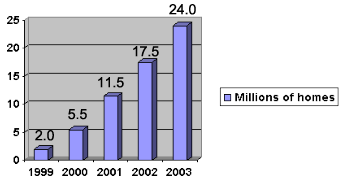
2000). The figure below depicts Goldman Sachs Research's recent
predictions for the growth of broadband in the home market (July 24,
2000).
Service providers are rushing to capitalize on these new
revenue streams, knowing they must capture customers today in the hopes of
upselling value-added services to them in the future. At a minimum,
today's SOHO audience requires high-quality, high-speed connectivity for
multiple PCs and other Internet devices. Voice services, including
multiple lines and PBX-like features for the home, will become available
in the near term. Entertainment services will also be highly desirable for
many households.
Providers must build customer loyalty by
differentiating themselves via these and other value-added service
offerings, to avoid becoming strictly a commodity business.
"Get Off The Web, I Need To Use The Phone!"
If a broadband connection is the answer, the first question is: how do you
distribute it around the home or small office so that available bandwidth
can be shared among multiple devices? Several possibilities currently
exist:
- Time sharing. If only one computer is connected to the
broadband connection, taking turns is the only solution. Dial-up modem
users are familiar with this usage model; only one computer at a time
can dial out on a line.
- Good old Ethernet. It's fast, cheap, and here today. But it
requires you to endure the cost and inconvenience of running cable all
over the premises. It also requires you to tether your devices to the
cable, reducing mobility around the home and constraining the
placement of printers and other network-connected
devices in places of business.
- Home PNA networking. A proven and affordable way to turn your
phone system into an Ethernet, basically. At 10 Mbps it delivers
acceptable throughput for most current applications, though the
quality of wiring on the premises can affect speed and quality. And,
like Ethernet, you still need to be plugged into it.
- Wireless networks. The new kid on the block. All things being
equal, wireless is the way to go because it requires no wires or
jacks. Current wireless LANs that support the IEEE 802.11b or HomeRF
standards offer acceptable range (150-300 feet) and bandwidth (10-11
Mbps).
The table below illustrates the basic pros and cons of these competing
technologies:
|
Technology
|
Fast?
|
Cheap?
|
Range
OK?
|
No
new wire?
|
Cordless?
|
|
Ethernet
|
Yes
|
Yes
|
Yes
|
No
|
No
|
|
Home PNA
|
Yes
|
Yes
|
Yes
|
Yes
|
No
|
|
Wireless LAN
|
Yes
|
Yes
|
Yes
|
Yes
|
Yes
|
Price, which had been a limiting factor in the adoption of wireless
technologies by SOHO consumers, has recently dropped below the consumer
price threshold of $100 per node. The emergence of competing standards has
served to drive down prices to this consumer level, which in turn has
expanded shipment and therefore economies of scale.
Studies show, not surprisingly, that consumers prefer wireless
networking because it offers greater freedom and flexibility without the
expense and inconvenience of new wiring. It's a big advantage to be able
to relocate PCs and other devices at will, or to check e-mail with your
laptop without plugging it into the wall. Wireless service can therefore
increase both subscription and retention rates for providers. Broadband
gateways with integrated wireless LANs can lower initial deployment costs
by eliminating expensive in-home wiring at installation time. Wireless
capability can also offer additional revenue potential through easy,
low-cost expansion of a customer's network. Gaming and other entertainment
applications, for instance, are easier to enable and more
appealing to consumers when combined with the freedom of wireless device
mobility.
But from a provider standpoint, the issue is not what types of LANs
will dominate the SOHO market, but whether your network has the
intelligence to support any or all of them. This is particularly the case
with respect to the competing wireless standards, where HomeRF may be
appropriate for residential customers, but 802.11b is better for small business premises
such as real estate offices.
Don't Go Changing
One reason that data and voice play so well together over public networks
is that the experience for the end consumer is transparent and unchanged
-- the phone still works the same. And the acceptance of voice/data
convergence within the home will be equally smooth, to the extent that
this all-important, paramount requirement is met at the local network
level. Service providers need to understand this above all else: the
consumer experience must remain unchanged, except where it is
significantly improved.
The trouble is that it gets harder to approach this goal as you get
closer to the customer premises. Take, for instance, the availability of
phone service during a power outage. Today's phones work because the
network supplies the power. People don't expect to be able to send e-mail
when the lights go out, but they do want the phone to work. Service providers
and equipment vendors have their work cut out for them developing power
backup or automatic failover capabilities to meet these customer
expectations.
How Good Is Good Enough?
A corollary to the maxim that all changes consumers experience must be
positive is that the quality of service, both to the home and in the home,
must consistently meet or exceed customer expectations for the service
being offered.
For best-effort broadband Internet access, this might mean a surfing
experience that's better than a modem-based experience. For voice, it
means a level of quality comparable to the existing phone network. When
you're collecting e-mail, for example, you don't care what order the text
arrives in; you just need it to be reassembled in the correct order so you
can read the message after all of it arrives. Voice services are very
different: since you're listening in real-time as another person is
talking, a sound out of order or dropped completely distorts the
conversation. Remember the frustration of those old international
satellite calls, with their long echoes and delays? No current phone
customer would accept that low level of quality. Movies and TV have many
of the same quality requirements as voice, but with even higher bandwidth
requirements.
Obviously, those real-time versus non real-time expectations translate
into very different kinds of service on a packet network, with very
different requirements for network intelligence. To cover all these bases,
providers who wish to move from data-only to voice/data networks need to
build enough intelligence into their entire network, from the central
office to the customer premise, to meet consumer expectations. You will
need to be able to deterministically guarantee that the quality of
multiple traffic flows supports user experiences as good or better than
they are today. Otherwise, consumers will stick with the technology they
have, or switch to a provider who can meet their expectations.
Making Them Pay
Competing on price has led us on a "race to the bottom."
Consumers have been trained to expect something for nothing (i.e., much
faster Internet service with no significant difference in price between
broadband and dial-up access). The different types of broadband service --
from DSL to cable to 2-way satellite, fixed wireless and even older
technologies like ISDN -- are not well differentiated, and are currently
viewed as directly competitive. Providers who can differentiate their
services are the ones that will succeed in this environment.
This means that network intelligence is absolutely essential for
success, because without it you can't differentiate your services
effectively. Some of your SOHO customers will be content with best-effort
Internet service. But many others will want real-time services like
telephony, TV, and music; or content filtering; or a firewall. Maybe even
service level guarantees. You need to make it very easy for customers to
buy and consume these value added, high margin services, because they will
make or break your bottom line. Network intelligence will enable you to
sell differentiated services to those who are willing to pay for them.
We all know there are only two reasons why somebody will buy -- or switch
to-- your service: 1.) it's cheaper or 2.) it offers new features, or does
the same things an order of magnitude better. If you can do things
cheaper, great. But with an intelligent network you can focus on building
and keeping market share, and on creating new revenue streams, through
differentiated services. Also keep in mind that once you have
intelligence distributed throughout the network, the cost of selling new
services to existing customers is next to nothing. And the more services a
customer buys from you, the higher the margins and the tougher they are
for your competitors to
steal.
Creating Network Intelligence
Network intelligence can mean any number of things, but it all comes down
to this: you need to make your service easy to use and hard to
misuse. You need to make it easy for people to buy new services from
you -- and easy for you to sell them. This requires you to place your
primary network intelligence on the customer premises, at the interface
between your network and the consumer's LAN. That way you can gather data
from the multiplicity of devices on the LAN automatically, while providing
a foundation for Quality of Service (QoS), Service Level Agreements (SLA),
user identification, and so on.
The technology that makes this possible is the intelligent broadband
gateway. What makes a gateway intelligent? A typical residential
broadband gateway generally consists of a device with built-in
broadband capability and at least two premise distribution capabilities
(such as USB and Ethernet). An intelligent broadband gateway
goes one step further, providing intelligence to assist
users in configuration and troubleshooting. Basically, once it's in place
the gateway should be able to control almost all interactions between your
network and the customer's network. Such a gateway should also be
standards agnostic, so it can deal with most any LAN configuration.
Among the key benefits of an intelligent broadband gateway are:
- Lower Mean Time To Install (MTTI), ideally with plug-and-play
installation and configuration by the end user to ensure the lowest
possible deployment costs. Customers will want the ability to add new
devices and reconfigure services easily; thus, delivering this
capability will also increase market penetration.
- Lower Mean Time To Diagnose (MTTD) through comprehensive
internal/external diagnostics, means a far greater chance that
problems will be resolved without a truck roll, and this reduces life cycle
costs. The gateway should enable customers to detect and fix most
problems themselves, provide critical technical details for solving
more complex issues, and also enable the provider to reprogram the
unit from a central location.
- Minimized order-to-bill delay, which follows from reductions in MTTI
and MTTD, accelerates initial revenue capture and shortens inventory
holding costs, both of which fall directly to the bottom line.
In the final analysis, an intelligent gateway is a more expensive
initial purchase than a "dumb" residential gateway, but it makes up
the difference many times over by speeding service installation, reducing
user support costs, and driving future revenue opportunities. Services not
provided via this interface must be provided further along the network.
Many of today's VoDSL platforms, which rely on the central office both to
manage the service and to address specific customer needs, are a
cautionary case in point. A centralized service model simply cannot
"know" enough about the SOHO environment to maintain the network
characteristics required to deliver high-quality, easy-to-consume services
all the way to the end devices in the customer's network.
Looking Ahead
Look for convergence of data and voice on residential LANs to begin taking
place in a big way as early as this year. It's currently being evaluated
in the labs, with a few small business deployments already in operation.
As providers reengineer their networks to provide deterministic,
differentiating services, these services will be available to much of the
U.S. population by 2002 or 2003.
In parallel with these infrastructure advances, service providers and
content providers like Disney and Sony will be working to package consumer
services. Continued reductions in the cost of wireless LAN technology will
result in more and more wireless networks. Maturation of industry-wide
wireless standards will further catalyze deployment of new services, and
promote interoperability among network devices.
How can you keep ahead of this withering pace of change? Build the smartest
network you can, and bring that intelligence right to the place where
your network meets the customer's LAN. Make your service easy to use
and hard to misuse, and support all the key LAN standards. That way
you'll be in position to offer new services quickly and at competitive
rates, while providing deterministic, high quality services to those
customers who are willing to pay for these value-adds.
In the long term, service provider revenue will rest on the delivery of
new, value-added services like virtual private networks (VPNs), enhanced data
security, home portals, and video telephony. No doubt we'll all soon be
enjoying services we haven't even thought of yet! The point is that your
network needs to provide the flexibility and intelligence required to
offer who-knows-what application, without compromising Quality of Service
anywhere along the line.
In this context, the intelligent broadband gateway can serve as a
platform that enables new services and makes it easy to buy and deliver
new capabilities cost-effectively, while meeting consumer expectations for
quality and cost.
John Stephens is chief technology officer of Cayman Systems, Inc.
Cayman Systems is a global provider of broadband gateway solutions, enabling the delivery of voice, video and high-speed data to the 21st century small office and home via technologies such as DSL, cable and broadband wireless. Cayman develops and delivers intelligent, straightforward solutions that enable broadband service providers to deliver revenue-generating services while maintaining tight cost controls. |

 Internet Telephony Magazine
Click here to read latest issue
Internet Telephony Magazine
Click here to read latest issue CUSTOMER
  Cloud Computing Magazine
Click here to read latest issue
Cloud Computing Magazine
Click here to read latest issue IoT EVOLUTION MAGAZINE


