
August 1999
COMMUNICATIONS SERVERS AND THE CONVERGED ENTERPRISE
BY BROUGH TURNER
There's a lot of talk about voice and data convergence these days - but the process
itself has barely begun. Today's reality? Almost every enterprise still has separate
data and telecommunications networks. On the data side they have an Internet connection, a
firewall, a WAN access router, and a LAN with wires running to all the computers in the
building. On the voice side there are traditional voice lines or perhaps a T1 trunk coming
from the public telephone network into a corporate PBX, with another set of wires running
to each of the telephones. In some corporations - the early adopters - there is
connectivity between these two networks via IP telephony gateways. And in some
corporations, specific telephone equipment like the voice mail system, fax server, or
conference bridge may be administered over the LAN. However, the networks have not
converged - yet. But the time is ripe, and the first steps are visible.
Traditional enterprise networks include a PBX-centric voice network and a LAN with a
firewall connection to the Internet. There may also be some newer components; for example,
an IP telephony gateway that passes voice traffic from one enterprise location to another
over the IP network.
One way to approach convergence is to purchase an IP-based PBX. Cisco has such a
product (purchased when they acquired Selsius) as does 3Com (who purchased NBX Corp.).
Lucent has announced their IP Exchange product, and most of the traditional PBX vendors
have at least an IP-PBX story, if not a definite product announcement.
Migrating the PBX (see Figure 1) to an IP-PBX
requires an IP telephony gateway (already discussed) and additional software (the block
marked "IP PBX logic" in Figure 1). In addition, the
traditional telephones would need to be replaced with Ethernet telephones, since using
workstations as telephones is expensive and cumbersome. Migrating to an IP-PBX would be
one step toward convergence since the voice traffic would typically be transported over
the Ethernet wiring. But there would still be quite a few separate systems, typically with
separate administration.
THE COMMUNICATIONS SERVER
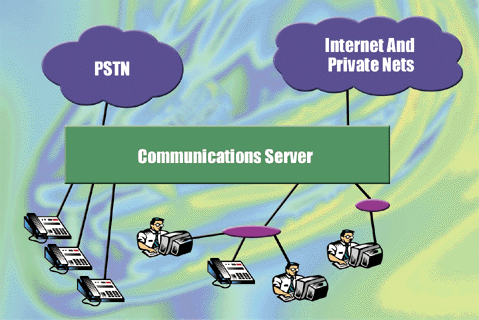
The next step toward convergence is the communications server. A few people are
using this term for what is little more than a PC-PBX with integrated voice mail, but
generally the term denotes an integrated communications box that serves both voice and
data functions. In other words, discrete functions in the traditional enterprise network
model (such as the firewall, router, PBX, and IP telephony gateway in Figure
1) are collapsed into one device (Figure 2).
Such a unified solution is especially attractive for the smaller business that has no
MIS department. In such a scenario, a communications server handling both the voice and
data is a real advantage, provided it’s simple to administer. In the past year, the
first true communications servers have begun to appear, primarily from start-ups such as Praxon, Shoreline
Teleworks, and Vertical Networks. All three of
these companies advertise solutions, targeted at small and medium-sized businesses, that
integrate voice, data, messaging, and Internet connections in a single box.
Internally, these first communications servers are still separate voice and data
solutions integrated into a single box. Their breakthrough is to provide integrated
administration of the voice and data functions. They have yet to embrace IP-PBX operation,
so two sets of interior wiring are still required. But they’ve gone further toward
solving small business communications problems than the first IP-PBX products.
As IP-based PBX technology advances, the ability to build a communications server that
uses a single wiring plant for voice and data will come. Hardware will get simpler, and
communications servers will become more and more economical. And the market for add-on
products, mostly software, will grow dramatically!
THE BIG PLAYERS WEIGH IN
While the integrated communications server solutions on the market today are from
start-ups, there is an increasing interest among larger companies as well. For example, in
March, Hewlett-Packard announced an alliance with Nortel in which Nortel agreed to
repackage their PBX technology on boards that fit into HP PC servers. The intent is not to
create yet another PBX, but to combine telecom and IT in a platform that can support
open-systems computing and communications.
And in June, Intel announced the purchase of Dialogic. Intel has a long history in
desktop telephony — they created the telephony API which eventually became
Microsoft’s TAPI and they appear to have been responsible for Microsoft’s
adoption of H.323 for desktop audio and video conferencing. However, Intel has never had a
direct presence in PBXs or server-based computer telephony. Their stated reason for
acquiring Dialogic was to gain the telephony expertise they need to develop communications
server platforms. Obviously they’d like communications servers to be based on
Intel-built silicon wherever possible.
Meanwhile Cisco, whose products dominate much of the data communications market, is
trumpeting their intention to drive a “migration from Old World circuit-based
networks to New World packet-based networks.” In addition to acquisitions of
companies like Selsius, Transmedia Communications, and Global Internet Software Group,
Cisco has also introduced Windows-based administration and management into a world that
was once completely based on SNMP.
All players, large and small, are attracted to the small-business communications server
market, which is the market that provides the highest unit volumes. In a large enterprise,
the converged network is still likely to contain multiple servers, if only for performance
and scaling reasons. And the larger enterprise’s MIS department is more likely to
need the flexibility of separate systems and to be able to handle the administration
overhead. It’s the smaller business or the branch office with no MIS department that
most needs all communications functions in a single box.
For Intel, another attraction of relatively low-port-count communications servers is
the possibility of performing the necessary digital signal processing functions on the
main Intel processor using MMX instructions. Today’s PC is more than adequate for
single-channel desktop signal processing, but with ever faster Pentiums, multi-channel
systems are becoming feasible. Over the next three years, look for two, four, or more
channels of voice or fax functions running directly on the Pentium (or Merced) chip. An
Intel small-business communications server could be as simple as an Intel motherboard with
integrated Ethernet and telephony trunk interfaces. This may take a few years, but
Moore’s law will make it possible.
COMMUNICATIONS SERVER OF THE FUTURE
Cost will impact the form factor of the small-business communications server.
Today the price of a small-business telephone system with four lines and sixteen
telephones can range from less than $2,500 to over $5,000 installed, depending upon how
fancy the telephones are, whether the system includes voice mail, and so on. Without the
telephones, voice mail, or installation, the central system unit must cost less than a
desktop PC. To meet this price point, the small-business communications server will need
to be a highly integrated box like the key telephone system or WAN access router it
intends to replace. How much PC technology can this box use? Will it be running Windows NT
or UNIX?
The greatest cost of new products today is the software development, and communications
servers will be distinguished by their applications, i.e., their software. So no matter
how the hardware is packaged, communications servers will leverage as much mainstream
software as possible. This points to development environments like Windows or UNIX, even
if deployment is on embedded Window NT, Windows CE, or embedded Linux. And since Windows
CE and embedded Linux can both run on a wide range of processors, a Pentium CPU is not a
foregone conclusion.
Most likely, the small business communications server will be an embedded system
running on a single processor with a minimum of additional chips and just the physical
interfaces necessary to connect to the telephone and datacom worlds. But the winning
products will run software from the world of mass-market PCs and the Internet — and
be open to CTI developers. Even though they may not look like PCs, they will host
third-party software — the critical element in any future communications solution.
Brough Turner is senior vice president of technology at Natural MicroSystems, a
leading provider of hardware and software technologies for developers of high-value
telecommunications solutions. For more information, call Natural MicroSystems at
508-620-9300, or visit the company’s Web site at www.nmss.com..
E-mail to the author ([email protected]) is also welcome.
Figure 1 Existing And
Emerging Corporate Infrastructure [return to text]
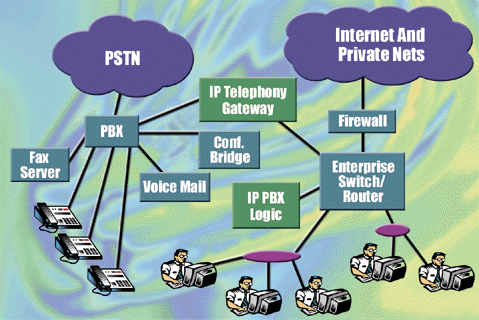
Figure 2 The Communications
Server [return to text]
 |

 Internet Telephony Magazine
Click here to read latest issue
Internet Telephony Magazine
Click here to read latest issue CUSTOMER
  Cloud Computing Magazine
Click here to read latest issue
Cloud Computing Magazine
Click here to read latest issue IoT EVOLUTION MAGAZINE


