
June 1999
A NEW SWITCHING ARCHITECTURE
For A New Competitive Environment
BY DOUG KLAIBER
Throughout the telecommunications marketplace, a trend toward deregulation and
liberalization has raised expectations for increased competition, reduced consumer prices,
and led to innovative new services. Here in the United States, the Telecommunications Act
of 1996 was widely touted as the beginning of a new age of affordable, new services. Yet
consumers have yet to see any significant new service offerings or savings in their
monthly bills. Why hasn't the promise of lower costs and new service offerings been
realized in the marketplace? The answer lies not in the halls of government but in the
central office facilities of service providers. The rules have changed but the
infrastructure has not.
ARCHITECTURAL LIMITATIONS
While the stage has been set for a new competitive landscape, the existing network
architecture has prevented its realization. In markets where CLECs (competitive local
exchange carriers) are challenging the ILECs (incumbent LECs), these CLECs are often
merely reselling services using the existing infrastructure. In fact, industry experts
estimate that more than 90% all CLEC access lines are passively resold.
Facility-based CLECs attempting to build new networks have been hampered by the high
cost of large, proprietary Class 5 switches. With a typical up-front cost of $3 million
per deployment, traditional switch technology has prevented CLECs and other
next-generation service providers from significantly altering the cost models long
employed by the ILECs.
The existing proprietary Class 5 switching infrastructure has also hampered service
providers' ability to create and deploy innovative new services to gain a competitive
advantage. The proprietary architectures of the existing switch platforms have made
network operators entirely dependent on switch vendors for new software applications and
upgrades. These software upgrades and new services often take years to develop, are
extremely expensive, and remain the exclusive property of the switch manufacturer. This
makes it difficult for service providers to differentiate themselves and limits the
services available to consumers.
NETWORK TRANSFORMATION
Today, however, the U.S. telecommunications market is poised to enter a new era of
competition - an era that finally realizes what the Telecommunications Act of 1996
promised. The Public Switched Telephone Network (PSTN) will be transformed as voice, data,
and enhanced services converge. A new network architecture will emerge, driven by new
technologies, new demand, and increased competition.
Today's network is divided into two elements: the PSTN and the Public Switched Data
Network (PSDN). The PSTN consists of large, centralized proprietary Class 5 switches with
Remote Switching Modules (RSMs) and Digital Loop Carriers (DLCs). This architectural
configuration, representing $250 billion in network investment and hundreds of billions of
dollars in annual service revenues, has changed little over the last several decades.
In contrast, the substantially smaller PSDN - consisting of network point of presence
(POPs) and remote access devices - is growing at a dramatic rate. The growth of the PSDN
is being driven by the Internet, intranets, Virtual Private Networks (VPNs), and remote
access. However, the PSTN remains the principal means for delivering data services.
According to Dataquest, 46.5 million analog modems will be sold in the year 2000. And
nearly all personal computers purchased today come equipped with a 56K modem.
Many industry pundits have been claiming that packet-switched voice will displace
circuit-switched voice in a matter of a few years. However, despite the hype, VoIP has yet
to establish itself in any significant manner. If packetized networks are truly destined
to displace circuit-switched networks, the process could easily take a decade or more - if
it ever happens at all.
Thus, some form of convergence between the PSTN and the emerging PSDN is inevitable.
The trouble is, no one is certain of how and when this evolution will take place.
Nevertheless, two things seem clear:
- With the existing central office switch infrastructure representing a
multi-billion-dollar investment, it is unlikely operators will opt for a wholesale
replacement of it any time soon.
- While packet-based technologies like IP and ATM will dominate in transport applications
and are well suited for Class 4/toll circuit switching, Class 5 TDM (time division
multiplexing) will be required in the network for some time. Class 5 switching will become
more distributed, reside at the edge of the network, and become integrated with enhanced
service offerings.
In other words, circuit switching and packet switching will co-exist for quite a while,
with IP, ATM, and TDM all playing complementary roles.
A NEW ARCHITECTURE
Against this evolving network landscape, a new network architecture is emerging - a
next-generation architecture blends the PSTN and the PSDN.
Instead of large, centralized, proprietary switch infrastructures, this next-generation
architecture pushes central office functionality to the edge of the network. The result is
a distributed network infrastructure that leverages new, open technologies to dramatically
reduce the cost of market entry and increase flexibility, while accommodating both
circuit-switched voice and packet-switched data.
This shift is strikingly similar to the change that occurred in corporate information
processing during the last decade. Economics and breakthrough technology combined to
completely alter the data networking architecture. Today, instead of networks based on
large, centralized, expensive mainframes and "dumb" terminals, we have
distributed networks made up of low-cost, "smart" desktop computers linked
together. This architecture has allowed the mainframe computers to do what they were
originally designed to do and permitted applications to be pushed closer to the end-user,
reducing overall cost, while greatly enhancing system flexibility and functionality.
In other words, this new generation of low-cost, open switching platforms has the
potential to transform the telecommunications service market in the same way the desktop
PC changed the corporate computing landscape. Large centralized Class 5 proprietary
switches will continue to play a roll in the network, but distributed open Class 5 access
and enhanced services platforms will play a dominant role in altering the network
landscape.
THE MISSING LINK
Key to the success of this transformation is a new next-generation architecture -
purposely built to provide the "missing link" between the PSTN and the PSDN.
This next-generation switching architecture represents an entirely new approach to
delivering services, designed to:
- Deliver robust switching functionality at a cost that is orders of magnitude lower than
traditional, proprietary Class 5 switches.
- Distribute central office switching functionality throughout the network.
- Protect existing investments by supporting a wide range of analog and digital network
standards, interfaces, media, and service elements.
- Reduce the number of network elements by combining a range of telephony, application,
and service delivery functions.
- Enable new service creation through programmability and the flexibility of an open
Application Programming Interface (API).
- Provide a high degree of scalability, enabling network operators to rapidly and
cost-effectively grow their subscriber base.
- Promote extensibility through open architecture design to take advantage of future
technology advances.
- Redefine true, carrier-class design for maximum fault tolerance and zero downtime.
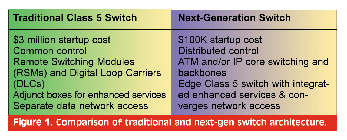
Clearly, this approach represents a dramatic departure from the "old" switch
architecture. The differences in a side-by-side comparison are immediately apparent in Figure 1.
CHANGING THE ECONOMIC MODEL
The most immediate and obvious benefit of these next-generation switches is their cost.
Compared to traditional Class 5 switches, next-generation switches reduce up-front
investment by a factor of 30 and offer scalability that is far less expensive and far more
linear.
The market implications of this cost advantage are clear. With a next-generation
switch, even small, start-up CLECs can afford to enter under-served secondary or tertiary
markets and compete profitably. As these CLECs gain market share, next-generation switches
can be rapidly and cost-effectively scaled to meet growing demands.
THE SERVICE ADVANTAGE
Reducing cost, however, is only part of the competitive equation. Today's subscribers
demand services that add value to their personal communications. The ability to create and
deploy customized services that satisfy subscribers' needs is required to compete
profitably.
Next-generation switches offer an advantage: flexible programmability, with enhanced
service applications integrated within the switch architecture. This eliminates the need
for a separate enhanced services platform in most situations, further reducing up front
costs. The open software architecture of next-gen switches allows rapid development of new
services and features. When combined with the low cost and distributed nature of
next-generation switches, this flexibility enables network operators to create bundled
service offerings tailored to discrete subscriber bases - even in the smallest
deployments. The implications and benefits of this are clear to any network operator in a
competitive situation.
DELIVERING ON THE PROMISE
While opinions abound, the fact is that no one is certain how the multi-billion dollar
telecommunications market will shake out. To compete and win in the next century, network
operators will need vision and extreme flexibility. Advanced next-generation switching
architectures offer the ability to:
- Reduce the cost and complexity of network operations by pushing switch functionality to
the edge of the network.
- Satisfy the need for voice/data convergence, giving network operators the flexibility to
take advantage of emerging technologies and standards.
- Protect existing network investments, while allowing network operators to
cost-effectively deliver new services to new markets.
Next-generation switches will provide a solid migration path from the networks of today
to the converged networks of tomorrow. They offer full PSTN integration and true Class 5
switch capabilities, together with seamless integration with IP and ATM data backbones.
Their open programmability enables next-generation switches to deliver customized enhanced
services to discrete subscriber bases. Additionally, their low cost and high scalability
enables profitable operation in both small and large deployments.
Doug Klaiber is director of marketing for Taqua Systems, Inc., and he can be
reached for comment at (508) 778-8808 or online at [email protected]. Taqua is an emerging
leader in next-generation switching platforms based in Centerville, Massachusetts. For
more information on Taqua visit their web site at www.taqua.com.
FIGURE 1
[Return to text]
 |

 Internet Telephony Magazine
Click here to read latest issue
Internet Telephony Magazine
Click here to read latest issue CUSTOMER
  Cloud Computing Magazine
Click here to read latest issue
Cloud Computing Magazine
Click here to read latest issue IoT EVOLUTION MAGAZINE


