
TMCnet News
Federal President of Germany meets Novaled founders and Future Prize winnersDRESDEN, Germany --(Business Wire)-- As part of his first official tour of Saxony, German Federal President Joachim Gauck called in at the TU Dresden (Technical University of Dresden) where he met the team of scientists who founded Novaled and won the President's award for technology and innovation - the Deutscher Zukunftspreis (German Future Prize). 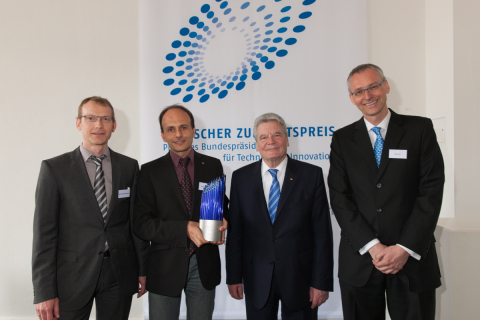
German Federal President Joachim Gauck meets Novaled founders (f.l.t.r.: Dr. Blochwitz-Nimoth, Dr. Pfeiffer, German Federal President, Prof. Leo ) (Photo: Business Wire) During the course of his visit to the Institute of Applied Photophysics at TU Dresden, President Gauck met the winners of the 2011 Deutscher Zukunftspreis, Professor Karl Leo (TU Dresden / Fraunhofer (News - Alert) COMEDD), Dr Jan Blochwitz-Nimoth (Novaled AG) and Dr Martin Pfeiffer (Heliatek GmbH). They were honoured for the outstanding results of their research into organic semiconductors and for the successful commercial exploitation of their findings. The annual award is worth €250,000 to the winners. „At the beginning there was an idea, a vision, for which we were deemed crazy by a lot of people. Today, the rise of organic electronics cannot be stopped. Organic semiconductors have outgrown basic research and found their way into industrial applications a long time ago. We have been acknowledged for this transfer with the Zukunftspreis and we are very excited about the visit of Bundespräsident Joachim Gauck and his interest in our work", said Professor Karl Leo. "The interest shown by President Gauck indicates the high value he attaches to pioneering research and to its economic exploitation for Germany," said Dr Blochwitz-Nimoth, Chief Scientfic Officer at Novaled. "Organic electronics already features strongly in the lives of many people today, with Novaled products playing a significant role, for example in OLED mobile displays that are making a contribution to green technology by virtue of their increased efficiency and longevity." The work done by Leo, Blochwitz-Nimoth and Pfeiffer has helped to drive forward progress in the whole field of organic electronics. In their laboratories at TU Dresden, the three scientists developed a technology for organic semiconductors that facilitates the production of innovative and efficient components, including organic light-emitting diodes (OLEDs) with dramatically reduced energy consumption and a longer lifetime, and organic photovoltaic cells with significantly enhanced efficiency. This has led to visionary and resource-efficient applications in many different areas of life. With the founding of Novaled AG and Heliatek GmbH (manufacturers of organic photovoltaic cells), the team which first came together at TU Dresden has established a leading organic electronics cluster in Saxony/ Germany. The Novaled spin-off has made a successful market entry with OLED materials and technologies. These are now finding application in a new generation of flat-panel displays with brilliant colour saturation such as those used in Samsung smartphones, in energy-saving lighting systems and in efficient flexible organic photovoltaic cells (OPV). The company has been posting profits since 2011 (turnover 2011: €17.4 million) and has a 130-strong workforce. Heliatek currently holds the world record for organic photovoltaic cells with a cell efficiency of 12%. The company has recently opened the first factory of its kind in the world for the production of organic photovoltaic cells in a continuous roll-to-roll process under vacuum conditions and is working with prominent partners in the industry towards the market launch of flexible organic photovoltaic film. About organic electronics: Modern electronics is based mostly on crystalline semiconductors - materials such as silicon, the processing of which is time consuming and expensive. Organic electronics based on carbon compounds provides environmentally friendly alternatives and new areas of application. Organic semiconductors make it possible to produce lightweight, flexible, efficient and large-area electronics using minimal energy and materials. For example, organic light-emitting diodes (OLEDs) that distribute light evenly and naturally, or organic photovoltaic cells (OPV) that absorb light well even under unfavourable conditions. At the same time, such components have properties that make completely new applications viable, e.g. transparent, curved surfaces or windows that absorb light during the day and gradually disperse it at night. Ultra-thin screens that are highly efficient in displaying information and video material in brilliant colour, with the prospect of transparent and flexible film not far off in the future. The market for organic electronics has enormous potential; estimates from market research suggest that sales of OLEDs and OPVs alone will be worth around €33 billion in 2018 (Source (News - Alert): DisplaySearch, nanomarkets). About Novaled About OLEDs
Photos/Multimedia Gallery Available: http://www.businesswire.com/multimedia/home/20130430006366/en/ |
