
TMCnet News
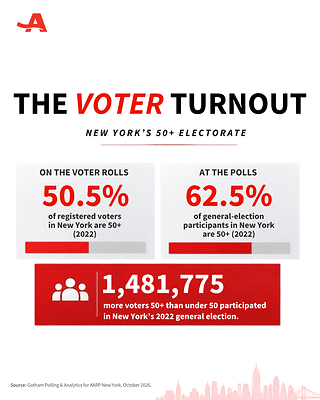
NY's 50+ Voters Outnumber Younger Voters by 1.3 Million in Historical Turnout Scenario, New Analysis FindsNew voter analysis reveals shifting party affiliations, changing participation patterns and the enduring influence of voters 50+, who accounted for 62.5% of general-election participants in 2022. ALBANY, N.Y., Oct. 21, 2026 /PRNewswire/ -- New York voters age 50 and older could once again account for a commanding share of the electorate in 2026, according to a new analysis prepared by Gotham Polling & Analytics for AARP New York.
If participation resembles New York's 2018 and 2022 gubernatorial elections, approximately 3.7 million voters age 50 and older could participate in the 2026 general election, compared with roughly 2.4 million voters under 50, a difference of about 1.3 million. Under that historical baseline, voters 50+ would account for approximately 61% of participants with known adult ages. The analysis presents a historical scenario, not a forecast of 2026 turnout. Recent voting patterns underscore the influence of older New Yorkers. Voters age 50 and older comprised nearly 63% of identified general-election participants, despite representing just 50.5% of registered adults. Nearly 1.5 million more voters age 50 and older participated than voters under 50. "The message to candidates across New York is clear: voters 50 and older show up. Their support must be earned, not assumed," said AARP New York State Director Beth Finkel. "Candidates should explain where they stand on the issues affecting older New Yorkers and their families, including protecting Social Security, supporting family caregivers, and addressing the costs of housing, health care and utilities." "Polls tell us who voters say they'll support, but historical data tells us who actually shows up," said Stephen Graves, president of Gotham Polling & Analytics. "Older New Yorkers have consistently represented a substantial share of the electorate, including in closely contested congressional districts. Understanding those participation patterns is essential to understanding the state's political landscape." The analysis also shows that older voters are not a single partisan bloc. In the 2022 general election, substantial numbers of older Democrats, Republicans and unaffiliated New Yorkers participated, underscoring the breadth of the 50+ electorate. Older Voters Account for a Growing Share of the Electorate Between the 2018 and 2022 general elections, identified participation among voters age 50 and older increased 1.9%, while participation among voters under 50 declined 11.5%. The report cautions that the growing share of older participants reflects both trends, rather than growth among older voters alone. Unaffiliated Voter Registration Is Growing Participation among unaffiliated voters has also increased. Between 2020 and 2024, participation among unaffiliated New Yorkers increased by 106,545, while participation among voters recorded as Democrats declined by 96,683 and participation among Republicans increased by 37,342. The analysis cautions that these figures reflect changes in the sizes of participating groups and do not establish that individual voters switched parties. Unaffiliated registration means a votr has no recorded party enrollment; it does not indicate whether that voter is undecided. Taken together, the findings show an electorate in transition while reinforcing a consistent pattern: New Yorkers age 50 and older have represented a disproportionately large share of general-election participation and could again wield significant influence in 2026. Older Voters Represent a Majority in Selected Congressional Districts The district-level analysis examines voters registered in each selected district as of October 1, 2026, and their previously recorded voting histories. The figures describe current registered cohorts, not the complete historical electorates of those districts, and do not indicate candidate preferences.
New York City and Regional Differences Shape the Electorate Younger voters also showed a recent increase in primary participation concentrated in New York City. The city accounted for 95.2% of the statewide increase in under-50 primary participants between 2024 and 2026. The report cautions that primary participation should not be treated as a predictor of general-election turnout because the elections involve different electorates and eligibility requirements. Other regional findings highlight the diversity of New York's electorate:
Read the full analysis here. About the Analysis The study describes identifiable participation and reconstructed registration and does not predict candidate choices or provide individual turnout rates. About AARP AARP is the nation's largest nonprofit, nonpartisan organization dedicated to empowering Americans 50 and older to choose how they live as they age. With a nationwide presence, AARP strengthens communities and advocates for what matters most to the more than 100 million Americans 50-plus and their families: health security, financial stability and personal fulfillment. AARP also works for individuals in the marketplace by sparking new solutions and allowing carefully chosen, high-quality products and services to carry the AARP name. As a trusted source for news and information, AARP produces the nation's largest circulation publications, AARP The Magazine and AARP Bulletin. To learn more, visit www.aarp.org/about-aarp/, www.aarp.org/español or follow @AARP, @AARPenEspañol and @AARPadvocates on social media.
SOURCE AARP New York 
|
 View original content to download multimedia: