
TMCnet News
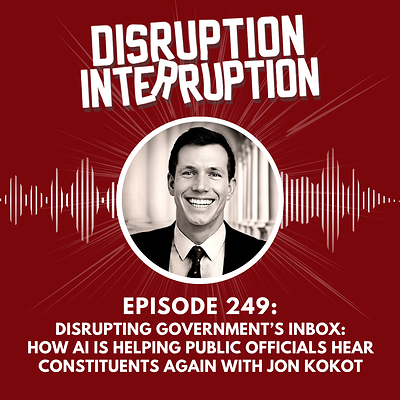
Disrupting Government's Inbox: Jon Kokot Targets Unanswered Constituent MessagesOn Disruption Interruption, Jon Kokot, Co-Founder and CEO of Civic, explains how artificial intelligence can help government offices manage growing volumes of constituent messages and give staff a clearer picture of the issues residents are raising. TAMPA BAY, Fla., Oct. 1, 2026 /PRNewswire/ -- The Bipartisan Policy Center reports that, by some estimates, Congress receives more than 80 million constituent contacts annually, including phone calls, mail, social media messages, and casework requests. For offices tasked with organizing, understanding, and responding to public communications, that volume can be difficult to manage. Jon Kokot, Co-Founder and CEO of Civic, joins host Karla Jo Helms (KJ) on the Disruption Interruption Podcast to explain why government technology has struggled to keep pace with growing volumes of constituent communication and how artificial intelligence (AI) could help offices process those messages more effectively. "Government technology has not kept up," Kokot says. "There's a lag there, and we're trying to close that gap."
When Constituent Messages Outpace Office Capacity Kokot says AI drafting tools and new communication channels have made it easier for residents to contact public officials, adding to the volume arriving through email, website forms, phone calls, voicemail, social media, and in-person conversations. At the same time, he says some state and local offices still rely on Outlook, spreadsheets, and disconnected applications to manage those interactions. The backlog can become substantial. Kokot recalls hearing from government staff facing as many as 300,000 unanswered emails. "There is a clear gap between the staff available to handle this, the technology that they're using, and the volume that is necessary to be processed, analyzed, responded to, and taken action on," he says. Requests for help, such as passport-renewal assistance, can get lost, while concerns like legislation, local services, or neighborhood issues can remain unprocessed, making recurring patterns harder to identify. Older systems can also make prior interactions difficult to surface when staff need context. "Maybe there's a 10-year relationship that's buried deep within old emails and letters and all this stuff," Kokot says. Connecting Incoming Messages to Constituent Service To manage that volume, Kokot says government offices need a way to bring messages, contact histories, and service requests into one place. Civic's platform connects with Outlook, Gmail, and website forms, while a mobile app lets staff record in-person conersations. Phone and voicemail still require manual entry. AI categorizes messages by topic, updates constituent records, and populates geographic heat maps showing where concerns originate. "It is multi-channel communication all coming into a centralized inbox," Kokot explains. Civic's first customer, a New York City local office, is using the platform to process 311-related requests, which can include non-emergency reports such as noise complaints, broken windows, or sidewalk damage. Kokot explains that staff can route an issue to the relevant department and identify residents to update after action is taken, while the AI assistant can compile reports on recurring topics. Civic is also being tested by early adopters in the U.S. House of Representatives. "At the moment, we have offices operating in a beta environment until we do get that final approval," Kokot says. Kokot's goal is for automated processing to help staff complete their daily inbox work in a few morning hours rather than letting it consume the full workday, reducing administrative strain on staff and giving residents consistent follow-up on the concerns they raise. "We want to improve the function of our democracy, so that residents feel that they have agency in this American experiment," Kokot says. Links Disrupting Government's Inbox: How AI Is Helping Public Officials Hear Constituents Again with Jon Kokot Disruption Interruption is the podcast where you will hear from today's biggest Industry Disruptors. Learn what motivated them to bring about innovation and how they overcame opposition to adoption. LinkedIn: https://www.linkedin.com/in/jonathan-kokot/ About Disruption InterruptionTM About Jon Kokot About Karla Jo Helms References
Media Inquiries:
SOURCE Disruption Interruption 
|
 View original content to download multimedia: