
TMCnet News
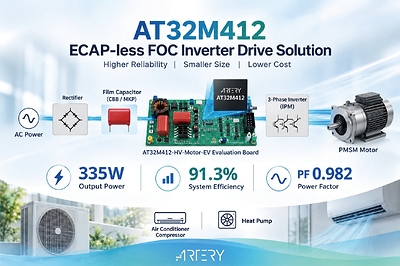
Artery Technology Launches AT32M412-Based ECAP-less FOC Motor Drive Solution to Reduce Costs and Improve EfficiencyElectrolytic-Capacitor-Less Design: A New Direction for Motor Drive Control TAIPEI, Sept. 23, 2026 /PRNewswire/ -- As home appliance and industrial motor drive systems continue to evolve, higher reliability, smaller system size, and lower costs have become key design priorities. Artery Technology has introduced an electrolytic-capacitor-less (ECAP-less) field-oriented control (FOC) motor drive solution based on the AT32M412 microcontroller. By replacing conventional high-capacity aluminum electrolytic capacitors with small-capacity film capacitors, the solution combines high-performance computing, high-speed data acquisition, and integrated analog peripherals to support advanced motor control algorithms. Conventional variable-frequency drives (VFDs) typically use large-capacity aluminum electrolytic capacitors for energy buffering and voltage smoothing on the DC bus. However, prolonged operation at high temperatures can cause electrolyte evaporation, leading to capacitance degradation and increased equivalent series resistance (ESR), which can limit the overall service life of the drive system. ECAP-less drive technology replaces conventional electrolytic capacitors with small-capacity film capacitors, such as CBB or MKP types. Without the risk of electrolyte dryout, film capacitors can extend system service life while reducing capacitor volume, PCBA size, mechanical height constraints, and overall BOM cost. They also provide better thermal stability and electrical characteristics under extreme high- and low-temperature conditions. Because an ECAP-less architecture has lower energy storage capacity, appropriate software feed-forward compensation implemented by the microcontroller can actively smooth line-side current, improving power factor (PF) and reducing total harmonic distortion (THD). AT32M412: Purpose-Built for High-Performance Motor Control With significantly reduced buffer capacitance, pronounced 100 Hz/120 Hz voltage ripple occurs on the DC bus, requiring greater processing performance to execute complex control algorithms in real time. Designed for high-performance motor control, the Artery Technology AT32M412 microcontroller is based on an Arm® Cortex®-M4 core running at up to 180 MHz. It integrates a single-precision floating-point unit (FPU) and DSP instruction set to support advanced motor control algorithms, including sensorless FOC. The AT32M412 features two 12-bit, 2.5 Msps high-speed ADCs, each with independent data sampling registers for synchronized multi-channel segmented sampling. It also integrates four high-speed operational amplifiers (OPAs) with a 30 V/µs slew rate and 8.5 MHz bandwidth to accommodate current signal variations at a 16 kHz PW switching frequency. In addition, the AT32M412 supports PGA mode with six software-configurable gain settings, eliminating the need to redesign hardware amplification circuits for different power ratings and helping improve development efficiency.
At the system level, AC line power passes through EMI filtering and full-bridge rectification, with small-capacity film capacitors providing limited energy buffering. Three-phase motor currents are sampled through shunt resistors and amplified by the AT32M412's four integrated high-speed OPAs. The high-speed ADCs then synchronously acquire key signals, including phase currents and AC line voltage. Based on the sampled data, the microcontroller generates six-channel high-frequency PWM signals to control the intelligent power module (IPM) and drive a permanent magnet synchronous motor (PMSM). The AT32M412-HV-Motor-EV evaluation board supports both ECAP-less and electrolytic capacitor configurations, with CBB or MKP film capacitors selectable according to application requirements. It also supports speed control through PWM IN pulses via optocoupler isolation and includes an isolated UART communication interface and regenerative braking resistor circuit. Multiple Control Algorithms Address DC Bus Voltage Ripple To mitigate the impact of DC bus voltage ripple on motor control, the AT32M412 solution implements several key control strategies. A SOGI software phase-locked loop (SOGI PLL) uses a second-order generalized integrator (SOGI) algorithm to detect AC line phase and frequency in real time while improving immunity to line noise. Single-shunt current sampling, combined with PWM timing control and synchronized high-speed ADC triggering, enables phase-current sampling at a 16 kHz PWM switching frequency. Power feed-forward compensation calculates capacitor power in real time and injects the corresponding compensation into the motor's q-axis current command. This actively shifts the phase-current peak relative to the DC bus voltage peak, smoothing line-side input current and keeping it in phase with the AC line voltage. Load power curve modulation further adjusts motor output power dynamically in response to DC bus voltage ripple, helping suppress voltage fluctuations, stabilize motor output, and further reduce input current harmonics. Measured PF of 0.982 and System Efficiency of 91.3% Tests conducted on the AT32M412-HV-Motor-EV evaluation board demonstrated a system efficiency of 91.3% at a motor speed of 4,500 rpm and an output power of 335 W, with an AC line input power of 367 W. With the capacitor power compensation algorithm enabled, the MCU controls the d-q axis currents so that inverter power appropriately compensates for capacitor power, bringing the line-side input current (I_AC) into close phase alignment with the AC line voltage (V_AC). Even without large-capacity electrolytic capacitor buffering, the system maintains stable power output and achieves a measured power factor (PF) of 0.982. For input current harmonics, Artery Technology established a theoretical analysis model based on measured electrical parameters of P = 366.7 W, Irms = 1.697 A, and PF = 0.982. The analysis indicates that the fundamental component of the input current lags the AC line voltage by only 2°, with an overall THD of approximately 18.5%. Under a 360 W load condition, the absolute values of individual harmonic currents derived from the model are below the corresponding limits specified in IEC 61000-3-2 Class A. Accelerating High-Reliability Motor Drive Applications Based on the AT32M412 microcontroller, Artery Technology's ECAP-less motor drive solution combines Cortex-M4 processing performance, highly integrated analog peripherals, and control algorithms including SOGI phase locking, power feed-forward compensation, and dynamic load modulation to address the voltage fluctuations introduced when film capacitors replace conventional electrolytic capacitors. Test results demonstrate that the architecture reduces PCBA size and hardware cost while achieving a measured power factor of 0.982. Designed for applications with stringent reliability and service-life requirements, including air-conditioning compressors and heat pumps, the solution provides a robust and cost-effective platform for high-performance motor drive systems.
SOURCE ARTERY Technology 
|
 View original content to download multimedia: