
TMCnet News
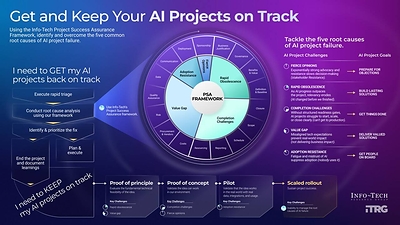
AI Project Setbacks Are Often Mistaken for Failure, Finds Info-Tech Research GroupAs organizations accelerate AI adoption under pressure to deliver measurable results, many struggle to determine whether AI initiatives are truly failing or simply encountering predictable obstacles. New insights from Info-Tech Research Group identify five root causes of AI project failure and provide a structured framework to help leaders identify challenges, determine whether recovery is possible, and keep future AI projects on track. The firm's blueprint, Get and Keep Your AI Projects on Track, equips IT leaders with practical tools and readiness assessments to improve AI project outcomes. ARLINGTON, Va., Aug. 17, 2026 /CNW/ -- Rising reports of AI project failure have intensified scrutiny around AI investments, making it increasingly difficult for IT leaders to determine whether struggling initiatives should continue, change course, or stop altogether. To help organizations navigate these decisions, Info-Tech Research Group has recently published its Get and Keep Your AI Projects on Track blueprint, which helps evaluate struggling initiatives and establish practices that support future AI project success.
According to Info-Tech's research, AI projects face a more intense set of challenges than traditional IT initiatives. While organizations often interpret project setbacks as signs of failure, many AI initiatives face predictable challenges tied to rapidly evolving technology, changing expectations, governance requirements, and adoption barriers. "Many of the obstacles organizations are encountering today are temporary growing pains rather than permanent barriers to AI success," says Jenn Aswald, research analyst at Info-Tech Research Group. "IT leaders need to understand which issues require intervention and which will diminish as AI capabilities, governance practices, and organizational experience mature." Key Challenges IT Leaders Face in AI Project Delivery
To address these challenges, the Get and Keep Your AI Projects on Track blueprint outlines a structured three-phase approach that helps organizations assess struggling initiatives, determine the best path forward, and keep future AI projects on track. Phase 1: Assess Current State. Evaluate project health, conduct rapid triage, and conduct a root cause analysis to identify the obstacles preventing project success. Phase 2: Diagnose, Decide, and Act. Prioritize obstacles, determine whether recovery is realistic, and build a roadmap that aligns resources to the most critical remediation efforts. Phase 3: Keep Future AI Projects on Track. Apply lessons learned, establish readiness checks, and implement practices that reduce the likelihood of future project failure while improving long-term outcomes. The firm's Get and Keep Your AI Projects on Track blueprint includes practical resources that help organizations assess struggling AI initiatives, capture lessons learned, and apply those insights to future projects. By using Info-Tech's approach, IT leaders can improve project relevance, strengthen business value realization, reduce unnecessary costs, and keep AI projects on track from initial concept through scaled rollout. For exclusive and timely commentary from Info-Tech's experts, including Jenn Aswald, and for access to the complete Get and Keep Your AI Projects on Track blueprint, please contact [email protected]. About Info-Tech Research Group To learn more about Info-Tech's HR research and advisory services, visit?McLean & Company, and for data-driven software buying insights and vendor evaluations, visit the firm's?SoftwareReviews?platform.? Media professionals can register for unrestricted access to research across IT, HR, and software, and hundreds of industry analysts through the firm's Media Insiders program. To gain access, contact?[email protected]. For information about Info-Tech Research Group or to access the latest research, visit?infotech.com?and connect via?LinkedIn?and?X.?
SOURCE Info-Tech Research Group 
|

 View original content to download multimedia: