
TMCnet News
CIOs Lack Financial Insight to Influence Risk Mitigation Investment, Finds Info-Tech Research GroupAs technology, geopolitical, and regulatory risks intensify, many organizations continue to rely on qualitative assessments that fail to quantify business impact. Findings from Info-Tech Research Group show that without financially grounded insight, CIOs, CISOs, and risk leaders cannot effectively prioritize mitigation efforts, justify spending, or communicate risk exposure in terms that executives and boards can act on. The firm's blueprint, Execute Data-Driven Risk Assessments, provides a structured methodology and practical tools to help organizations quantify risk and enable more informed, defensible decision-making. ARLINGTON, Va., Aug. 13, 2026 /CNW/ -- As boards and executives demand clearer justification for risk-related decisions, IT leaders are under increasing pressure to interpret risk impact in measurable business terms. However, many organizations remain constrained by traditional risk assessments that classify risks as high, medium, or low without defining their financial impact. According to new insights from Info-Tech Research Group, this gap limits organizations' ability to prioritize risk response, secure funding, and address their most critical threats. The firm's Execute Data-Driven Risk Assessments blueprint offers a structured approach to move from descriptive scoring to decision-grade, financially grounded risk insight.
Info-Tech's research highlights a disconnect between how risk is assessed and how decisions are made. While qualitative assessments are fast and widely used, they fail to answer the question executives care about most: what is the financial impact? Without that clarity, IT leaders struggle to justify mitigation spending, compare trade-offs, or align response with business priorities. At the same time, traditional quantitative methods are often too complex, data-intensive, and difficult to sustain, leaving organizations without a practical path forward. "Organizations are making decisions on their most severe risks without truly understanding their impact in financial terms," says Anubhav Sharma, principal research director at Info-Tech Research Group. "If risk cannot be expressed in financial terms, leaders cannot justify mitigation investments or influence board-level decisions." Why Traditional Risk Assessments Are Failing IT Leaders
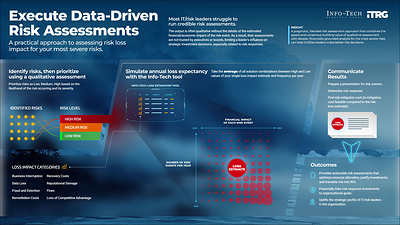
Info-Tech's Practical Approach to Data-Driven Risk Assessment Phase 1: Identify and Review Key Risks Phase 2: Conduct Qualitative Assessment of Risks Phase 3: Conduct Deeper Quantitative Financial Assessment Phase 4: Communicate Results and Evaluate Next Steps This structured approach helps organizations generate credible financial ranges and clearly communicate the drivers of risk exposure. By translating risk into financial terms, organizations can move beyond theoretical discussions and toward actionable decisions. The Execute Data-Driven Risk Assessments blueprint includes a storyboard, Risk Assessment Workbook, and Risk Owner Communication Deck to help organizations operationalize this approach. By applying these insights, organizations can strengthen credibility, secure funding, and make more defensible decisions to reduce exposure. For exclusive and timely commentary from Info-Tech's experts, including Anubhav Sharma and Carlene McCubbin, and access to the complete Execute Data-Driven Risk Assessments blueprint, please contact [email protected]. About Info-Tech Research Group To learn more about Info-Tech's HR research and advisory services, visit McLean & Company, and for data-driven software buying insights and vendor evaluations, visit the firm's SoftwareReviews platform. Media professionals can register for unrestricted access to research across IT, HR, and software, and hundreds of industry analysts through the firm's Media Insiders program. To gain access, contact [email protected]. For information about Info-Tech Research Group or to access the latest research, visit infotech.com and connect via LinkedIn and X.
SOURCE Info-Tech Research Group 
|

 View original content to download multimedia: