
TMCnet News
Application Replacement Fails Without Onboarding and Sunsetting Strategies, Finds Info-Tech Research GroupOrganizations often approach application replacement as a technical upgrade, but new findings from Info-Tech Research Group show it is a lifecycle challenge. Organizations that focus on deploying new systems without ensuring effective onboarding or fully retiring legacy applications limit value and increase risk. The firm's blueprint, Master Systematic Application Replacement With a Fit-for-Purpose Plan, outlines a structured methodology to address both sides of the transition. ARLINGTON, Va., July 15, 2026 /PRNewswire/ -- As organizations accelerate application replacement, many struggle to balance user needs, strategic goals, and operational realities. Recent insights from Info-Tech Research Group indicate that the successful onboarding of new applications and the retirement of legacy systems depend on preparing early, coordinating across teams, and managing transitions with full visibility into risks and dependencies.
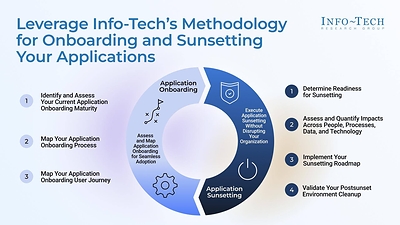
To address these challenges, Info-Tech's recently published Master Systematic Application Replacement With a Fit-for-Purpose Plan blueprint outlines a two-phase methodology designed to help CIOs and IT leaders navigate the full application lifecycle from onboarding to sunset. The firm's resource provides practical guidance for assessing onboarding maturity, aligning stakeholders, and mapping user journeys. The methodology also supports organizations in evaluating readiness for sunsetting, identifying risks and dependencies, and building a structured roadmap for the retirement of low-risk applications. "Application onboarding sets the tone for the entire lifecycle, shaping how users adopt, engage with, and ultimately realize value from a new system," says Jinit Shah, research analyst at Info-Tech Research Group. "By focusing on early outcomes and aligning cross-functional teams, organizations can accelerate time-to-value and improve long-term success." Info-Tech's Two-Phase Framework for Systematic Application Replacement The two-phase approach is designed to help IT and applications leaders: Phase 1: Assess and Map Application Onboarding for Seamless Adoption Phase 2: Plan and Execute Application Sunsetting Without Disruption The firm also emphasizes that without a clear approach to sunsetting, organizations risk disruption, data issues, and lingering dependencies that undermine transformation efforts. "Application sunsetting is more than just shutting down a system; it requires a controlled transition that protects data, maintains continuity, and minimizes risk," adds Shah. "By identifying dependencies early and validating readiness, organizations can avoid disruption and confidently move away from legacy systems." By applying Info-Tech's lifecycle approach, organizations can improve user adoption, reduce operational risk, and ensure legacy systems are retired without disruption. The blueprint equips IT leaders with practical tools and structured guidance, including onboarding maturity assessments, journey mapping frameworks, and application sunsetting workbooks, to align stakeholders, manage dependencies, and execute application replacement more effectively across the lifecycle. For exclusive and timely commentary from Info-Tech's experts, including Jinit Shah, and access to the complete Master Systematic Application Replacement With a Fit-for-Purpose Plan blueprint, please contact [email protected]. About Info-Tech Research Group To learn more about Info-Tech's HR research and advisory services, visit McLean & Company, and for data-driven software buying insights and vendor evaluations, visit the firm's SoftwareReviews platform. Media professionals can register for unrestricted access to research across IT, HR, and software, and hundreds of industry analysts through the firm's Media Insiders program. To gain access, contact [email protected]. For information about Info-Tech Research Group or to access the latest research, visit infotech.com and connect via LinkedIn and X.
SOURCE Info-Tech Research Group 
|

 View original content to download multimedia: