
TMCnet News
Couchbase Launches the AI Data Plane, the Operational Data Foundation for the Agentic EnterpriseUnified data layer from cloud to edge gives production AI agents the governed memory, context, and performance they need to remember, reason, and act on real-time context SAN JOSE, Calif., June 30, 2026 /PRNewswire/ -- Couchbase, The Operational Data Platform for AI™, today announced general availability of the AI Data Plane™, a unified data infrastructure layer for enterprise AI agents. The Couchbase AI Data Plane gives enterprises persistent agent memory, real-time context retrieval, and consistent data access from cloud to edge and into their lakehouse architectures. By collapsing the fragmented data services that have stalled agent deployments into a single, governed layer, enterprises can move from pilots to production-grade agents that deliver more consistent decisions, richer customer experiences, and measurable efficiency gains at scale.
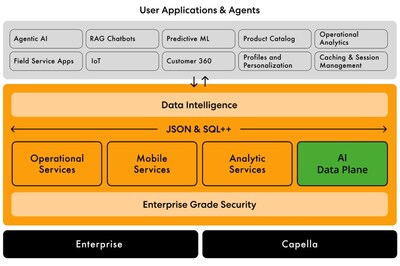
The AI Data Plane unifies Agent Memory, an Agent Catalog for discoverable agent tooling, and an enterprise-supported, self-managed MCP server for standardized integration of model-context protocols. It consolidates previous Couchbase deployment models into a single architecture that runs across Couchbase Capella and self-managed environments, and is complemented by new Enterprise Analytics 2.2 capabilities for Apache Iceberg-based lakehouse federation in addition to a Trino adapter (currently expected to launch in Q3 calendar 2026). The enterprise-supported platform is backed by Couchbase's engineering and support organization, eliminating point solutions and giving platform teams a single operational surface for the data services their agents depend on. "Most enterprises quickly discover that moving from chat-style pilots to production-grade agentic systems is really a data problem, not just a model problem," said Devin Pratt, Research Director, AI, Automation, Data & Analytics, IDC. "IDC expects that 80% of agentic AI use cases will require real-time, contextual, and widely accessible data, so the architecture has to support that. Approaches that make agent memory and context retrieval first-class capabilities of the database itself, like Couchbase's AI Data Plane, address this directly. By unifying vectors, documents, cache, and operational data in a single distributed platform, from cloud to edge, Couchbase reduces the integration tax that has been slowing down real-world agent deployments and gives organizations a more governable, scalable foundation for the next wave of AI-powered applications." Persistent Agent Memory CIOs shaping their AI infrastructure strategies need a unified data platform that governs memory, context, and retrieval across the full agent lifecycle – not another point solution to integrate and maintain. Couchbase Agent Memory delivers this by providing a unified persistence layer as a single service within the operational data platform instead of forcing teams to stitch together separate caching, vector, and document stores. Because it is framework-agnostic and validated with LangGraph, CrewAI, and LlamaIndex, engineering teams can switch or combine orchestration frameworks without rebuilding their memory layer. As enterprises move from prototypes to production agents, the gap between what agents can reason about and what they can remember across sessions has become a critical bottleneck. Simple agents can succeed with vector search, which Couchbase offers at billion scale, but production-grade agents require the ability to store conversational context, retrieve structured operational data, and maintain state across sessions and restarts, all with sub-millisecond latency at the point of decision. "What matters most for enterprise-grade conversational AI agents is that data retrieval is fast, consistent, and seamless. When you're running human-to-AI agent interactions, everything behind the scenes needs to be predictable and consistent to provide natural interaction," said Patrick Ferriter, SVP of Product at Agora. "That's what we're solving together with Couchbase, and it's why we chose them asa partner for the data layer for our conversational AI platform. Every one of our conversational AI use cases requires efficient data retrieval to feed the pipeline for AI agents, whether that's outbound sales, customer service, physical AI, or something entirely new. We've had a multi-year relationship with Couchbase, and as we've scaled into agentic workloads, this was a natural extension to our partnership." Built for Agentic AI at the Edge Throughput is equally critical, since agentic workloads can demand orders of magnitude more from the data layer than traditional applications do. Every agent action triggers context retrieval, memory writes, and state synchronization in rapid succession, often across thousands of concurrent sessions. The AI Data Plane is engineered for this scale, leveraging Couchbase's proven scale-out memory-first architecture, which already supports tens of millions of transactions per second with sub-millisecond latency for some of the world's most demanding enterprises. The AI Data Plane builds on Couchbase's distributed multi-model architecture, which supports JSON documents, key-value, SQL for JSON queries, full-text search, eventing, and vector search in a single distributed system. Agent Memory extends this foundation with session persistence and context retrieval, while the MCP server and Agent Catalog provide the integration and observability layers required for production agent deployments. Enterprise Analytics 2.2: Lakehouse Federation with Iceberg and Trino Core analytics enhancements include Google Cloud Storage support, JWT authentication, Oracle and SQL Server change data capture, asynchronous long-running queries, an index advisor, index-only query plans, SQL++ UPDATE support, and corresponding SDK updates across Java, .NET, Python, JavaScript, and Go. These enhancements give platform teams faster, more governed analytics across their existing tools and languages, so they can build and optimize AI and data workloads without adding infrastructure complexity. A new Trino adapter, expected in Q3, will provide in-place SQL access to Couchbase operational data from Trino-based platforms including AWS Athena, Amazon EMR, Google Dataproc, and Starburst. This eliminates the need for enterprises to extract and replicate live data into separate analytical stores before querying when building AI and analytics workflows that span operational and lakehouse environments. Capella iQ Enhancements Edge, Mobile, and Distributed Application Updates New innovations include:
"The database layer is where agentic AI either scales or stalls, and most of the industry is still treating agent memory as an afterthought," said Barry Morris, Chief Product and Strategy Officer at Couchbase. "We built the AI Data Plane because our customers told us that stitching together separate vector, caching, and document stores for every agent was the single biggest drag on their production timelines. Agent Memory gives them a unified, framework-agnostic persistence layer that operates identically in cloud and self-managed environments from cloud to edge, and runs at the latency their agents actually need. That's what it takes to move from pilot to production—and the vendors who understand this will define the infrastructure category for the next decade of AI." Availability All products listed above are available immediately, with the exception of the Trino adapter, coming in Q3. Pricing and packaging details are available at www.couchbase.com/pricing. Additional resources: About Couchbase Couchbase®, the Couchbase logo, and the names and marks associated with Couchbase's products are trademarks of Couchbase, Inc. All other trademarks are the property of their respective owners.
SOURCE Couchbase, Inc. 
|

 View original content to download multimedia: