
TMCnet News
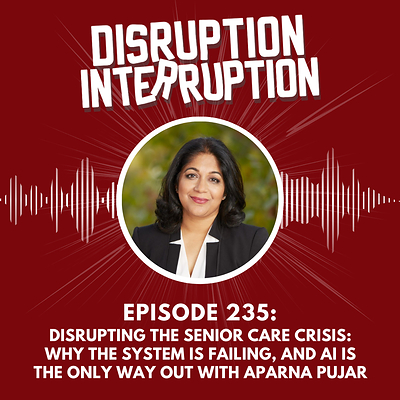
Disrupting Caregiving: Why Passive AI May Be the Only Scalable Way to Age at HomeEven though roughly 80% of older adults live at home, care planning often begins only after a fall, hospitalization, or cognitive scare forces the family to act. Aparna Pujar, CEO and founder of Zemplee, argues that the problem is not just cost, it is a system still built around episodic intervention instead of continuous support. TAMPA BAY, Fla., June 24, 2026 /PRNewswire/ -- Growing old at home should not require a crisis to prove someone needs help. Among older adults, falls are already a massive and growing crisis: in the U.S., more than 14 million adults 65 and older (about 1 in 4) report falling each year, and the fall death rate for this age group has risen 21% since 2018. On this episode of Disruption Interruption, host Karla Jo Helms (KJ) speaks with Aparna Pujar, CEO and founder of Zemplee, about why the senior care industry is still reacting too late, why families are left to learn caregiving in real time, and how passive, AI-powered monitoring may be the only scalable path forward. As Pujar puts it, "most often, determining their care needs comes very late in the game, and it's a very expensive delay."
Why Senior Care Still Starts Too Late For Pujar, the real failure sits where most older adults actually live: at home. About 20% of seniors live in institutional settings, while the remaining 80% live independently or with family, often without meaningful proactive support. The problem, she argues, is that families usually do not start planning until something serious happens. By the time a fall, hospitalization, or other acute event forces the issue, families are no longer planning calmly. They are reacting under pressure, often with little preparation and even less visibility. The emotional structure of caregiving makes the system even harder to navigate. Parents often hide decline because they do not want to burden their children, while adult children are forced to improvise under pressure. "Parents don't tell you," Pujar says. "Half the time, if you ask them, they'll always say, 'Oh, I'm doing fine.'" The result is a care system that often begins with confusion, guilt, and guesswork instead of preparation. Pujar's point is that this is no longer a niche family problem, but a broad social and economic one. The world is aging faster than most care systems are adapting. According to the World Health Organization, people aged 60 and older already outnumber children under 5 globally, and by 2030, one in six people in the world will be 60 or older. By 2050, the global population over 60 is expected to reach 2.1 billion. In that context, episodic care does not stay contained within one household. It spills into hospital systems, workplaces, and families already trying to absorb the cost, time, and emotional strain of aging. Pujar frames it plainly, "It not only affects everybody, it affects everybody intergenerationally." Passive Care Before the Crisis Zemplee is Pujar's answer to that delay. Inspired by her own experience as a remote caregiver for her parents in India while working at eBay, she built the company around the idea that support should happen in the background of everyday life, not only after something goes wrong. The model uses passive sensors and AI to detect patterns in movement, routines, nutrition, and activity inside the home without requiring the older adult to learn new technology or change behavior just to be monitored. "We are trying to not increase the cognitive load for them," Pujar says. "It's all passive." That is what Pujar means when she calls the technology "lifestyle integrated." Instead of asking older adults to constantly report symptoms or adapt to a new interface, the system quietly observes routine activities and monitors any subtle signs of decline, such as falls, cognitive changes, or chronic-condition flare-ups. Her goal is not to make the home feel clinical. It is to turn it into what she describes as a "fully equipped, digital, caring platform" that helps preserve dignity, independence, and safety for as long as possible. That is the disruption at the center of her argument: stop waiting for the fall, hospitalization, or panic call, and start building a care system that reaches people earlier, more quietly, and far more humanely. Pujar's larger point is that aging should not be treated as an afterthought or a crisis category. It is a universal life stage, and the systems around it should be designed with that reality in mind. In her words, "Everybody's gonna get old, so we have to design our future. If I'm going to be a part of this system 20 years from now, how do I want that to work for me?" Links Disrupting the Senior Care Crisis: Why the System is Failing, and AI is the Only Way Out with Aparna Pujar Disruption Interruption is the podcast where you will hear from today's biggest Industry Disruptors. Learn what motivated them to bring about innovation and how they overcame opposition to adoption. LinkedIn: https://www.linkedin.com/in/aparnapujar/ About Disruption Interruption™ About Aparna Pujar About Karla Jo Helms References
Media Inquiries:
SOURCE Disruption Interruption 
|
 View original content to download multimedia: