
TMCnet News
Feinstein Institutes' Elmezzi Graduate School Honors Next Generation of Researchers at Commencement CeremonyBridging the critical gap from lab bench to patient bedside, the Elmezzi Graduate School of Molecular Medicine at Northwell Health's Feinstein Institutes for Medical Research celebrated its newest physician-scientist graduates trained to bringing scientific discovery into life-changing therapies. A commencement ceremony was held on May 21 at the Feinstein Institutes where Alexandra Bekiaridou, MD, PhD, and Russell Hollis, MD, PhD, received their PhD degrees, and Cori Bargmann, PhD, and Tak W. Mak, PhD, received honorary degrees. This press release features multimedia. View the full release here: https://www.businesswire.com/news/home/20260604919422/en/ 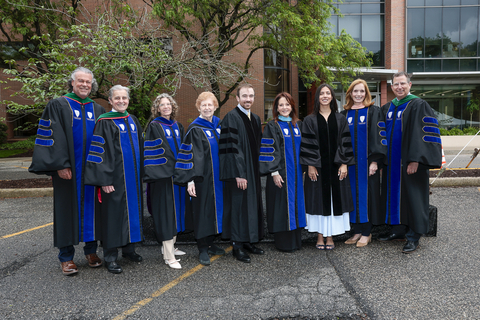
A commencement ceremony was held on May 21 at the Feinstein Institutes where Alexandra Bekiaridou, MD, PhD, and Russell Hollis, MD, PhD, (center) received their PhD degrees. (Credit: Feinstein Institutes) The Elmezzi Graduate School is a PhD program for physicians seeking careers in biomedical research. Elmezzi students conduct research in Feinstein Institutes laboratories to develop new biomedical knowledge, therapeutic approaches and diagnostic tools. The Elmezzi Graduate School of Molecular Medicine is supported, in part, through a generous endowment from The Thomas and Jeanne Elmezzi Foundation. "This year's Elmezzi commencement is a testament to the Feinstein Institutes' dedication to producing knowledge to cure disease," said Bettie M. Steinberg, PhD, interim dean of the Elmezzi Graduate School of Molecular Medicine and professor in the Feinstein Institutes' Institute of Molecular Medicine. "Our graduates represent the vital next generation of scientists, positioned to transform groundbreaking discoveries from the lab into tangible, life-changing therapies for patients." Dr. Bekiaridou's research under Stavros Zanos, MD, PhD, associate professor in the Institute of Bioelectronic Medicine at the Feinstein Institutes, focused on the intricate relationship between the spleen and its innervation in regulating immune cell programming during Pulmonary Arterial Hypertension (PAH). Dr. Bekiaridou's findings, which demonstrated how splenic norepinephrine can influence the migration of myeloid cells from the spleen to the lung in the diseases and offers insights that could support the development of novel treatments targeting inflammation in PAH. Fellow graduate Dr. Hollis - whose research under Ping Wang, MD, chief scientific officer at the Feinstein Institutes, and Monowar Aziz, PhD, associate professor in the Institute of Molecular Medicine at the Feinstein Institutes - investigated new treatments for mesenteric ischemia, a deadly disease in which the small intestine's blood supply is cut off. Dr. Hollis analyzed how the peptide MOP3, developed in Dr. Wang's lab, prevents overactivation of the immune system when toxins from the injured intestine are released. MOP3 scavenges these toxins, namely eCIRP, and helps convert macrophages to anti-inflammatory immune cells. This process limits the damage to vital organs and promotes recovery. "Throughout the history of medicine, physician-scientists have fueled new innovations and discoveries that are essential for a healthier world," said Kevin J. Tracey, MD, president and CEO of Feinstein Institutes and Karches Family Distinguished Chair in Medical Research. "Our Elmezzi graduates are prepared to lead the development of breakthrough therapies and diagnostics." The two honorary degrees recipients were Dr. Bargmann, the Torsten N. Wiesel professor and head of the Lulu and Anthony Wang Laboratory of Neural Circuits and Behavior at The Rockefeller University, and Dr. Mak, the senior scientific staff at the Ontario Cancer Institute and professor in the Departments of Medical Biophysics & Immunology University of Toronto, Ontario. Dr. Bargmann was recognized for her groundbreaking work on the relationships between genes, neural circuits and behaviors, particularly her insights into sensory recognition and innate behaviors. Dr. Mak was recognized for his pioneering discoveries in the genetics and molecular biology of cancer and the immune system, including cloning the human TCRß chain (foundational for CAR-T therapy) and identifying CTLA4's role in T cell regulation (paving the way for checkpoint inhibitor immunotherapies). Dr. Mak was also recognized for his entrepreneurial impact, including co-founding companies that have developed FDA-approved cancer treatments. To find out more about the Elmezzi Graduate School of Molecular Medicine and its programs click here.
About The Elmezzi Graduate School of Molecular Medicine
About the Feinstein Institutes
View source version on businesswire.com: https://www.businesswire.com/news/home/20260604919422/en/ |
