
TMCnet News
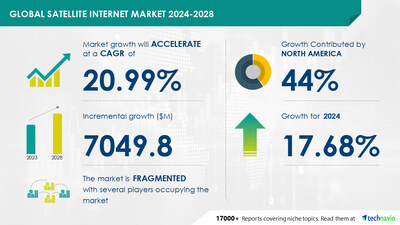
Satellite Internet Market size is set to grow by USD 7.04 billion from 2024-2028, Growing number of iot devices to boost the market growth, TechnavioNEW YORK, July 26, 2024 /PRNewswire/ -- The global satellite internet market size is estimated to grow by USD 7.04 billion from 2024-2028, according to Technavio. The market is estimated to grow at a CAGR of 20.99% during the forecast period. Growing number of iot devices is driving market growth, with a trend towards increasing deployment of 5G network. However, influence of bad weather on satellite internet poses a challenge. Key market players include ASELSAN AS, AT and T Inc., AXESS Network Solutions S.L., Cobham Ltd., EchoStar Corp., General Dynamics Corp., Honeywell International Inc., Hytera Communications Corp. Ltd., Indra Sistemas SA, Inmarsat Global Ltd., Israel Aerospace Industries Ltd., L3Harris Technologies Inc., Leonardo Spa, Marlink SAS, RTX Corp., SES SA, Singapore Telecommunications Ltd., SITA, Space Exploration Technologies Corp., Thaicom Public Co. Ltd., Thales Group, and Viasat Inc..
Get a detailed analysis on regions, market segments, customer landscape, and companies - Click for the snapshot of this report
Key Market Trends Fueling Growth Telecommunication service providers and network device manufacturers are exhibiting growing interest in deploying 5G networks due to their larger bandwidth and ultra-fast Internet connectivity with low latency. These features will significantly enhance enterprise performance. However, satellite internet can complement 5G by providing backhaul services in areas where physical infrastructure installation is challenging. The increasing traffic and number of IoT devices outside densely populated cities also make satellite internet essential. These factors are expected to boost the global satellite internet market during the forecast period. The 5G network's superior capabilities and satellite internet's ability to extend connectivity to remote areas will drive market growth. Satellite Internet market is on the rise, providing connection to remote places and rural areas where terrestrial networks fail. With speeds reaching Megabits per second, satellite communication offers high-speed broadband services in mountainous regions and over oceans. This global connectivity is crucial for digitized economies, public safety & security, and critical infrastructure. Healthcare organizations in remote areas benefit from telemedicine, enabling seamless communication between hospitals and patients. Broadband traffic is increasing, making satellite Internet an essential alternative for communities in need. Satellite telecommunications providers ensure seamless connectivity for maritime, aviation, and disaster management scenarios. The satellite industry bridges the digital divide, delivering broadband networks to areas previously unserved or underserved. Discover 360° analysis of this market. For complete information, schedule your consultation- Book Here! Market Challenges
For more insights on driver and challenges - Download a Sample Report Segment Overview This satellite internet market report extensively covers market segmentation by
1.1 K-band- The K-band segment holds a significant market share in the global satellite internet industry. This growth can be attributed to the increasing usage of K-band frequency in defense, broadcasting, and security radar systems. K-band monolithic microwave integrated circuits (MMICs) are a rising trend, enabling the production of low-noise amplifiers and K-band power amplifiers at large scale, with lower costs and high durability. These advancements are anticipated to boost the market expansion during the forecast period. K-band frequency is primarily utilized for wireless broadband access in remote locations and is employed in local-multipoint distribution systems (LMDS), fixed satellites, and digital point-to-point radio services. K-band MMICs are increasingly adopted in applications such as terrestrial microwaves, broadcasting, communications, and speed detectors. For instance, China Aerospace Science and Technology Corporation (CASC) launched Chinasat 19, a high-power communications satellite, in November 2022, which utilizes K-band frequency for broadband internet services. Additionally, Viasat delivered 22 Ka-band gateways to India between October 2020 and October 2022, facilitating connectivity in underserved areas during the COVID-19 pandemic. These factors are expected to fuel the growth of the K-band segment in the global satellite internet market. For more information on market segmentation with geographical analysis including forecast (2024-2028) and historic data (2018 - 2022) - Download a Sample Report Learn and explore more about Technavio's in-depth research reports The global Low-Cost Satellite Market is witnessing significant growth, driven by advancements in technology and increasing demand for cost-effective space solutions. The Leo-Satellite Market is expanding rapidly, with low Earth orbit satellites gaining prominence for their ability to provide global internet coverage and real-time data. Additionally, the Satellite Phone Market is evolving, fueled by the need for reliable communication in remote areas. Together, these markets highlight a trend towards more affordable and accessible space technologies, promising enhanced connectivity and communication capabilities worldwide. Research Analysis Satellite Internet, a vital component of satellite communication, offers global connectivity with high-speed capabilities, bridging the digital divide in remote areas. Space technology enables this service, providing uninterrupted communication networks in regions where terrestrial infrastructure is lacking. With increasing bandwidth capabilities, satellite Internet is becoming a viable alternative for businesses and individuals in various sectors, including education, healthcare, and economic development. OneWeb and Eutelsat's merger are recent developments in the industry, focusing on expanding their reach and improving network management systems. However, challenges such as congestion, natural disasters, and infrastructure limitations persist. International coordination and collaboration are essential to ensure efficient use of resources and mitigate potential issues. Additionally, satellite Internet plays a crucial role in Marine connectivity, enhancing communication capabilities and social inclusion. The industry continues to evolve, with satellite operators exploring new Orbits, such as Low Earth Orbit (LEO), to improve performance and reduce latency. Market Research Overview Satellite Internet refers to high-speed connection networks that utilize satellite communication for global connectivity. This technology provides seamless communication in remote locations, maritime, and aviation industries, as well as during disaster management and emergency response scenarios. Satellite technology advancements, such as high-capacity satellite constellations, have increased bandwidth capabilities, enabling real-time digital services. However, satellite infrastructure faces challenges, including cost, infrastructure limitations, and congestion. Satellite Internet is crucial for bridging the digital divide in rural areas and mountainous regions, offering alternatives to terrestrial networks like cable and DSL. With the advent of OneWeb, Eutelsat merger, and other satellite operators, satellite capacity is expanding, leading to improved user experience and increased internet speeds. Satellite technology is essential for various sectors, including education, healthcare services, economic development, and social inclusion. It enables up-to-date information transfer, real-time communication, and critical infrastructure protection. Satellite Internet is also vital for public safety & security, broadband networks, and businesses operating in oceans, mountains, and remote places. Satellite infrastructure development requires international coordination, investors, funders, integrators, and service providers. The integration of wireless networks, such as LEO (Low Earth Orbit) and GEO (Geostationary Earth Orbit), is crucial for providing high-speed network connectivity to meet the demands of the digitized economy. Satellite Internet offers significant benefits, including improved communication capabilities, increased social inclusion, and equality. However, it faces challenges, such as bandwidth limitations, satellite infrastructure costs, and natural disasters. Despite these challenges, satellite technology continues to advance, offering promising solutions for providing internet access to underserved areas and industries. Table of Contents: 1 Executive Summary
7 Customer Landscape About Technavio Technavio is a leading global technology research and advisory company. Their research and analysis focuses on emerging market trends and provides actionable insights to help businesses identify market opportunities and develop effective strategies to optimize their market positions. With over 500 specialized analysts, Technavio's report library consists of more than 17,000 reports and counting, covering 800 technologies, spanning across 50 countries. Their client base consists of enterprises of all sizes, including more than 100 Fortune 500 companies. This growing client base relies on Technavio's comprehensive coverage, extensive research, and actionable market insights to identify opportunities in existing and potential markets and assess their competitive positions within changing market scenarios. Contacts Technavio Research
SOURCE Technavio 
|
 View original content to download multimedia: