
TMCnet News
Toshiba's Breakthrough Algorithm Harnesses Edge of Chaos to Dramatically Boost Performance of its Quantum-Inspired ComputerToshiba Corporation has developed a breakthrough algorithm that dramatically boosts the performance of the Simulated Bifurcation Machine (SBM), its proprietary quantum-inspired combinatorial optimization computer. The new algorithm significantly improves the probability of obtaining an optimal solution or a known best solution within a limited number of trials-referred to as the success probability, a key benchmark for evaluating combinatorial optimization technologies. This press release features multimedia. View the full release here: https://www.businesswire.com/news/home/20260407918434/en/ 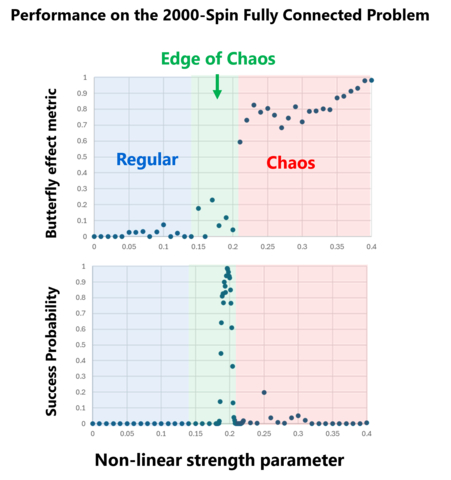
Figure 1: Results demonstrating that the newly developed third-generation SB algorithm can find the known best solution with nearly 100% probability at the edge of chaos for a fully connected 2,000-spin Ising problem. The SBM is designed to solve large-scale combinatorial optimization problems in a wide range of fields, including new drug discovery, delivery route optimization, and investment portfolio design. While previous algorithms could find optimal or known best solutions with a sufficiently large number of trials, large-scale problems often trapped the search process in local optima, significantly lowering success probability under practical constraints that limit the number of trials. Toshiba has overcome this challenge by developing a third-generation simulated bifurcation (SB) algorithm. This ground-breaking advance builds on the original SB algorithm, announced in April 2019*1, and the second-generation SB algorithm, released in February 2021*2, which delivered major boosts to computational speed and accuracy. The new algorithm expands the bifurcation parameter that triggers the bifurcation phenomena*3-a defining feature of the SB algorithm-from a single global parameter to individual parameters assigned to each posiion variable*4. These bifurcation parameters are independently controlled according to the values of the corresponding position variables, enabling a more adaptive and effective solution search. With the introduction of this advanced control mechanism, the algorithm exhibits either regular or chaotic behavior*5, depending on conditions. Crucially, Toshiba discovered that by effectively harnessing chaos at the edge of chaos-the boundary between regular dynamics and chaotic motion-the algorithm can escape local optima far more efficiently. As a result, the success probability of reaching the global optimum increases dramatically, approaching 100%. The SBM based on the new algorithm is therefore much faster. It delivers a time to solution (TTS) required to obtain an optimal or known best solution that is approximately 100 times faster than the SBM based on the second-generation algorithm. These advances are expected to accelerate the practical applications of combinatorial optimization across a broad range of challenges. The research results were published in the April 6, 2026 issue of Physical Review Applied, a peer-reviewed journal of the American Physical Society*6.
Note:
About Toshiba
View source version on businesswire.com: https://www.businesswire.com/news/home/20260407918434/en/ |
