
TMCnet News
The cost of ambition: new research finds almost 90 per cent of women worldwide are penalized and undermined because of their achievements at workThe Tallest Poppy™, an international study led by Women of Influence+, TORONTO, March 1, 2023 /PRNewswire/ - Women of Influence+, a leading global organization committed to advancing gender equity in the workplace, today released its groundbreaking findings from The Tallest Poppy 2023 study. The first international research project of its kind, The Tallest Poppy uncovers the consequences of Tall Poppy Syndrome and the impact it has on women in the workplace worldwide. Tall Poppy Syndrome occurs when people are attacked, resented, disliked, criticized, or cut down because of their achievements and/or success.
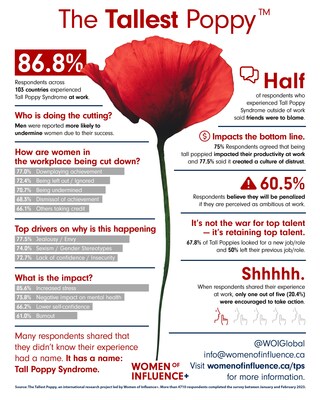
The Tallest Poppy study reveals that women who are successful are being bullied and belittled, challenged on their successes, and made to feel as though it's not their place to take up so much space. According to the study's findings, almost 90 per cent (86.8 per cent) of respondents experienced this phenomenon at work. The study heard from thousands of working women from all demographics and professions in 103 countries to determine how their mental health, well-being, engagement, and performance are affected by interactions with their clients, colleagues, and leaders surrounding their success and accomplishments. The Tallest Poppy reveals that women who are successful are being bullied and belittled, challenged on their successes, and made to feel as though it's not their place to take up so much space. "Our data tells an eye-opening story about how Tall Poppy Syndrome negatively impacts ambitious, high-performing women, and what this means for organizations," said Dr. Rumeet Billan, CEO, Women of Influence+ and author of the study. "When reading through stories about personal experiences from respondents, we noted a recurring theme: those who had, or are, experiencing Tall Poppy Syndrome did not know these phenomena had a name. Not only does our data reveal the negative effects of being cut down because of one's achievements, it helps us understand how the cutting is being done, who is most likely to do the cutting, and most importantly, legitimizes the experiences of women who, in many cases, have experienced this throughout their careers." Cutting down Tall Poppies: who is holding the shears? The Tallest Poppy study found that men in leadership positions1 were more likely to penalize or undermine women due to their success. Women, on the other hand, were more likely to cut down peers or colleagues. The act of "cutting" someone down because of their achievements or success manifests in the workplace in a number of different ways. Any or all of these actions are a form of "cutting" and contribute to Tall Poppy Syndrome:
Additional ways people experience Tall Poppy Syndrome include: belittling, being silenced, disparaging comments, and microaggressions.
Other effects include feelings of isolation and burnout, and the lack of desire to share or celebrate one's success or accomplishments. This phenomenon has a direct impact on productivity and, if not dealt with, can damage an organization's culture. According to the study, top talent will burnout, check out, and ultimately leave. "Organizations often talk about the 'war for top talent,' when instead, there should be a focus on retaining top talent," said Dr. Billan. "As a result of Tall Poppy Syndrome, high-performers are minimizing their skills and accomplishments, 60.5 per cent of those who responded to our survey believe they will be penalized if they are perceived as ambitious at work. When ambitious workers find themselves in an environment where excelling is penalized, their productivity will be impacted, and they will have one foot out the door. This not only negatively impacts the individual, but the organization as well."
When the goal is productivity and the impact is the bottom line, understandably, no organization would want to allow Tall Poppy Syndrome to continue in their place of work. What can organizations do to counter Tall Poppy Syndrome? "I really don't know," one said. "I wish I knew." Others added: "I honestly have no idea," "I wish I had an answer for you." But, many others offered up well-thought-out solutions. The responses came in loud and clear. Women are calling for change and accountability. Raise awareness – this phenomenon has a name: Tall Poppy Syndrome Hold people accountable Set a standard of transparency Adopt zero tolerance Invest in training for all employees and celebrate wins The Tallest Poppy study demonstrates that Tall Poppy Syndrome is an issue impacting women in the workplace across countries, organizations, industries, and sectors. No organization or individual is completely immune to it. During a time when women are burned out, stressed out, and fed up, organizations can no longer afford to drag their feet or turn the other way. For more information, to download Women of Influence+'s The Tallest Poppy white paper, or to view the infographic, visit: www.womenofinfluence.ca/tps
We measure influence by impact — the ripples that are made, the doors that are opened, the number of seats that are added to the proverbial decision-making table. Influence is about how decisions, innovations, and systems create a more inclusive and equitable world for everyone. At WOI+, we are unafraid to shake the status quo to transform society's expectations of our capabilities. We are dedicated to sharing and elevating the unfiltered success stories of a diverse group of role models. We know that when done right — from the podium or the page — these stories not only inspire, educate, and connect — they start to redefine our perceptions of gender roles and abilities. We are changing the narrative. The result? Our community is equipped with the connections, support, training, and tools to carve new pathways, and excel within their careers on their own terms. Follow us: Instagram @woiglobal | LinkedIn @woiglobal | Facebook @woiglobal | Twitter @woiglobal
SOURCE Women of Influence+! 
|

 View original content to download multimedia: