
TMCnet News
Azul Addresses the Java Runtime Security Blind Spot Autonomous AI Can Now ExploitAzul, the trusted leader in enterprise Java for today's AI and cloud-first world, today launched a free JVM vulnerability risk assessment to address the blind spot that autonomous AI exploitation tools are increasingly able to find. With mean time to exploit (MTTE) collapsing from months to days or hours, the unmanaged Java estate has become an urgent enterprise security vulnerability. Azul's assessment gives DevOps and SecOps teams complete visibility into the hidden risks embedded in the runtime of their Java estate before threat actors get there first, and is designed to complement the broader security, licensing and compliance solutions and services delivered by Azul's trusted partners. This press release features multimedia. View the full release here: https://www.businesswire.com/news/home/20260617352753/en/ 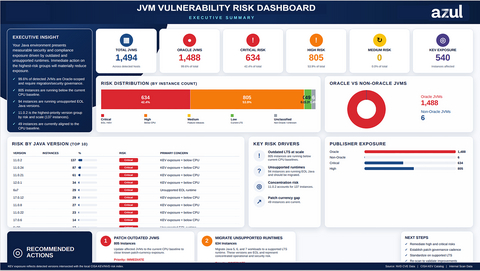
Azul's JVM Vulnerability Risk Assessment dashboard. The Threat Landscape Has Transformed For most of Java's enterprise history, a sophisticated exploit required a sophisticated attacker. Zero-day discovery and weaponization were largely the domain of nation-states and elite offensive security teams. The barrier was expertise - deep JVM knowledge, reverse engineering and months of painstaking technical effort. That barrier has collapsed. Anthropic's Claude Mythos demonstrates that AI can autonomously uncover previously unknown vulnerabilities and generate working exploit paths at scale - without human expertise. What once required deep, specialized expertise can now be accomplished with little more than an advanced AI model and an API key. The result is an expanding population of potential attackers. MTTE - once measured in months - can now collapse to days or hours. Meanwhile, most enterprises still patch non-critical Common Vulnerabilities and Exposures (CVEs) on a "best effort" basis, leaving extended windows of exposure between vulnerability disclosure and remediation. For large, complex Java estates with legacy versions in production, embedded or unmanaged JVMs and incomplete runtime visibility, that gap is a critical security and compliance liability. The JVM Vulnerability Risk Assessment - See Everything, Prioritize What Matters Azul's JVM vulnerability risk assessment is available at no cost, direct from Azul and via select Azul partners. In a single engagement, organizations receive:
The assessment is purpose-built for the risk environment AI-driven attackers have created: one in which the gap between assumed security posture and actual security posture is measured not in audit findings, but in active exploits. Why Security Patch Velocity is the Frontline Defense Java's quarterly updates are the primary mechanism by which known vulnerabilities are remediated. But in an environment where autonomous AI systems continuously discover new vulnerabilities or chain together previously known CVEs into exploits, the pace of standard patch deployment is no longer sufficient on its own. Azul's enterprise Java platform addresses this challenge through a multi-layered approach designed for large, complex Java estates:
The zero-day problem remains the hardest frontier. No scanner, SIEM (Security Information and Event Management), or EDR (Endpoint Detection and Response) platform can detect a vulnerability that has not yet been disclosed. Against unknown exposure, organizations maintaining a fully current Java estate are materially harder to exploit as they continuously remove outdated runtimes and previously exposed attack surfaces from production, minimizing the footprint that agentic AI exploits can target. Elevated Stakes for Regulated Enterprises Organizations in financial services, healthcare, utilities and government face a compounding challenge. They operate some of the largest and most complex Java estates in existence, and they face the strictest regulatory obligations. Frameworks including PCI-DSS, SOX, HIPAA, DORA, NERC CIP and FedRAMP all require demonstrable visibility into deployed software versions, timely vulnerability remediation and documented patch history. Autonomous AI exploitation tools do not distinguish between regulated and unregulated targets. But the consequences of a breach in a regulated environment - and the burden of demonstrating adequate security posture to auditors - make estate visibility and rapid CPU deployment not merely a best practice but a compliance requirement. "Anthropic's Mythos has shown that AI can now discover and weaponize vulnerabilities on its own - including flaws that survived decades of human review. That's the real lesson for every CISO: the deep expertise that used to stand between attackers and your software estate is no longer a barrier," said Scott Sellers, co-founder and CEO of Azul. "The unpatched JVM is already a growing liability, not a future one. Azul's JVM vulnerability risk assessment was created to help security leaders find and close that exposure before AI-driven attackers can exploit it." Azul's JVM vulnerability risk assessment maps JVM exposure, KEV risk and patch gaps across the entire enterprise Java estate and delivers a concrete remediation roadmap to close them. The assessment can be utilized as a standalone vulnerability analysis specific to a Java runtime estate or can be augmented into existing security, licensing and compliance solutions and services offered by Azul partners. To understand your organization's exposure, request a free JVM vulnerability risk assessment today. FAQs
How do I find unmanaged or embedded JVMs across my enterprise Java estate?
How do I know which Java versions in my environment are the highest security risk?
What's the best way to reduce the attack surface autonomous AI tools can exploit in my Java environment?
Why are Critical Patch Updates (CPUs) important?
Why are unpatched Java environments a growing security liability?
About Azul Azul is the trusted leader in enterprise Java for today's AI and cloud-first world. Its open source-based Java platform empowers organizations to optimize the entire Java lifecycle to accelerate performance, strengthen security, reduce licensing and cloud costs, and boost developer productivity. Azul powers mission-critical systems for 36% of the Fortune 100, 50% of the Forbes Top 10 World's Most Valuable Brands, and the world's top 10 financial trading companies. Learn more at azul.com and follow @azulsystems.?
View source version on businesswire.com: https://www.businesswire.com/news/home/20260617352753/en/ |
