
TMCnet News
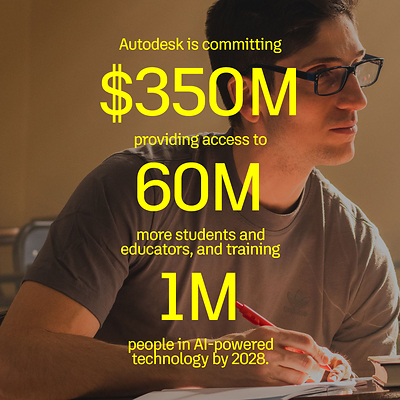
Autodesk commits $350 million to prepare the next generation for the AI jobs that design and make the physical worldNew research finds AI is increasing demand for the people who design, build, manufacture, and create the physical world – and inspiring more young people to pursue those careers. Autodesk's three-year commitment will give 60 million more students and educators free access to Autodesk's professional tools, train nearly one million in AI-powered workflows, and help more than 200,000 people earn industry-recognized certifications. SAN FRANCISCO, June 22, 2026 /PRNewswire/ -- As the Class of 2026 enters one of the toughest job markets for new graduates in years,* new research from Autodesk points to an unexpected shift: AI is pulling the next generation toward hands-on, physical-world work.
To help prepare students and today's workforce for these opportunities, Autodesk has made a $350 million commitment over the next three years to provide free technology access, training, and certifications for the AI-powered jobs that design and make the physical world: the architects, engineers, construction professionals, product designers, manufacturing professionals, creatives, and skilled tradespeople with technical expertise behind everything that's built. These industries employ nearly 300 million professionals** worldwide and are projected to represent $30 trillion in global economic value by 2027.*** "AI is raising the floor for everyone, but it is human ingenuity that will vault the ceiling," said Dara Treseder, Chief Marketing Officer at Autodesk. "That is why access matters. The next generation already has the curiosity, creativity, and ambition to solve real problems. What too many young people still lack are the professional tools, training, and experiences that help turn that potential into a career. Preparing them for the future we're building is a responsibility we all share, and one Autodesk is proud to help lead." A $350 million commitment to the future workforce By the end of 2028, Autodesk will:
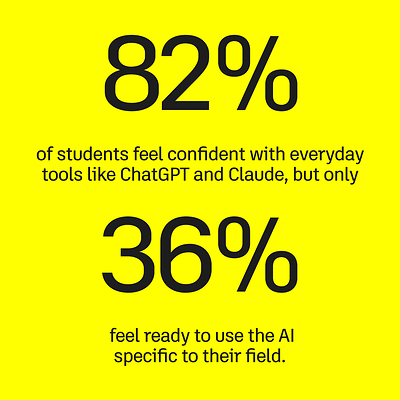
The readiness gap behind this investment The commitment responds to findings from Autodesk's second annual AI Jobs Report, also released today. Students have the instinct but not the preparation: 82% are confident using everyday AI tools like ChatGPT and Claude, but only 36% feel confident with the AI specific to their future careers, and nearly two in three say they know only the basics, not the technology that could set them apart. Most are closing the gap alone — 80% are teaching themselves job-relevant skills online, while fewer than one in five build them through internships or real-world experience. Demand is moving fast in the other direction. AI job listings across architecture, engineering, construction, manufacturing, and design have grown nearly two and a half times in two years, and the fastest-growing roles are creative, not purely technical: design is now the most in-demand skill in AI hiring, and human skills like communication and leadership both rank ahead of coding. This lands as no surprise to the 56% of college students who say they aren't sure they're learning the right AI skills to land a job after graduation. AI is pulling the next generation toward the physical world The research also overturns a common assumption. Rather than steering young people toward screens, AI is deepening their pull toward the physical world. More than 66% of students say they want careers where they make things or work with their hands – up six points from 2024 – and when asked which work feels more appealing as AI reshapes the workforce, students choose the physical world over digital by more than two to one. Among working professionals, the margin is more than four to one. That instinct is the engine of the Design and Make industries and the reason Autodesk is investing to meet it. Read more about Autodesk's education efforts here. *Federal Reserve Bank of New York, The Labor Market for Recent College Graduates Methodology of Autodesk's 2026 AI Jobs Report GlobalData used its proprietary Job Analytics platform to track daily job postings from companies globally. It also used its advanced platform to analyze job postings on company career pages and other trusted sources. All data is anonymized and does not include private or individual recruiter listings. About the results: The data spans three rolling 12-month periods measured from May to April: the 2024 cycle includes postings from May 2023 through April 2024 (1.289 million job listings), the 2025 cycle includes postings from May 2024 through April 2025 (1.488 million job listings), and the 2026 cycle includes postings from May 2025 through April 2026 (1.463 million job listings). These totals include both AI-related and general job listings. "AI-related" roles are defined as those where artificial intelligence is a major component of the position or its primary function—beyond surface-level mentions or general familiarity. This includes roles explicitly centered around AI use, implementation, oversight, and application. GlobalData also surveyed more than 1,000 students ages 14 to 23 across U.S. high school, university, community college, and vocational/trade schools, as well as more than 500 Design and Make professionals in May 2026.
SOURCE Autodesk, Inc. 
|

 View original content to download multimedia: