TMCnet News
AI Efficiency Layer Cuts Energy Use and Expands Server Capacity on Existing HardwarePALO ALTO, Calif., Aug. 01, 2026 (GLOBE NEWSWIRE) -- Trust Carbon Infrastructure, operated by Zenith Flow Innovations LLC, announced signed measurements showing that its patent-pending HXS compute-efficiency layer reduced energy use during AI serving on existing NVIDIA H100 hardware while increasing capacity without changing model outputs.
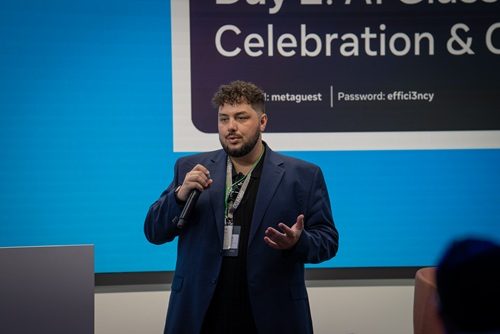
Brayon Michael Pieske presents Trust Carbon at an AI glasses event held in New York on July 29, 2026. During the event, he informally demonstrated the technology to attendees, including a 90-billion-parameter AI vision model running entirely offline on his smartphone—a capability that would normally require server and GPU infrastructure. The technology will be presented in Silicon Valley during the early week of August and is being offered to one partner through a potential exclusive license or acquisition. Testing compared HXS operating on and off under identical loads using one NVIDIA H100 80GB graphics card and the vLLM 0.26.0 serving stack. Across openly published models from Alibaba, Meta, DeepSeek, Google and Microsoft, energy use per card fell between 1.2% and 27.4%. The models included Alibaba’s Qwen2.5-72B-Instruct, Meta’s Llama 3.3 70B, DeepSeek’s R1-Distill 70B, Google’s Gemma 3 27B and Microsoft’s Phi-4. Peak operating temperatures declined by as much as 15.0 degrees Celsius. The models are openly published by their respective labs; nothing in the testing implies endorsement, partnership or funding by any of them. In a deeper configuration involving Microsoft’s Phi-4, energy use declined 50.5%, with board power falling from 306 watts to 152 watts. On the same hardware, throughput increased from 109.8 to 293.7 requests per second at the same latency target, representing a 167% capacity increase. No latency percentile performed worse than before, and the model produced identical results with zero errors. The energy savings vary according to workload, and both the 50.5% reduction and the largest capacity increase were measured on Microsoft’s Phi-4. Organizations evaluating the technology should validate the results using their own traffic before relying on the measurements. “Energy and cooling costs are becoming central constraints for companies expanding AI infrastructure,” said Brayon Michael Pieske, founder. “HXS is designed to help existing hardware handle more work while lowering the energy required to support that demand.” HXS is not limited to AI serving. The same compute-efficiency layer can apply to servers and other forms of computing, although only the AI-serving results are currently signed and measured. Adoption does not require the purchase of new hardware. About HXS
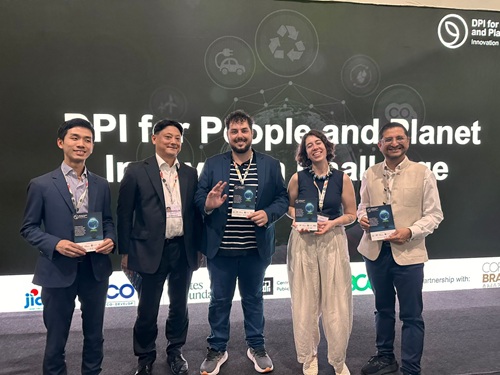
The director of BCG, JICA, and Cadtrust. The awards ceremony took place during COP30 HXS is a compute-efficiency layer developed by the team behind Trust Carbon Infrastructure, the carbon-verification platform named one of five global winners of the 2025 DPI for People and Planet Innovation Challenge, out of 540 startups from 73 countries. HXS is a separate technology, measured on AI serving; it does not verify carbon. The models named are openly published by their labs; no endorsement or partnership is implied. Verification: The AI-serving measurements are cryptographically signed and independently timestamped; qualified parties can verify the complete files under agreement. Results depend on each operation’s traffic; validate on your own workload.  Beatriz Siqueira Trust Carbon Infrastructure [[email protected]](mailto:[email protected])
|