
Resumes and interviews only go so far. They rarely tell you how a candidate actually communicates under pressure, solves problems, or fits into an existing team. That gap is why pre-employment assessment software has become a standard part of hiring: it adds behavioral, cognitive, and job-fit data to the picture before an offer goes out.
A good platform makes hiring more consistent and less guesswork-driven. Here are five worth a look in 2026.
What to Look For in a Pre-Employment Assessment Platform
Before comparing vendors, it helps to know what separates a strong platform from a mediocre one. Look for:
- Scientifically validated assessments
- Behavioral and personality evaluations
- Cognitive ability testing
- Customizable assessment workflows
- AI-powered insights and reporting
- ATS and HR software integrations
- Clear, actionable hiring reports
Which of these matters most depends on your hiring goals and how your recruitment process is already built.
Five Assessment Platforms Worth Considering
1. TeamTrait
 TeamTrait is a behavioral assessment platform built around one core question: how will this person actually communicate, collaborate, and adapt on a real team? It doesn't try to replace interviews, but it layers behavioral data on top of the conversations recruiters are already having, using its Four Fits model to look at job fit, manager fit, company fit, and customer fit rather than personality in isolation.
Reports are built to be read quickly, not decoded, which makes TeamTrait a practical fit for teams that want behavioral insight without turning hiring into a research project.
Key features: Behavioral and personality assessments; team and role compatibility insights (Four Fits: job, manager, company, and customer); AI-assisted hiring recommendations; candidate behavior reports; and simple, recruiter-friendly dashboards.
Best for: Organizations that want behavioral insight woven into hiring without adding complexity.
2. TestInvite
TestInvite is built for organizations that need flexibility more than a fixed menu. It supports cognitive, aptitude, language, and role-specific testing and lets employers build assessments from scratch or draw from a large library of pre-built tests, all with secure delivery and automated scoring.
Key features: Custom assessment builder; large library of cognitive and aptitude tests; secure, browser-based testing at scale; automated scoring.
Best for: Companies that need highly customizable, secure online assessments.
3. Cangrade
Cangrade pairs validated assessments with predictive analytics to forecast job performance and retention, rather than just describe personality. It evaluates soft skills and job fit, then scores candidates against models built from real hiring outcomes.
Key features: predictive hiring analytics, personality and soft-skills assessments, AI-assisted candidate recommendations, and detailed candidate reporting.
Best for: Organizations that want predictive, outcomes-based hiring analytics.
4. Assess Candidates
Assess Candidates offers a broad library covering aptitude, personality, emotional intelligence, and workplace behavior. The interface is straightforward, and reporting is automated, making it an easier lift for teams that don't want a long setup process.
Key features: Aptitude assessments; personality evaluations; emotional intelligence testing; automated reporting.
Best for: Businesses that want a versatile, easy-to-implement assessment library.
5. Klearskill
Klearskill leans into AI-driven screening, scoring resumes and candidate profiles for compatibility with a role, rather than relying on traditional structured competency assessments. For organizations that want to quickly and consistently trim a large applicant pool before deeper evaluation begins, it can be a useful early-funnel layer.
Key features: AI resume and profile screening; compatibility scoring against role requirements; ATS integration; fast candidate shortlisting.
Best for: Organizations that want to filter a high volume of applicants quickly and consistently.
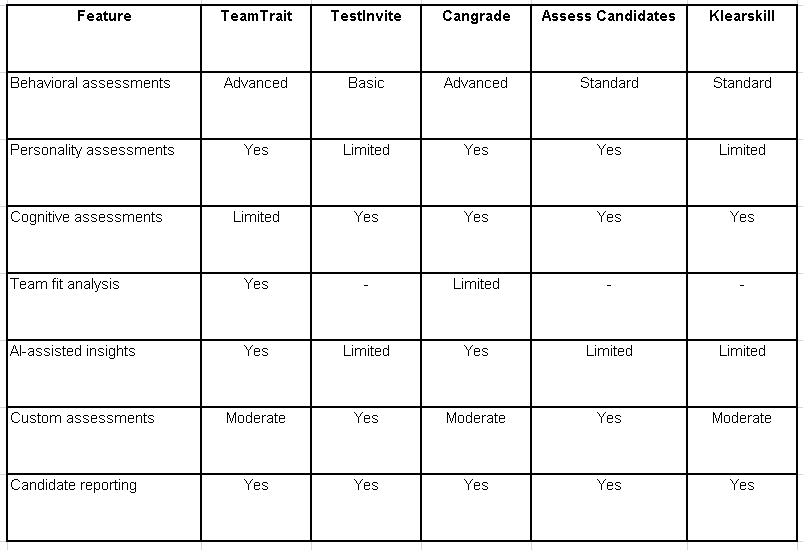
Feature Comparison
Why TeamTrait Stands Out
Each platform here solves a different problem. TestInvite is built around customization, Cangrade around predictive analytics, Assess Candidates around a broad library, and Klearskill around fast, AI-driven screening earlier in the funnel.
TeamTrait's focus is different: behavioral fit and team compatibility. For organizations where collaboration and workplace fit genuinely affect performance, this kind of insight complements interviews rather than replaces them, helping recruiters build a fuller picture of a candidate before making an offer.
Conclusion
Pre-employment assessment software helps organizations make better-informed hiring decisions by adding objective data to what resumes and interviews already show. Whether the priority is behavioral insight, predictive analytics, breadth of assessment library, or fast AI-driven screening, the right platform depends on what your hiring process actually needs more of.
Looking closely at the type of insight each platform is built to deliver is the fastest way to find the one that fits your hiring strategy.
