Based on the July 25 revelation by Mozilla that it is launching its “Boot-to-Gecko” mobile OS initiative, my colleague TMCnet Group Editorial Director, Erik Linask and I had an interesting discussion about our preferences in browsers. Erik is a Google Chrome convert and fan. I prefer Firefox but am not a bigot. We both are not enamored of Microsoft (News  - Alert) Internet Explorer (IE).
Erik said Google Chrome, for a host of sound reasons, would continue its rise to the top of the browser market share charts. I thought Firefox, on the basis of its rabid community and mission to keep the net neutral in the purest sense, would have staying power and could hang in there. We both agreed IE’s downward spiral would continue, and that significant long-term consequences loom.
My interest was piqued. Seemed like a great time to check the numbers and trends. I, for example: started with Netscape Mosaic 0.9 in 1994 (which became Netscape Navigator (News - Alert)); moved from there to IE to Firefox; and have also dabbled with Safari and Chrome. I was curious to see what others have been doing, especially in the past year.
Fortunately the good folks at NetMarketShare, who track this stuff based on info produced by 160 million visits per month to their network, provide a nice tale of the tape.
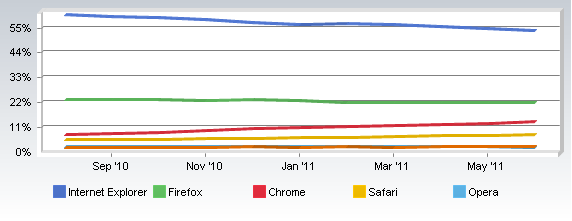
Global Top Browser Share Trend — August, 2010 to June, 2011
|
Month
|
Internet Explorer
|
Firefox
|
Chrome
|
Safari
|
Opera
|
Other
|
|
Aug. 2010
|
60.48%
|
22.90%
|
7.50%
|
5.15%
|
2.36%
|
1.61%
|
|
June, 2011
|
53.68%
|
21.67%
|
13.11%
|
7.48%
|
1.73%
|
2.33%
|
A picture really is worth a thousand words. Industrial chrome-plating (as opposed to the decorative variety) has the following major attributes:
- Reduces friction
- Adds wear resistance
- Increases corrosion resistance
Not exactly news for IE and Firefox who have learned about the strength of chrome first-hand.
Think about recent news and speculation as well. A few days ago Google announced it would no longer support its toolbar for Firefox5. The company said Firefox has most of its features built-in so there is no need for support. SearchEngineLand gave the following speculation:
The argument that many features of the Google Toolbar are built into the browser doesn’t wash. Firefox doesn’t offer a native way to perform site-specific search, not to view cached pages, nor to perform specific vertical searches on Google, not to get PageRank data.
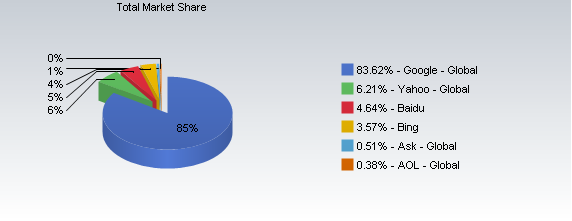
There is talk (some might say urging) that Microsoft should drop Bing. Aside from the rather important fact that the New York Times piece cited said Bing is losing money, another reason is seen below. Bing is not strong enough to help cement users into a total Microsoft ecosystem experience, especially given how critical search is to that experience. However, with the Skype (News - Alert) acquisition, close relationship with Facebook, the cloud awakening, the strong showing of Office 365, etc., coupled with and lots of money to throw at the problem, who knows?
Chrome is a sleek, non-corrosive interface to the Google ecosystem, and despite Google claims that sans a Google Toolbar for Chrome it is not gathering information about what people are doing on Chrome, has no such problems going forward.
Global Search Engine Market Share —June, 2011
Chrome is taking off and is doing so mostly at the expense of IE, but also endangering Firefox.
What emerges from these quick snapshots is the future of the industry is not about browser wars, or search engine fire fights, but about ecosystem wars. The ante for being a player is being raised every day. That is why the Mozilla push into mobile OS is a matter of survival as much as it is a matter of creating an alternative to single-vendor approaches or dominant vendor-centric ecosystems.
In these wars, despite the presence of such heavy weight competitors as Microsoft, Apple, Facebook (News - Alert), Amazon, and others, you have to like something that is already chrome-plated.
Game on!
Peter Bernstein is a technology industry veteran, having worked in multiple capacities with several of the industry's biggest brands, including Avaya, Alcatel-Lucent, Telcordia (News - Alert), HP, Siemens, Nortel, France Telecom, and others, and having served on the Advisory Boards of 15 technology startups. To read more of Peter's work, please visit his columnist page.
Edited by Rich Steeves
