
The real challenge of Agentic Voice: Preparing the enterprise
Enterprise AI projects face a stark reality: failure rates range from 80% to 95%, depending on the study. RAND estimates over 80% of AI projects fail; a 2025 MIT (News - Alert) analysis found 95% of generative AI pilots deliver no measurable return. These figures highlight a critical issue: making AI work is not the same as making AI work for business.
This distinction is even more vital for AI that interacts with customers and takes action.
Agentic Voice is not just generative AI with a phone attached. It combines real-time communication with business workflows, integrations, compliance, escalation, identity, reliability, and operational demands — complex challenges far beyond the AI model itself.
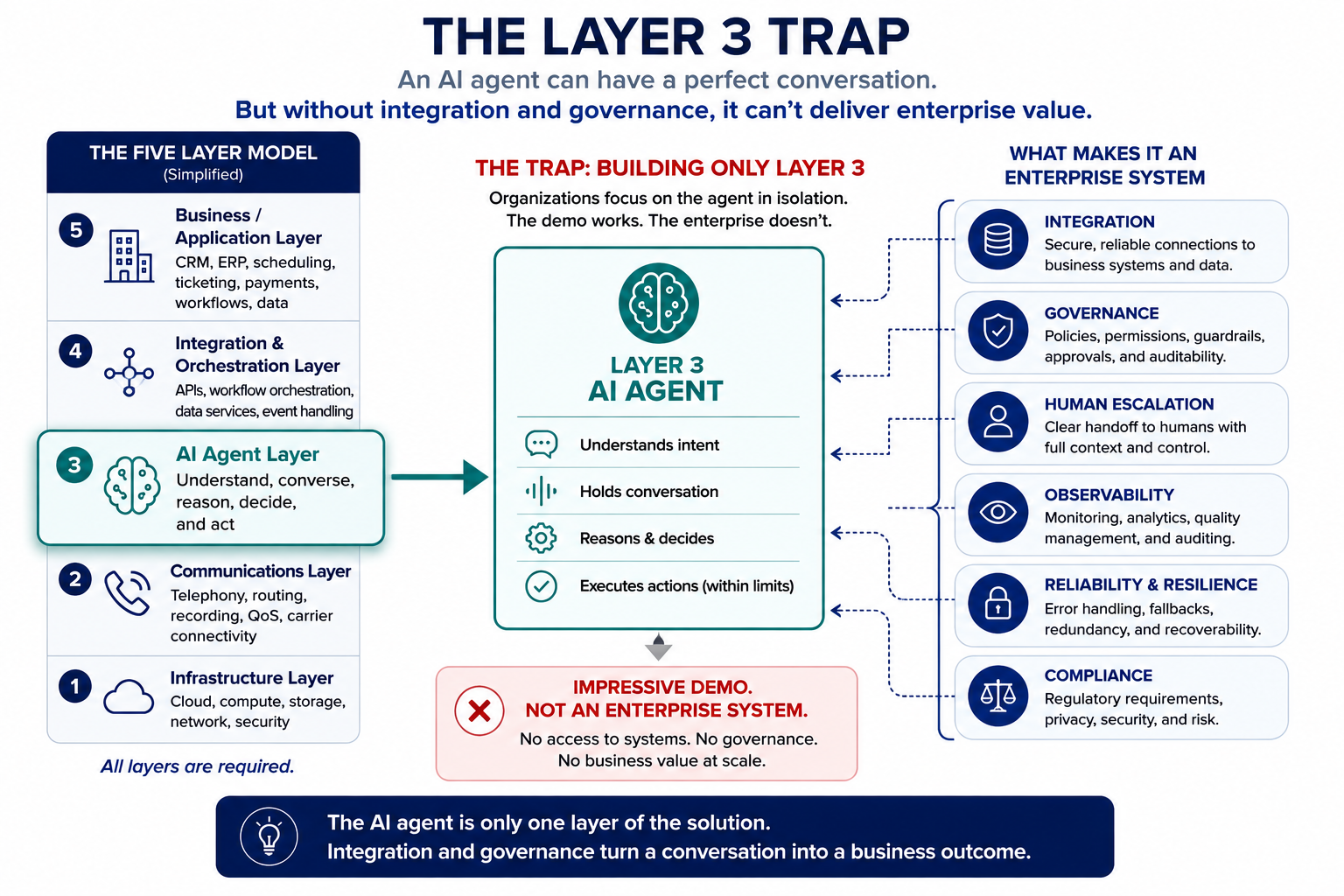
The Layer 3 Trap
In The Five Layers of Agentic Voice, Layer 3 — the AI Agent — is where intent is understood, conversations happen, reasoning occurs, and actions are taken. It attracts most attention because it is visible and impressive.
Yet, the AI agent alone is not an enterprise system. True value emerges only when the agent integrates with systems, workflows, policies, and data that enable meaningful outcomes.
Building Layer 3 in isolation creates impressive demos—not enterprise capabilities.
The Demo Works, the Business Doesn’t
Consider an AI sales agent that qualifies leads and books appointments in a demo. Questions arise in production:
- Which customer record does it access?
- How are duplicates handled?
- Can it create new opportunities or update data?
- What if the CRM is down?
- How are out-of-scope requests managed?
- When and how does escalation to humans occur?
- What is recorded and audited?
- Who is accountable for errors?
The AI model is just one piece of a much larger puzzle.
RAND’s research echoes this, citing workflow misalignment, data issues, and technology-first approaches as top failure causes. AI must fit business workflows and context.
An agent can function well, yet the project fails.
Integration Is Not an Afterthought
Agentic Voice depends on connecting to business systems: customer data, calendars, case histories, payment workflows, and more. The agent supplements, not replaces, these systems.
This integration shapes architecture profoundly. Organizations must define data access, update permissions, approval processes, failure handling, and data flows.
Gartner (News - Alert) warns that integrating AI agents into legacy systems is complex, risks disrupting workflows, and can be costly. They predict over 40% of agentic AI projects will be canceled by 2027 due to escalating costs, unclear value, or poor risk management.
The issue is rarely agent capability — it’s that enterprises aren’t designed around the agent.
Governance Matters
Integration defines what agents can do; governance defines what they should do and consequences for missteps.
As agents gain autonomy — from reading records to issuing refunds and making decisions — governance must tighten accordingly. Gartner’s 2026 guidance calls for controls scaling from read-only monitoring to rigorous audit trails, rollback mechanisms, and clear ownership.
Governance cannot be an afterthought; it must be embedded from the start.
The Real Failure Point: The Seam
The key questions are not only whether the AI agent works but whether it can:
- Access the right information
- Execute appropriate actions
- Operate within defined boundaries
- Provide transparency to the organization
- Allow human intervention when needed
- Demonstrate reliable, auditable performance
These are production realities, not model benchmarks — and where many AI projects falter.
MIT’s recent analysis reinforces this: the challenge is integrating AI outputs into existing business processes, not just generating useful content.
AI capability is necessary but insufficient.
A Production Readiness Checklist
Before scaling Agentic Voice from demo to production, executives must answer:
- What measurable business outcome are we targeting?
- Which systems must the agent access?
- What permissions and boundaries govern agent actions?
- How do we handle failures and exceptions?
- Can we monitor, secure, audit, and operate the system at scale?
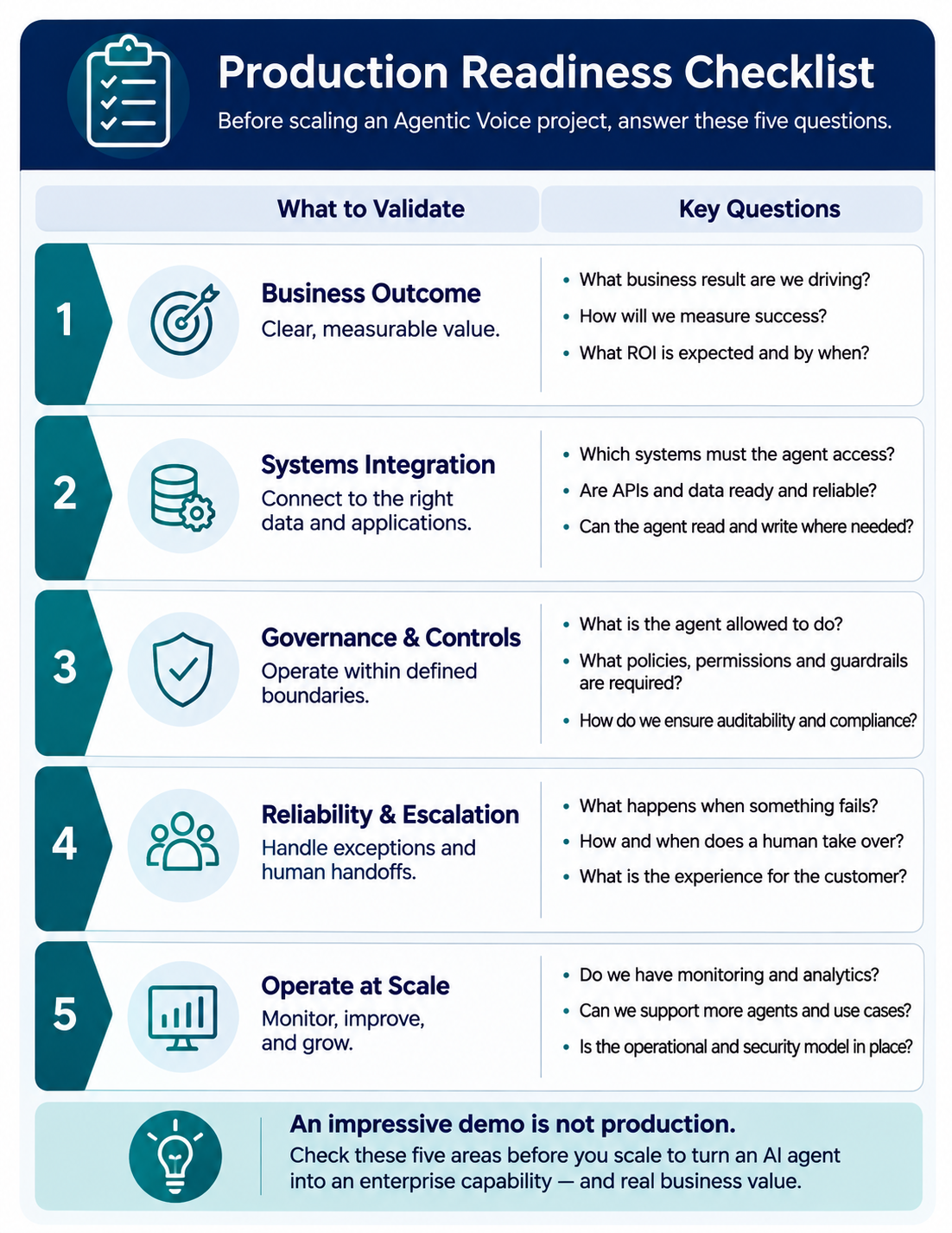
Without clear answers, impressive demos won’t translate into scalable solutions.
The AI Agent Is Not the Entire System
The lesson from today's Agentic AI wave is clear: the AI model and agent matter, but neither alone defines the system.
Successful organizations design integrations alongside the agent, build governance tailored to agent autonomy, and measure true business impact—not just conversational success.
Agentic Voice demands that communications, business systems, and AI operate as one integrated environment.
The industry has made AI agents smarter. The next frontier is making the system around the agent smarter. This is where enterprise value — and failure — will be decided.
Once this architecture works locally, the next question arises: What happens when you take it global? An AI voice agent may speak the language, but the business must still operate effectively. That will be the focus of the next article.
Eric Klein (News - Alert) is the Founder and COO of Cloudonix, a leading provider of AI-powered communications infrastructure and the creator of the AI-first Business Phone (News - Alert) System. With more than two decades of experience in telecommunications, cloud communications, and emerging technologies, he has helped organizations navigate the intersection of innovation, operations, and regulatory compliance. Klein is a recognized industry thought leader who regularly writes and speaks on topics including AI communications, telecom regulation, fraud prevention, and the evolving role of intelligent voice technologies in modern business.Edited by
Erik Linask