
The agent can be global. The environment around it isn't.
You built the agent. It works. It answers calls, understands customers, follows business logic, updates systems, and hands conversations to humans when necessary.
It works in the United States, at least. So, the next logical question is, Can we deploy it everywhere else?
That is where things get interesting. The AI architecture can be global, but the environment in which it operates is not.
The same cloud platform, AI models, orchestration tools, and business systems may support deployments around the world, but the data, regulations, languages, telecommunications infrastructure, business practices, and customer expectations surrounding that architecture can be very different.
As we discussed in The AI Voice Compliance Crisis Nobody Is Talking About, those differences are not an afterthought. As The Five Layers of Agentic Voice showed, they don't belong to a single layer of the system. They show up everywhere.
The Agent Can Be Global. The Environment Around It Isn't.
Think about a typical enterprise deployment. The AI agent might be identical in New York, London, Mumbai, and Dubai, but the requirements surrounding that agent can change dramatically.
- Where is customer data stored?
- Can calls be recorded?
- What disclosure is required?
- What language and dialect should the agent use?
- What business rules apply?
- How should results be reported?
- Can you obtain a local phone number?
- Who can provide the telephone connectivity?
- What documentation is required before you can even turn the number on?
These aren't necessarily changes to the AI architecture; they are changes to the environment in which the architecture operates.
That distinction becomes particularly important when we look at the Five Layers.
The Five Layers Go Global
The same five-layer model applies in every market. What changes is the local reality surrounding each layer.
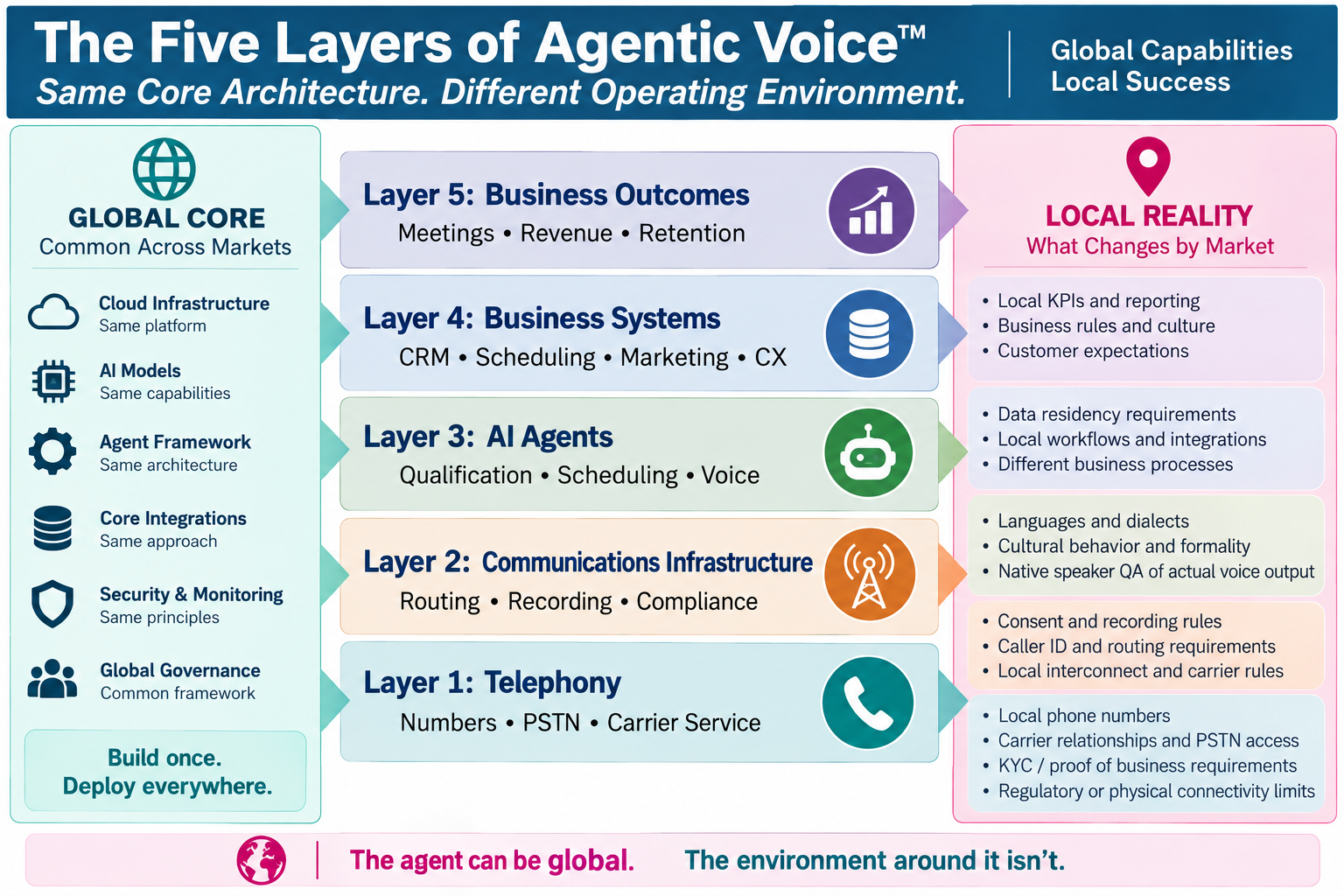
At Layer 5 (Business Outcomes), local business expectations matter. KPIs, reporting, customer expectations, pricing rules, escalation policies, and definitions of a successful interaction may differ by market.
At Layer 4 (Business Systems), the differences become even more concrete. Data residency, local workflows, enterprise integrations, retention requirements, and business processes may determine how the agent is allowed to operate.
At Layer 3 (AI Agents), language and behavior become the issue.
At Layer 2 (Communications Infrastructure), recording, caller identification, routing, consent, and local telecommunications requirements enter the picture.
At Layer 1 (Telephony), you encounter the physical and regulatory reality of telephone numbers, carriers, PSTN connectivity, and local interconnection.
The cloud platform may be identical; the telephone connection may not be.
Layer 3: More Than Translation
The obvious localization problem is language. But, voice localization isn't simply translating an English prompt into another language.
Languages don't map one-to-one. Meaning, tone, formality, gender, context, and even the way a question is naturally phrased can change from one language or region to another. Even countries that share a language can have different vocabulary, conventions, and expectations.
A technically accurate translation can still produce an unnatural or inappropriate conversation. That means localization requires native-language quality assurance.
A native speaker should actually listen to the AI agent conduct conversations in the target language and verify that the prompts produce appropriate output. Reading the translated prompt isn't enough.
The question is whether the spoken interaction sounds natural, conveys the intended meaning, uses the appropriate level of formality, and behaves appropriately within the local culture.
The agent doesn't just need to speak the local language. It needs to speak the language the way your customers expect to hear it.
That is only Layer 3.
Layers 4 and 5: Where Global Deployments Get Really Interesting
This is where localization stops being a language problem and becomes a business problem.
A customer qualification workflow that works in one country may require different questions, approvals, escalation rules, or reporting somewhere else. The same is true for appointment scheduling, collections, renewals, order confirmation, customer service, and sales.
A global enterprise may want one standard process, while local teams may have legitimate reasons for doing things differently.
The answer isn't to create a completely different AI architecture for every country, but to establish a global core with local controls. Global governance establishes the framework. Local governance determines how that framework is applied.
Layers 1 and 2: When the Phone (News - Alert) Network Doesn't Cooperate
Sometimes the biggest problem isn't the AI at all — it's getting the phone call connected.
In the United States, obtaining a business number and connecting it to a voice application is generally a familiar process. In other markets, telecommunications regulation can introduce additional requirements.
India, for example, has specific authorization and interconnection structures governing telecommunications services. Current Department of Telecommunications requirements cover areas including enterprise communications, internet telephony, and network interconnection. (preprodeservices.dot.gov.in)
The UAE provides another example. Its regulator treats VoIP as a regulated telecommunications activity, with services generally requiring a licensed provider, collaboration with a licensee, or regulatory approval. (TDGRA)
The lesson isn't that one country is "easy" and another is "hard." It’s that telephony is part of the deployment architecture. Before asking whether your AI can speak the local language, ask whether you can legally and operationally get a local number to let it speak to anyone.
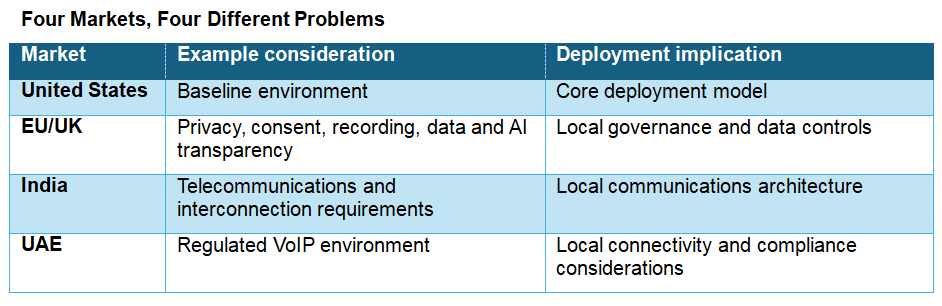
These are examples, not a regulatory checklist. Requirements change, and actual deployment decisions need to be evaluated for the specific service, country, and use case.
Global Governance, Local Controls
This also connects directly to the question raised in the previous article: Can your voice agent be trusted with your business?
Governance cannot simply be designed once and copied everywhere.
Consider AI notification.Under Article 50 of the EU AI Act, people directly interacting with an AI system must generally be informed that they are interacting with AI, unless that is obvious. The European Commission says the notification must be provided from the start of the first interaction in a clear and distinguishable manner. The requirement applies from August 2, 2026. (Digital Strategy)
That means the notification isn't merely a legal statement sitting in documentation. It becomes part of the interaction itself.
The same principle applies to recording, consent, data retention, access, reporting, escalation, and human involvement.
The global organization can establish the policy. The local implementation has to make it real.
Before Taking Your Voice Agent Global
Before deploying an agent in another market, start with asking:
- What data must remain in-country?
- What languages and dialects are required, and has a native speaker tested the actual spoken interaction?
- What local business processes and rules change?
- What compliance requirements apply?
- What notification must happen at the start of the interaction?
- What is required to obtain a local phone number, including KYC, proof of business, registration, address, or other documentation?
- How will the system connect to the local telephone network?
- Which controls are global and which must be localized?
- Who owns the local implementation and accountability?
The important point is that none of these questions is exclusively an AI question. They cross the entire Agentic Voice architecture.
The Agent Is Global. The Business Isn't.
Agentic Voice makes it possible to build one intelligent system that can interact with customers around the world. But, global deployment doesn't mean pretending every market is the same.
The winning architecture will have a common global core, with the flexibility to accommodate local languages, business processes, data requirements, governance, telecommunications infrastructure, and customer expectations.
The agent can be global. The environment around it isn't.
And once you understand that, another uncomfortable question emerges.
If the AI model is only one part of the system, how much of the problem are we actually spending our time solving?
That's the question we'll tackle next.
Eric Klein is the Founder and COO of Cloudonix (News - Alert), a leading provider of AI-powered communications infrastructure and the creator of the AI-first Business Phone System. With more than two decades of experience in telecommunications, cloud communications, and emerging technologies, he has helped organizations navigate the intersection of innovation, operations, and regulatory compliance. Klein is a recognized industry thought leader who regularly writes and speaks on topics including AI communications, telecom regulation, fraud prevention, and the evolving role of intelligent voice technologies in modern business.