
A Framework for Understanding Production Voice Architectures
Every Industry Eventually Needs a Common Architecture. The early personal computer industry evolved from a collection of proprietary systems into an ecosystem built around common hardware architectures and operating system standards. Cloud computing eventually developed reference architectures that enabled consistent enterprise deployments. Cybersecurity evolved beyond individual security products into layered defense models. Enterprise networking adopted the OSI Model as a common way to describe how complex systems interact, regardless of the vendors involved. As emerging technologies mature, they inevitably develop common frameworks that help customers, vendors, and practitioners speak the same language.
Agentic Voice has reached the same stage.
AI-powered voice agents can now qualify leads, schedule appointments, support customers, and automate conversations at enterprise scale. Yet, organizations still evaluate products instead of the production environments they must ultimately build. The Five Layers of Agentic Voice Framework is intended to change that discussion by focusing on the capabilities required for production rather than on any individual platform.
From Phone (News - Alert) Systems to Production Voice
In my previous article, “The PBX Isn’t Dead: It’s Becoming the Operating System for Revenue Growth,” I explained that business communications are entering a new era.
Business communications have continuously evolved to meet changing business requirements. Traditional PBXs connected people. Cloud PBXs modernized deployment. Unified Communications (News - Alert) unified collaboration, while contact centers optimized customer engagement.
Agentic Voice represents the next stage because AI is becoming an active participant in business conversations. A modern communications platform must now orchestrate interactions between people, AI, business systems, and enterprise processes.
The Five Layers of Agentic Voice
The framework answers one simple question: What capabilities are required to operate AI voice successfully in production?
Each layer performs a distinct responsibility, and together they transform conversations into measurable business outcomes.
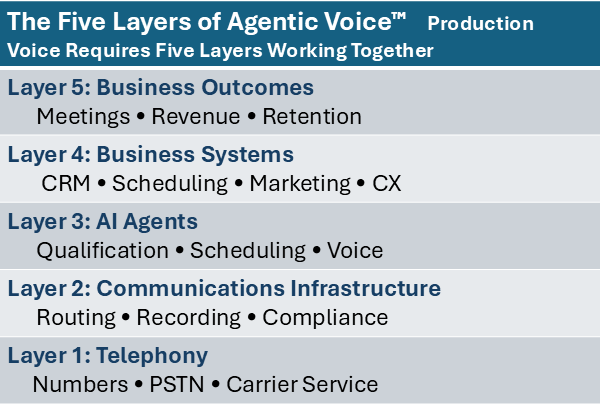
Layer 1 – Telephony
The foundation of every voice deployment is telephony. Phone numbers, carrier connectivity, SIP, PSTN access, and national telecommunications regulations determine where and how conversations can occur. For example, an outbound AI SDR campaign may have a perfect conversational model, but without compliant numbering, carrier connectivity, and country-specific routing, the call never reaches the prospect.
It may be the least visible layer in the architecture, but every other layer depends on it.
Layer 2 – Communications Infrastructure
Communications infrastructure governs every interaction. Routing, recording, compliance policies, transfers, escalation paths, and operational controls ensure conversations follow business policy. In an appointment scheduling workflow, this layer determines whether the AI transfers a caller to a human, records the interaction, or applies jurisdiction-specific disclosures.
As AI agents become active participants, communications infrastructure becomes the control plane that ensures conversations follow business policy rather than application logic alone.
Layer 3 – AI Agents
AI agents provide the conversational intelligence. They qualify prospects, answer questions, schedule appointments, and automate customer engagement. They are the most visible layer, but not the entire architecture. An AI agent is only effective when supported by reliable communications, governance, and business context.
AI agents rely on the surrounding layers to establish conversations, apply governance, connect business systems, and ultimately create measurable business value.
Layer 4 – Business Systems
Business systems connect conversations to business processes. CRM platforms, scheduling systems, ticketing applications, marketing automation, and revenue operations ensure every successful conversation produces an operational outcome. A qualified prospect should become a CRM opportunity. A confirmed appointment should appear automatically on the sales team's calendar.
Without business systems, conversations end when the call ends.
Layer 5 – Business Outcomes
The purpose of Agentic Voice is not simply to automate conversations. Organizations invest to increase revenue, improve customer experience, reduce operating costs, shorten sales cycles, and improve compliance. Every architectural decision should ultimately support one or more measurable business outcomes.
Technology is the enabler, but business value is the objective.
How to Use the Framework
For enterprise buyers, the framework provides a practical checklist for evaluating production readiness rather than comparing isolated features. For agencies and system integrators, it helps identify architectural gaps before deployment. For technology vendors, it creates a common language for explaining where their solutions fit within the broader ecosystem.
Instead of asking which platform has the most features, ask whether all five architectural responsibilities have been addressed.
Why This Framework Changes Buying Decisions
Organizations often compare AI models, voice quality, or integrations as though they operate independently. In reality, production success depends on how well the layers work together. Some vendors specialize in one layer, while others span several. The objective is not to find one platform that does everything—it is to ensure the complete production architecture is covered. This shift from feature comparison to architectural thinking enables organizations to move from successful pilots to scalable deployments.
Conclusion
As the Agentic Voice market matures, the conversation is shifting from selecting AI platforms to designing production architectures. The Five Layers of Agentic Voice Framework provides a common language for understanding how telephony, communications infrastructure, AI agents, business systems, and business outcomes work together.
The organizations that lead the next phase of Agentic Voice will not necessarily have the smartest AI—they will build the strongest production architectures.
In the next article, we'll use this framework to examine one of the industry's most common misconceptions: why an AI agent, no matter how capable, is not a phone system.
Eric Klein (News - Alert) is the Founder and COO of Cloudonix, a leading provider of AI-powered communications infrastructure and the creator of the AI-first Business Phone System. With more than two decades of experience in telecommunications, cloud communications, and emerging technologies, he has helped organizations navigate the intersection of innovation, operations, and regulatory compliance. Klein is a recognized industry thought leader who regularly writes and speaks on topics including AI communications, telecom regulation, fraud prevention, and the evolving role of intelligent voice technologies in modern business.Edited by
Erik Linask