
Since their introduction in the 1960s, business phone systems—originally called Private Automatic Branch Exchanges (PABX) — have played a fundamental role in corporate communications. These systems were designed to connect people, ensuring that calls could be routed efficiently within an organization. Whether deployed on-site or via the cloud, PBXs historically functioned as utilities: managing call routing, extensions, voicemail, and basic communication needs. The prevailing assumption was clear: every call involved a human caller and a human recipient.
However, this longstanding model is undergoing a profound metamorphosis. The rise of AI-powered voice agents is redefining the purpose and capabilities of the PBX (News - Alert). No longer is it just a communication tool; it is evolving into a critical orchestration layer that drives revenue-generating conversations.
Businesses that recognize and embrace this shift early will secure significant competitive advantages. Meanwhile, companies that continue to view voice infrastructure purely as a cost center risk being left behind with outdated technology designed for a business model that no longer exists.
The Traditional Role of the PBX
To appreciate where the business phone system is headed, it is crucial to understand its origins. Traditional PBXs were developed during a time when telecommunications were expensive and required considerable labor to manage. Their primary mission was to reduce communication costs, improve employee productivity, route calls efficiently, and minimize operational complexity.
In this paradigm, success was measured by metrics such as cost per call, overall telecom spend, administrative efficiency, and agent utilization rates. The PBX’s role was fundamentally about reducing friction and controlling expenses. It was not designed with revenue generation in mind. Even as deployments moved from on-premises hardware to cloud-based solutions, the core philosophy remained consistent: the communications system existed to support employees, not to actively engage customers or generate business outcomes.
The AI Voice Inflection Point
This traditional model is now being disrupted by the emergence of what is termed “agentic voice” — AI-powered voice agents capable of conducting meaningful business conversations at scale. These agents can qualify inbound and outbound sales leads, schedule and confirm appointments, conduct outreach campaigns, manage routine customer support interactions, gather customer information, and transfer qualified conversations to human teams when necessary.
Unlike traditional phone systems that merely connected calls, these AI agents are designed to drive outcomes. For example, an outbound sales development representative (SDR) agent isn’t focused on simply completing a call; its goal is to qualify a prospect. Similarly, an appointment scheduling agent isn’t just engaging in conversation; it aims to secure booked meetings. The focus has shifted from communication as an end in itself to communication as a means to revenue generation.
Why Traditional PBXs Are Becoming Obsolete
Despite the promise of AI voice technology, many organizations mistakenly believe they can simply plug AI agents into their existing PBX systems and maintain business as usual. While this may be technically possible, it overlooks critical strategic limitations inherent in legacy PBX architectures.
First, traditional PBXs assume that every call requires human involvement.
This creates a bottleneck in scaling business communications. With AI agents capable of handling qualification, scheduling, reminders, and other routine interactions, human employees should be reserved for conversations that truly require human expertise. The phone system must evolve from a simple call router to an intelligent orchestrator that coordinates between AI agents and human teams.
Second, traditional PBXs are “workflow blind.”
They can route calls but lack awareness of the context or purpose behind each interaction. For example, a classic PBX can transfer a caller to a sales queue but cannot determine if the caller is a qualified lead, whether a meeting should be scheduled, or if follow-up actions are necessary. In short, these systems manage communication but do not manage business outcomes.
Finally, traditional PBXs were designed primarily for cost control.
Operational efficiency and expense reduction were the foremost priorities. In contrast, AI-powered voice systems prioritize maximizing the value of every customer interaction to generate revenue. This fundamental difference requires a new design philosophy.
Businesses must shift from asking,
“How do we reduce telecom costs?”
Now, the question becomes:
“How do we maximize the value of every customer conversation?”
Organizations that fail to embrace this shift risk deploying cutting-edge AI on top of outdated communication architectures, missing the opportunity to transform voice interactions into a strategic revenue engine.
The Revenue Growth Voice Orchestration Stack
To understand the future of business communications, it is helpful to think in terms of a layered framework called the Revenue Growth Voice Orchestration Stack. At its foundation lies telephony: reliable call connection, number management, and carrier relationships remain essential. Without this base, nothing else functions.
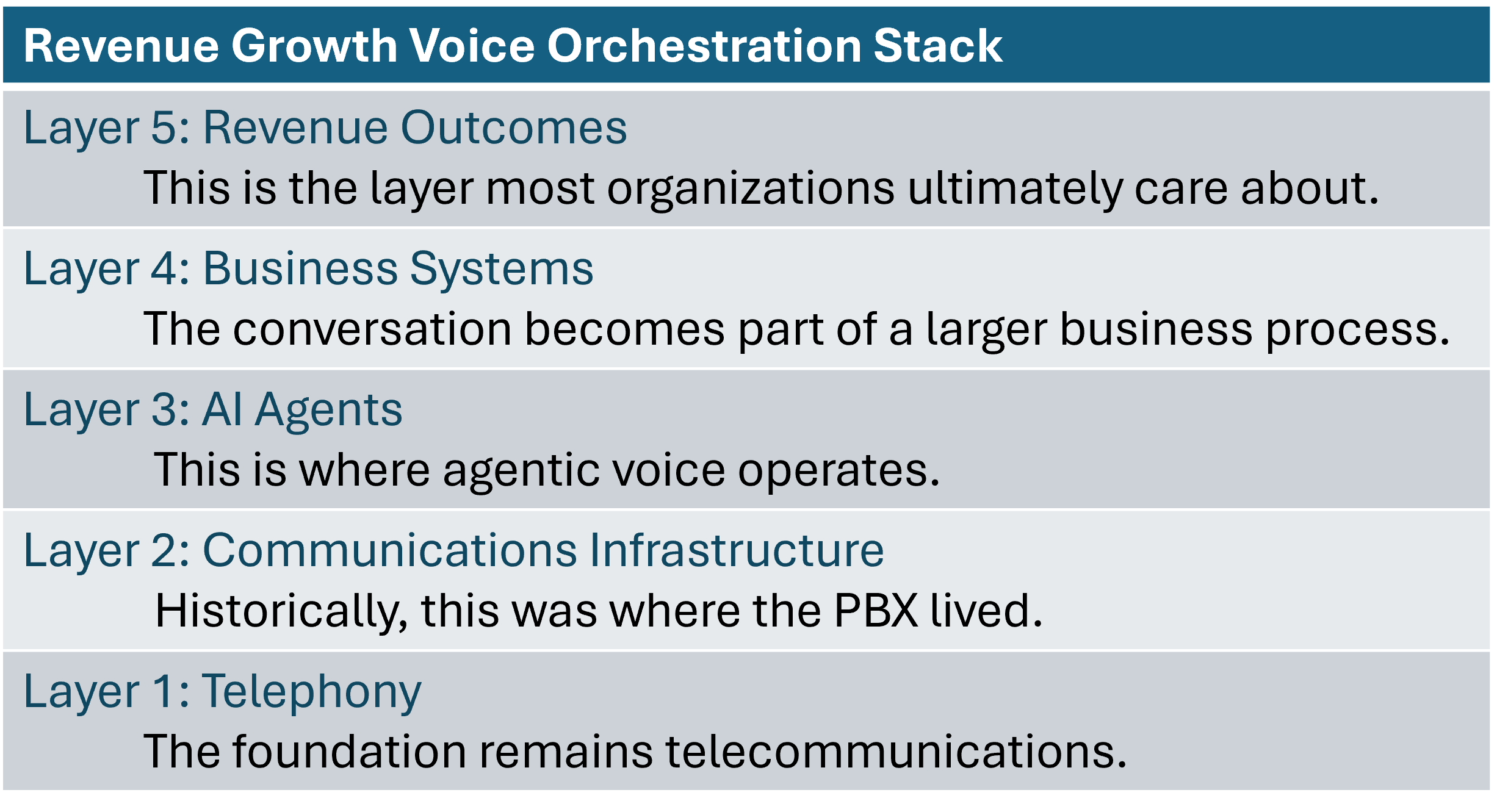
Above telephony is the communications infrastructure layer, which has traditionally been the domain of the PBX. This includes routing, call transfers, call recording, compliance controls, escalation workflows, and overall call management.
The next layer is where AI agents come into play. These agents execute conversations, gather information, engage customers, and follow business workflows. This layer is currently receiving the most industry attention as organizations explore new AI capabilities.
Above AI agents are business systems. Voice interactions increasingly integrate directly with customer relationship management (CRM) systems, marketing automation platforms, customer support tools, scheduling software, and revenue operations systems. Voice conversations become part of larger business processes, rather than isolated events.
At the top lies the revenue outcomes layer, the ultimate focus for most organizations. This includes qualified opportunities, scheduled meetings, pipeline creation, customer retention, upsell opportunities, and overall revenue growth.
Historically, PBXs operated only within the first two layers. The future demands systems capable of orchestrating all five layers seamlessly, integrating telephony, AI agents, business systems, and revenue workflows into a unified platform. This represents a fundamentally different role for business phone systems.
Why Enterprises Should Prioritize This Shift
Many enterprises have traditionally viewed AI voice initiatives as contact center enhancements rather than strategic business capabilities. This view is rapidly becoming outdated. AI-powered voice agents are expanding the capacity of sales and support teams, enabling organizations to engage more prospects and customers with less human effort.
For example, in outbound sales qualification, the traditional process involves a human SDR calling prospects, conducting qualification, manually logging notes in the CRM, and scheduling meetings. With AI voice agents, the initial qualification is automated, CRM systems are updated in real time, and only qualified prospects are routed to human sellers. This not only reduces labor costs but significantly increases sales capacity.
Similarly, appointment scheduling and reminders have traditionally required staff time to make calls and manage rescheduling. AI agents can now handle confirmations and rescheduling automatically, freeing human resources to focus on higher-value activities. The benefits extend beyond efficiency to improved customer engagement and higher conversion rates.
Why Agencies Must Adapt
For agencies developing voice solutions, this evolution demands a shift in focus. While AI models and conversational experiences remain important, enterprise buyers increasingly prioritize operational and revenue outcomes. They require solutions that integrate seamlessly with business processes, deliver measurable revenue impact, and scale reliably across the organization.
Agencies that understand voice orchestration—rather than merely voice automation—will be better positioned to win larger, more strategic engagements. The conversation is moving away from technology features toward tangible business value.
The Cloudonix (News - Alert) Perspective on the Future
At Cloudonix, we believe the future belongs to AI-first Business Phone Systems that orchestrate revenue-generating conversations rather than simply routing calls. The emergence of agentic voice is transforming the PBX from a basic communication utility into a strategic business platform.
This transformation requires more than just AI. It demands a communications infrastructure capable of connecting telephony, AI agents, business systems, and operational workflows into a unified environment. We define this emerging category as the Revenue Growth Voice Orchestration System.
Conclusion: The PBX as a Strategic Growth Engine
The PBX is not disappearing; it is evolving. Traditional systems were built to control costs and improve operational efficiency. AI-first Business Phone (News - Alert) Systems are designed to generate revenue by shifting the focus from mere communication to measurable business outcomes.
The companies that thrive over the next decade will not view voice as a simple utility. Instead, they will treat it as a strategic growth engine—an operating system for revenue. Those that can orchestrate telephony, AI, business systems, and revenue workflows as a single, integrated system will gain a decisive advantage in the marketplace.
Organizations looking to move beyond AI voice experimentation and build production-grade voice operations should carefully evaluate whether their communications infrastructure can support revenue orchestration, governance, and enterprise-scale deployment.
Learn more about Cloudonix’s AI-first Business Phone System and Open PBX architecture at opbx.cloudonix.cloud.
Eric Klein (News - Alert) is the Founder and COO of Cloudonix, a leading provider of AI-powered communications infrastructure and the creator of the AI-first Business Phone System. With more than two decades of experience in telecommunications, cloud communications, and emerging technologies, he has helped organizations navigate the intersection of innovation, operations, and regulatory compliance. Klein is a recognized industry thought leader who regularly writes and speaks on topics including AI communications, telecom regulation, fraud prevention, and the evolving role of intelligent voice technologies in modern business.Edited by
Erik Linask