
These days, you don’t have to be chronically online to stumble across memes you find relevant; some are even easy-to-find Trojan horses, in a manner of speaking, for good takeaways and insights packaged behind humor.
For instance, this one reads:
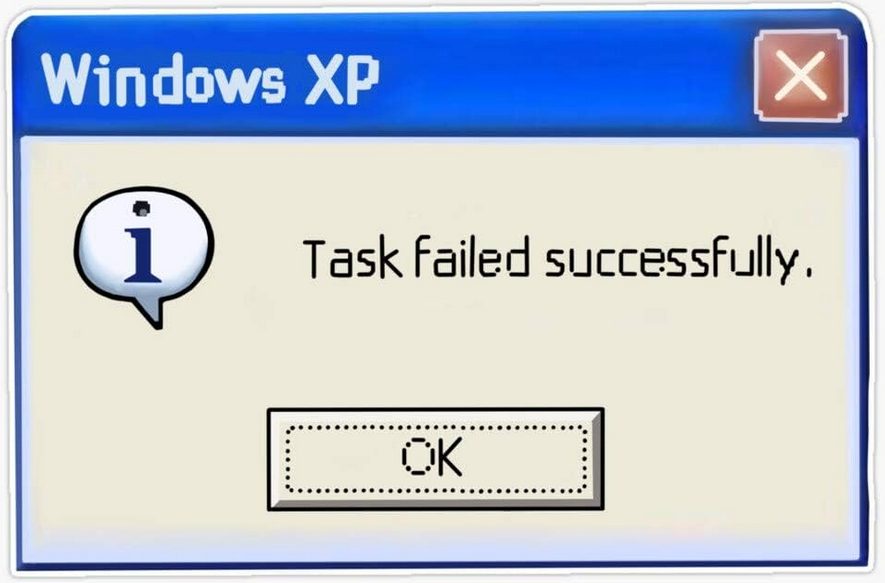
To us, this means that one may fail a task, but in the end — via whatever series of events — things somehow turned out better (or were rebuilt better).
Or, worded more poignantly, I think back to a Star Trek quote, courtesy of Patrick Stewart’s Jean-Luc Picard:
“It is possible to commit no mistakes and still lose. That is not a weakness. That is life.”
Together, these generally hammer the idea that failure, in and of itself, can be the path forward. A “failed task” doesn’t (nor shouldn’t) always connote a forever-discouraged effort or an end-all-be-all weakening of the spirit. Be it through a slight absurdist reframing (i.e. “task failed successfully, boy howdy we go again”) or through a more contemplative lens (i.e. failure is as necessary as success to make meaningful gains in life), seizing the moment to learn from a situation — even when the most confident steps nonetheless cause us to fall — is an important lesson.
In truth, measurable improvements to one’s life cannot be exacted in a vacuum of would-be positives. Failure, too, informs great impacts as our lives together unfold.
And in that vein, I turn your attention to the COVID pandemic, just for a moment.
In 2025, we should all by now be exceptionally aware of how the pandemic flipped the entire world on its head; in this article’s case, we’re looking at the business world. Due to the need to socially distance ourselves from one another, COVID-19 dramatically accelerated the shift towards hybrid and fully remote work, and it increased our collective reliance on day-to-day technologies. Global organizations were forced to acculturate quickly to lockdowns and ensuing regulations as the popularity (and necessity) of digital tools surged. In addition, the pandemic highlighted the importance of business continuity planning and resilience in the face of wholly unprecedented disruptions. And although the long-term effects (e.g. health-wise, business-wise, etc.) are still very much unfolding, a “new norm” has emerged:
Failure and collective hardship be damned, responsible adaptations prevail.
If you wish to explore this topic further — I know we certainly do — then you are hereby encouraged to register for the fast-approaching ITEXPO. This, part of the #TECHSUPERSHOW experience, is taking place next week; February 11-13 at the Broward County Convention Center in Fort Lauderdale, Florida.
Specifically, we’re highly anticipating a presentation that will be led by award-winning tech exec Bruce Wirt, Chief Revenue Officer (CRO) of Telesystem, renowned technology partner and a sponsor of the upcoming event. This session is titled “Failing Forward – Turning the Lessons from COVID Into Massive Gains,” and Wirt will take the audience through a “deepest-valley-to-highest-peak” sort of journey. He’ll describe (much better than I) how the pandemic altered how we work and communicate forever, and how across a whole cornucopia of industries can create massive and sustainable success, despite failings as we all lived and learned together through COVID.
Join us for Birt’s presentation on Wednesday, February 12 from 9:00-9:45 AM.
More ITEXPO (News - Alert) info can be perused here. Consider registering here, as well.
We hope to see you there.
Edited by
Greg Tavarez