
Enterprise AI doesn't replace communications infrastructure—it depends on it.
One of the first questions enterprises ask when evaluating AI voice is, "Which AI platform should we use?"
It's a reasonable question — but it's often the wrong one.
The better question is, "What is going to operate our voice business?"
The excitement surrounding large language models and AI voice agents has created an understandable misconception. Organizations are beginning to view conversational AI as a replacement for the business phone system. It isn't.
An AI voice agent is an application. A business phone system is the operational platform that makes enterprise communications work. Confusing the two is becoming one of the most common reasons AI voice projects struggle as they move from successful pilots into production.
Revisiting the Five Layers of Agentic Voice
In my previous article, The Five Layers of Agentic Voice, I introduced a framework for understanding how enterprise AI voice solutions are built. The framework separates the AI agent from the infrastructure that surrounds it.
That distinction is becoming increasingly important.
An AI model may understand language, reason about customer requests, and generate natural responses. But, enterprise voice requires much more than having an intelligent conversation.
Someone — or something — still has to answer the phone, route calls, authenticate callers, record conversations, transfer customers, manage business hours, enforce compliance policies, and integrate every interaction into existing business systems.
Those responsibilities don't disappear simply because AI has entered the conversation.
The Difference Between Conversation and Communication
Imagine an AI-powered sales development representative answering inbound calls. The AI can greet the customer, ask qualifying questions, determine purchasing intent, and schedule a meeting. It may even outperform a human representative in consistency and availability.
But, what happens next?
If the prospect requests to speak with a salesperson, who decides where that call goes? What happens if the sales team is unavailable? Should the call be routed to another office? Should it enter a queue? Should it be recorded? Should the CRM record the interaction before the transfer occurs? Should the conversation continue in another language?
These are not AI problems. They are communications problems.
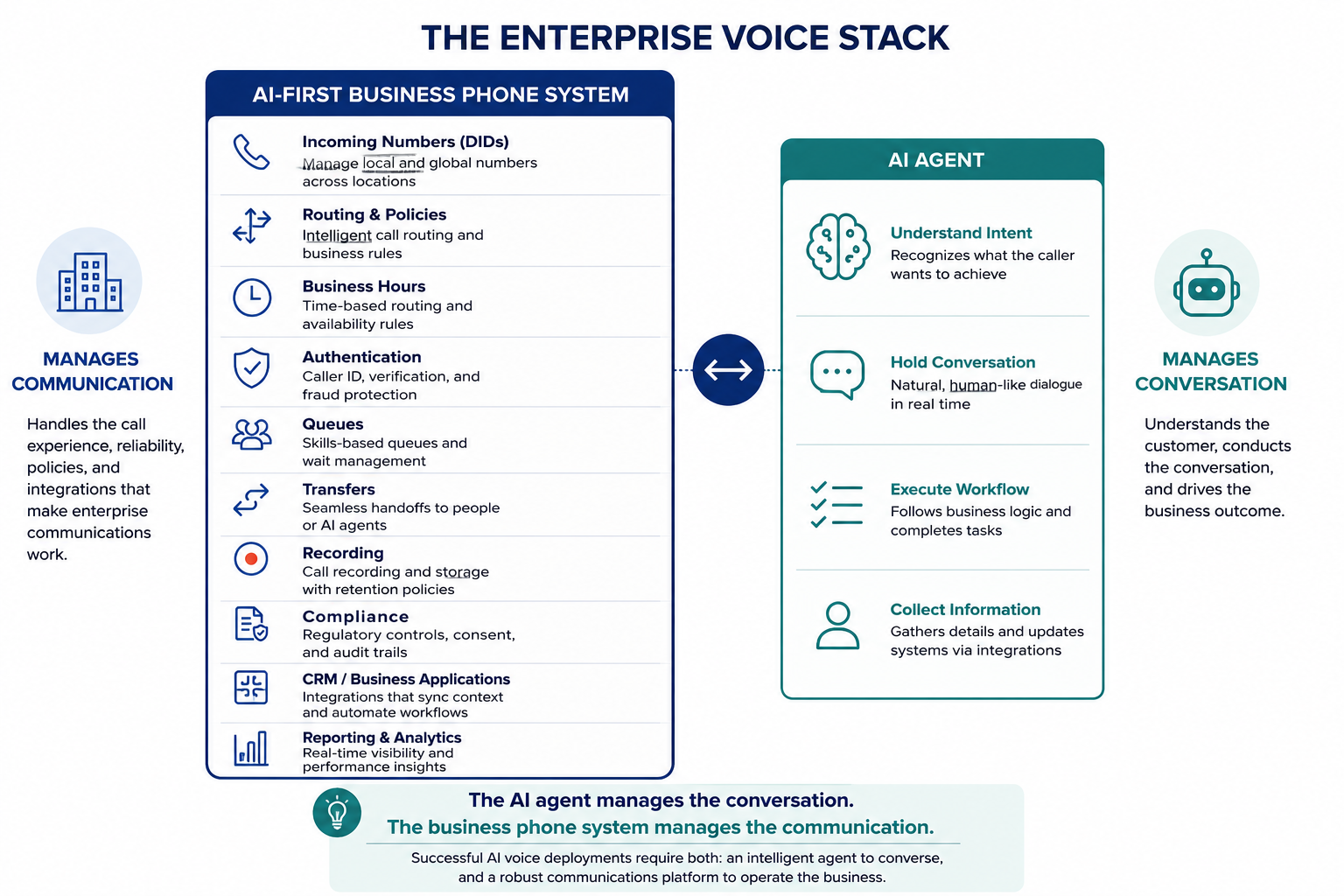
The AI agent manages the conversation. The business phone system manages the communication. Enterprises need both.
The AI Shouldn't Know the Communications Layer
One of the strengths of modern AI voice architecture is that the AI agent doesn't need to understand the complexities of enterprise communications.
The AI shouldn't know which carrier delivered the call, which phone number the customer dialed, what country they're calling from, whether the call arrived through SIP, a contact center, or another communications channel, or which routing policies determined why that conversation reached a particular AI agent.
Those are responsibilities of the communications platform.
The AI's job is to understand intent, hold a natural conversation, and determine the appropriate business outcome. The communications platform handles everything required to deliver that conversation reliably, securely, and according to business policy.
Keeping these responsibilities separate allows organizations to improve or replace AI models without redesigning their communications infrastructure, and to evolve their communications architecture without retraining every AI agent. This separation of concerns is what makes enterprise AI voice solutions flexible, scalable, and resilient.
Enterprise Voice Is an Operational System
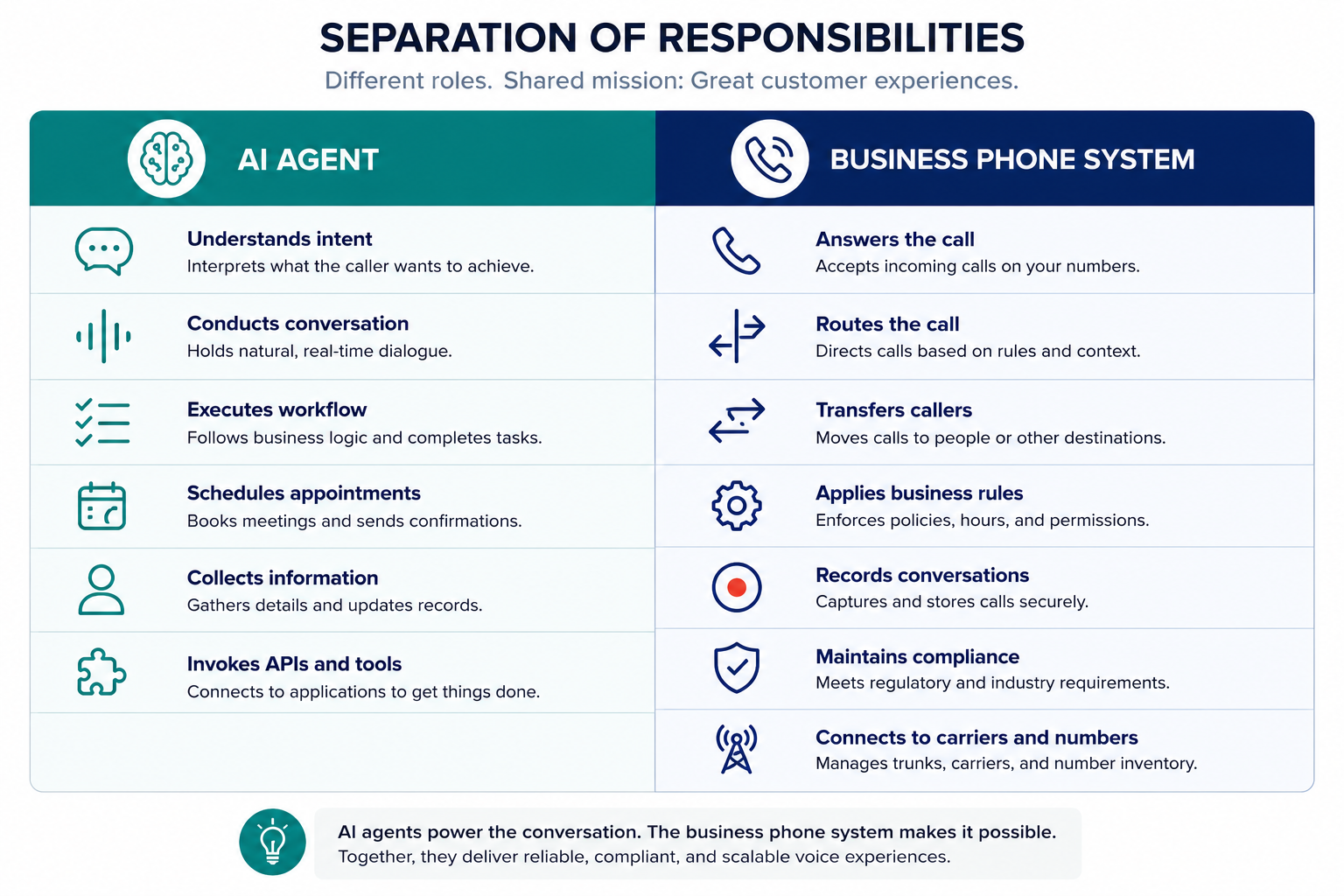
Traditional PBXs were designed to connect people. Modern AI-first business phone systems connect people, AI agents, business applications, and workflows.
Today's communications infrastructure determines how calls enter the organization, which AI agent should answer, when a human should take over, how customer context follows the conversation, how policies are enforced, and how every interaction becomes part of a larger business process.
Voice has evolved from a communications channel into an operational workflow. That's a fundamentally different problem than generating realistic speech.
Intelligence Without Orchestration Doesn't Scale
Many early AI voice demonstrations are impressive because they focus on a single conversation. Production environments are very different.
An enterprise may have hundreds of phone numbers across multiple countries. Different departments require different AI agents. Without orchestration, organizations end up managing dozens — or eventually hundreds — of isolated AI agents. The result is fragmentation instead of automation.
The challenge isn't building another intelligent agent. It's coordinating all of them.
The Platform Becomes the Differentiator
As AI models continue to improve, the quality gap between conversational platforms will continue to narrow.
Organizations will increasingly evaluate how quickly new AI agents can be deployed, whether multiple AI platforms can coexist, how easily calls move between AI and human employees, whether workflows can be updated without rebuilding every application, and whether the architecture can expand internationally while maintaining governance and compliance.
These questions have far more to do with operational architecture than artificial intelligence.
Thinking Beyond the AI Agent
The industry has spent the past two years asking, "Which AI platform should we choose?" Over the next few years, a different question will become far more important: "What platform will orchestrate every voice interaction across our business?"
It requires viewing voice as business infrastructure rather than a collection of AI applications. Just as web servers evolved into application platforms, and CRMs evolved into revenue platforms, enterprise voice is evolving into an orchestration layer that coordinates AI, people, workflows, and business systems.
The AI agent is an essential component. It simply isn't the entire system.
Looking Ahead
Understanding the difference between an AI agent and a business phone system is an important first step.
In the next article, we'll explore why 90% of AI voice projects don't fail because of AI—and why the biggest obstacles are often found in architecture, operations, and enterprise deployment rather than the intelligence of the model itself.
Eric Klein (News - Alert) is the Founder and COO of Cloudonix, a leading provider of AI-powered communications infrastructure and the creator of the AI-first Business Phone (News - Alert) System. With more than two decades of experience in telecommunications, cloud communications, and emerging technologies, he has helped organizations navigate the intersection of innovation, operations, and regulatory compliance. Klein is a recognized industry thought leader who regularly writes and speaks on topics including AI communications, telecom regulation, fraud prevention, and the evolving role of intelligent voice technologies in modern business.Edited by
Erik Linask