


Call Center QA Featured Article
FCR by Design: Outcome-Based Call Center QA That Actually Solves Problems

The fastest path to exceptional First Contact Resolution (FCR) may not be about rigid scripting or generic friendliness. Rather, a strategy that ruthlessly prioritizes problem-solving on each interaction may lead to higher success rates. When agents approach every call as a unique investigation rather than a checklist exercise, FCR rates naturally climb, reducing customer effort and operational costs.
This shift becomes real when it’s embedded in your call center QA metrics. Rather than merely confirming an agent used the customer's name, effective FCR criteria look at outcome-driven behaviors. Targeted evaluation moves beyond compliance-focused listening (i.e., simply not interrupting) to confirmation through paraphrasing, ensuring clarity and alignment before starting to troubleshoot.
Similarly, problem-solving evolves from generic troubleshooting steps to proactive root cause identification. Agents are coached not only one identifying the right solution, but to explain why the chosen solution works. This reduces the likelihood of recurring issues and repeat calls, and helps build customer knowledge and deepen relationships.
Even call duration is reframed when agents take the necessary time to ensure complete resolution, focusing explicitly on not rushing under arbitrary Average Handle Time (AHT) goals that can compromise FCR. Closing the call is no longer just scripting, but explicit, documented verification where agents confirm resolution of not only the primary concern, but also any secondary issues, and waiting for customer acknowledgement of resolution.
To move from a generic "did they follow the script" approach to a model that actually solves customer problems, your call center QA forms need to be re-engineered. High First Contact Resolution (FCR) isn't an accident; it's the result of specific agent behaviors – anticipating the next question, verifying resolution, and digging into root causes rather than just treating the symptom.
A standard QA form often over-weights compliance (like using the customer's name three times) and under-weights resolution. To drive FCR, your scoring must shift toward results-driven QA metrics.
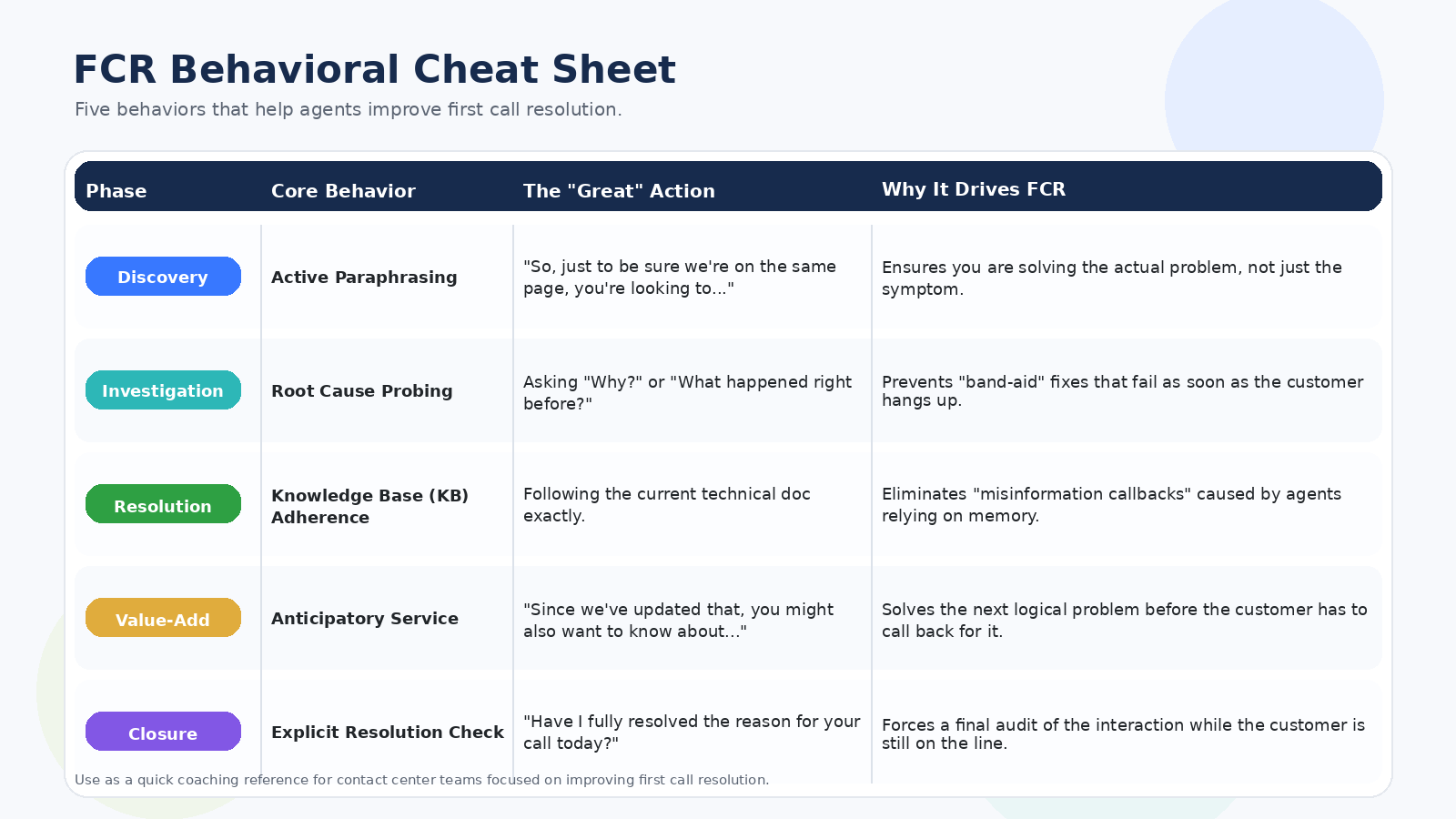
An explicit FCR-focused approach sometimes may diverge from traditional contact center metrics, but managers and corporate executives should be careful not to overlook the ultimate goal. Staying focused on keeping customers satisfied and loyal, driven by positive outcomes rather than adherence to certain common metrics will drive customer satisfaction and increase long-term results. Here are a few things to consider when implementing an outcome-driven approach:
Accuracy Over Speed – Don’t penalize or reprimand an agent for exceeding AHT if that extra minute was used to perform a permanent fix. A 10-minute call that resolves the issue is cheaper than two 5-minute calls that don't.
The "Next Step" Test – When reviewing a call, ask, "Did the agent leave a door open for another call?" If the agent fixed the bill but didn't explain the new billing cycle, that's a miss in an FCR-focused program.
Verify the "Yes" – A customer saying, "Okay, thanks" is not a resolution. A resolution is a customer explicitly answering "Yes" to the question, "Is there anything else, or have we taken care of everything you needed today?"
Ultimately, the data this integrated approach generates becomes a potent diagnostic tool for leadership. You’re not just scoring performance; you're quantifying resolution competency and identifying specific skill gaps that drive repeat calls. Weighting core behaviors sends an unambiguous message to the entire contact center floor: Solving the customer's problem is performance. This strategic alignment ensures that every role, from agent to quality analyst, is focused on the same outcome, delivering consistent, high-quality, and complete service – the kind of service that naturally solves customer issues on the first call and drives significant business value.
Edited by Erik Linask