


Call Center QA Featured Article
Points, Badges, and Better Agents: Using Gamification to Transform Call Center Agent Training
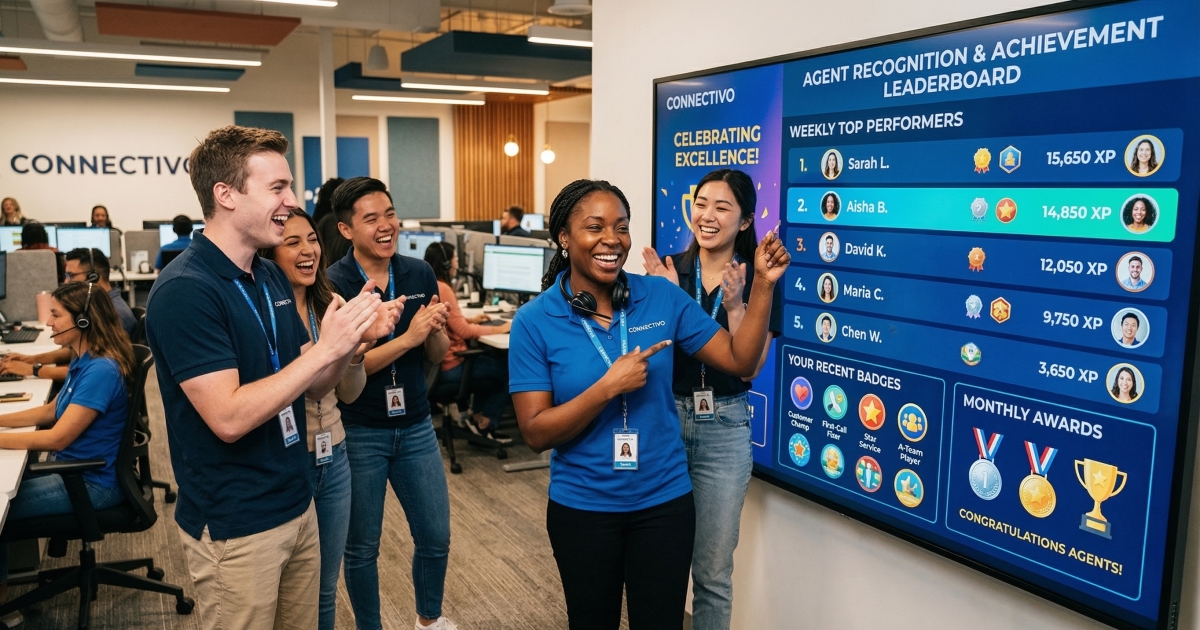
Let's be honest: Traditional corporate training often feels like a slow-motion walk through a desert of dry PowerPoint slides. In what should be a high-energy environment, asking contact center agents to sit through hours of static modules is a recipe for "zombie mode." Gamification flips this script by injecting game mechanics – such as points, badges, leaderboards, and quests – into the learning process. By transforming a chore into a fun challenge, organizations can drive deeper engagement, better retention, and a much faster path to proficiency.
The stakes are real. Contact centers invest significant time and money in hiring, onboarding and ongoing training, yet skill adoption – the actual transfer of learned behaviors to live customer interactions – remains one of the most persistent challenges. Gamification doesn't just make training more enjoyable; it addresses the underlying reasons that traditional training fails to stick: Lack of repetition, absence of feedback, and no meaningful incentive to stay engaged after the module closes.
The Power of Game Mechanics: Points, Badges, and Bragging Rights
At its core, gamification taps into basic human psychology and our desire for achievement, recognition, and competition. Instead of simply completing a training module, agents can earn experience points (XP) for passing quizzes or digital badges for mastering specific skills like "De-escalation Ninja" or "Technical Wizard." These visual markers of progress provide immediate gratification and a sense of tangible growth. Leaderboards take it a step further by fostering healthy competition; when agents see their names climbing the ranks based on their training scores or application of new skills, they are naturally more motivated to lean in.
However, the most effective gamification isn't just about the shiny objects. It's about creating a narrative. Imagine an onboarding program structured as a "Mission to Mars," where each training phase represents a stage of the journey. This sense of progression makes the learning journey memorable and gives agents a shared language that builds team cohesion right from the start.
It's also worth noting that different mechanics resonate with different people. Some agents are driven by competitive ranking; others are motivated more by personal progress and collecting credentials. A well-designed gamification system offers multiple on-ramps to engagement, so the agent who is energized by climbing a leaderboard and the one who just wants to earn every available badge are both pulled forward by the same system, just through different doors.
Bridging the Gap Between Learning and Performance
The true test of any training program is how well it translates to the real world. Gamification excels here because it allows for micro-learning and real-time application. By integrating your call center QA data into the game, you create a powerful feedback loop. For example, an agent might unlock a special achievement or bonus points if their next three calls receive a perfect score in a specific category, such as Active Listening.
This approach turns the data from your call center QA program into a source of excitement rather than anxiety. When the evaluation score becomes a way to level up in a company-wide game, agents begin to view quality standards as goals to be conquered. This shift in perspective ensures that the skills learned in the training environment are immediately and enthusiastically applied during live customer interactions.
Importantly, it also ensure leaderboards and other elements are focused on improvement and growth, giving every agent a chance to excel and win. When the rankings are just about traditional metrics, like AHT, call volumes, or even customer ratings, gamification can actually have a negative impact by repeatedly highlighting gaps between the same high and low performers. When that happens, low performers often don’t respond positively, but actually disengage – from training, from the team, or even from the job itself.
This integration also benefits managers and trainers. When gamification is tied to QA outcomes, patterns become visible quickly. If a large portion of the team is stalling at the same achievement level — unable to unlock the FCR badge, for instance, it sends a clear signal that the underlying skill may not have been adequately covered in training. Rather than waiting for performance reviews or score reports, leaders can identify and address gaps in near real time, making the entire training and coaching cycle more responsive.
Balancing Competition with Culture
While competition is a powerful motivator, it must be managed carefully to avoid creating a cutthroat or demoralizing environment. The goal is to elevate the entire team, not just celebrate the top 5%. To ensure gamification boosts morale across the board, leaders should include collaborative quests. These are goals that require the entire team to hit a certain threshold, such as a specific collective CSAT score that might unlock a group reward, like a pizza party or a relaxed dress code day.
Ensure that the game is also inclusive in its design. Offer different paths to success so that an agent who struggles with speed but excels in empathy still has a way to earn badges and recognition. By keeping the mechanics transparent, fair, and focused on growth, gamification moves from being a distraction to becoming a primary engine for building a high-performing, highly engaged workforce.
For contact centers operating in hybrid or fully remote environments, inclusivity requires an additional layer of intentional design. Remote agents face structural disadvantages that can quietly undermine even a well-intentioned gamification program. In an office setting, a leaderboard is a social object – something people react to together, comment on, and rally around. For a remote agent viewing the same leaderboard alone on a screen doesn’t translate the same way.
The visibility gap is equally important to consider. In-office agents benefit from informal touchpoints – spontaneous recognition moments, side-by-side coaching, casual conversations with managers. If any part of the gamification system relies on manager discretion to award points or recognition, remote agents can end up systematically under-rewarded not because of performance, but because of proximity. That's an equity problem dressed up as a game.
Finally, collaborative quests need extra design care in hybrid teams. Team challenges work best when members feel a genuine sense of shared investment. Remote agents who already feel peripheral to the team dynamic may not bring the same energy to a collective goal. Worse, if the team falls short, they may quietly worry that blame will drift toward those who are least visible. Building team challenges that explicitly require and recognize remote agent contributions goes a long way toward making the collaborative mechanic actually work.
The bottom line is that a truly inclusive gamification system in today's contact center can't treat remote agents as an afterthought. It has to be designed with them at the table from the start with metrics that don't punish circumstance, recognition that travels equally well across a screen, and team structures that make every agent feel like a meaningful part of the game.
Finally, remember that gamification is a system, not a one-time launch. The novelty of any new game wears off eventually. Organizations that treat gamification as a "set it and forget it" solution will see engagement drop off. To be successful, programs should evolve continuously with new challenges (and retiring outdated ones), and refreshing rewards to keep the experience feeling current. When gamification is treated as a living part of the training culture rather than a feature added to a platform, it delivers something far more valuable than higher completion rates. It builds a team that is genuinely invested in getting better, one level at a time.
Edited by Erik Linask