


Call Center QA Featured Article
Understanding the Voice of the Customer: From Insight to Impact
Customer sentiment has always been a key success factor, but it has never been as important as it is today. Customer loyalty is very fragile, and even seemingly minor disappointments can cause them to defect to competitors. The fact is that a company's success hinges on more than just the quality of its products; it depends on the quality of its customer relationships and interactions.
To build and maintain these relationships, businesses must actively listen to, interpret, and act upon what their customers are saying. This is the essence of understanding the Voice of the Customer (VoC). For contact centers, gathering and acting on customer feedback is an engine of continuous improvement, transforming a reactive support function into a strategic asset.
The real power of a VoC program lies in its ability to translate raw feedback into a refined plan for action. The process isn't about simply collecting data, but about creating direct, actionable links between customer insights and sentiment and agent training and development. These connections ensure that every training and coaching initiative directly impacts key performance metrics and, ultimately, the bottom line.
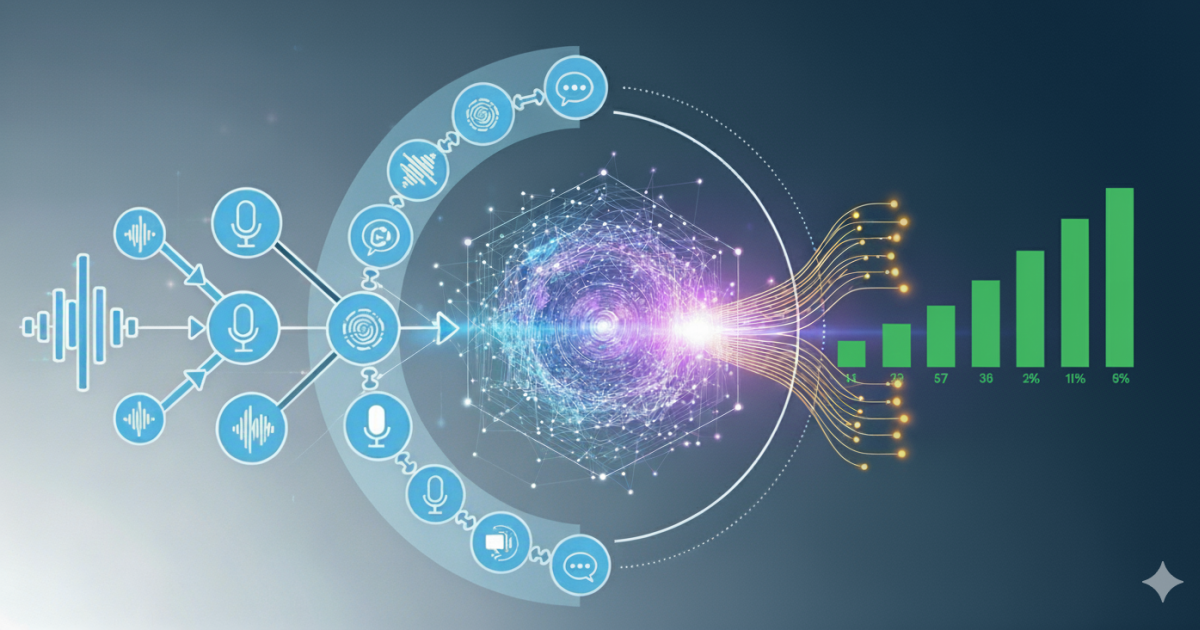
Effective VoC programs operate like a well-oiled machine, taking raw customer data and converting it into a refined, results-driven strategy. Look at this pipeline as having three primary phases:
Comprehensive Data Collection & Analysis
This is where feedback is gathered from every available source, and funneled into a central repository for analysis. While standard tools like post-interaction surveys (CSAT, NPS, CES (News - Alert)) provide crucial quantitative data, they only scratch the surface when it comes to truly understanding customer sentiment.
- Speech and Text Analytics: These technologies are invaluable for analyzing unstructured data from call recordings, chat transcripts, emails, and social media interactions. They can automatically identify common themes, measure sentiment, and flag emerging issues that customers might not mention in a survey – and which might otherwise be overlooked. For instance, an analytics platform might reveal a surge in calls where customers are expressing frustration with a new product feature, providing an unfiltered view of a problem.
- Call Center QA (Quality Assurance): This is a cornerstone of a robust VoC program. A well-designed QA program goes beyond a simple checklist of policy adherence. It uses a structured scorecard to evaluate soft skills, such as active listening, empathy, and problem ownership. When this data is aggregated, it serves as a powerful proxy for customer experience and can identify key developmental opportunities.
Identifying Causal Links
This is where call centers move beyond simple correlation to understanding causation, such as by using psychometrics, the science of measuring human traits and behaviors in a way that is reliable (consistent across raters and occasions) and valid (actually measures what it claims to measure). It offers a way to discover uncover evidence-based causal links and build out effective training and development plans.
By cross-referencing different data sets, call center leaders can pinpoint the specific agent behaviors that lead to positive or negative customer outcomes. For example, by analyzing call recordings and survey data, you might discover that customers who rated their experience highly interacted with agents who consistently used phrases like, "I understand" and who paraphrased the customer's issue. They can then correlate this behavior with results from other QA mechanisms, creating powerful insight that supports specific, trainable skills that directly impact customer satisfaction.
Similarly, if data reveals a high volume of repeat calls for a particular issue, a deep dive into the QA and analytics data might show that agents lack the necessary knowledge to provide a complete solution on the first contact, leading to a low First Call Resolution (FCR) rate. The analysis not only identifies the problem but also points directly to its root cause.
Targeted Training & Development
This is the most crucial and impactful stage because data collection and analysis are only as valuable as the actions they drive. Instead of generic, one-size-fits-all training, insights from QA programs should inform a hyper-targeted development plan. Every minute spent on development should be a direct investment in the skills that customers have told you are most important – and that may be different for every agent.
If analysis reveals a widespread knowledge gap related to a new product, the solution isn't another general training session. It's a specific, laser-focused module on that product, perhaps including a quick-reference guide and a practice simulation.
Feedback to individual agents should be precise and actionable. When reviewing a call, a supervisor shouldn't just say, "You need to be more empathetic." Instead, they can use the call center QA and VoC data to say something like, "On this call, our analytics showed the customer's sentiment was low when you used a scripted response. Let's practice using more personalized language to improve your empathy scores, which our data shows correlates to higher CSAT."
This level of detail makes the feedback actionable and the training directly relevant to the agent's performance.
This data-driven approach transforms agent training from a static event into a dynamic, ongoing process. It ensures that development efforts are aligned with real customer needs and that every training dollar is a direct investment in improved satisfaction, enhanced efficiency, and a stronger, more capable contact center. By systematically gathering and acting on the Voice of the Customer, organizations can move beyond mere reactivity, proactively shaping experiences that not only meet, but exceed expectations, fostering loyalty and driving sustainable growth.
Edited by Erik Linask