


Call Center QA Featured Article
Building Resilience in Call Center Agents to Prevent Burnout
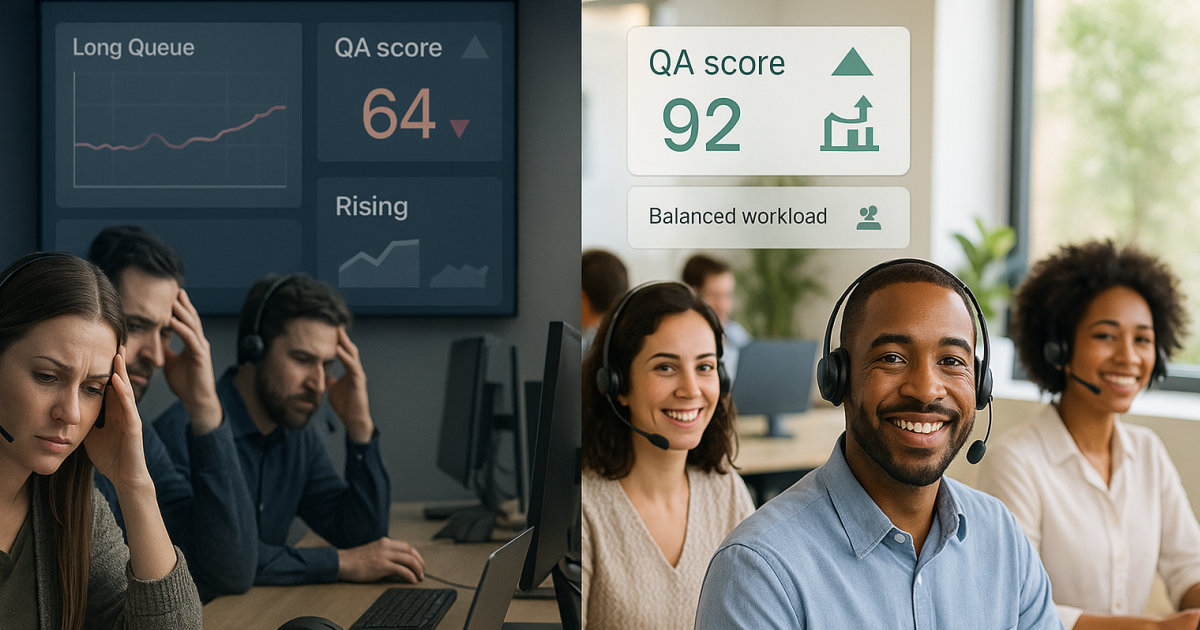
Burnout in contact centers rarely begins with a dramatic event; it builds over time as after-call work creeps upward, agents are required to respond to the same simple questions time after time, empathy thins, escalations become more frequent, and agents grow quieter on calls while they hunt for answers. In short, it happens when agents feel their work isn’t rewarding. Resilience – the capacity to absorb pressure, recover quickly, and sustain performance – is the quintessential counterweight. It doesn’t come automatically, though; it requires coordinated effort across people, processes, and systems, and it’s most effective when the organization treats it as an operational design challenge rather than an HR initiative.
Central to this theory is using call center QA not merely as a scoring mechanism, but as a practical tool that reduces friction, improves clarity, and guides targeted coaching.
At the personal level, resilience is grounded in skills like emotion regulation, cognitive reframing, and intentional recovery. Agents who have quick “reset rituals” – a minute of box breathing after a high-effort call, a posture check, or a short walk – return to the next customer with more mental bandwidth. These practices are more likely to stick when they’re backed by scheduling and workload policies that preserve micro-breaks and prevent back-to-back high-intensity cases.
At the team level, resilience is amplified by a psychologically safe culture. Agents who feel their concerns will be heard are more willing to raise process gaps early, ask for help, and participate in coaching.
At the system level, resilience is shaped by work design, meaning a distinct understanding of how routing balances complexity, how knowledge is structured for scanning, how tools reduce clicks and cognitive load, and how predictable recovery time is preserved throughout the shift.
Effective call center QA sits at the heart of all three levels. Clear, stable standards reduce uncertainty during live interactions and orient agents toward what “good” looks like under pressure. Regular calibrations among evaluators build trust that the system is fair, which lowers ambient anxiety and prevents the corrosive feeling that success is arbitrary.
This is where pshychometrics can deliver significant advantages. Psychometrics is the science of reliably measuring human traits and behaviors in a way that is reliable (consistent across raters and occasions) and valid (actually measures what it claims to measure). It helps eliminate bias and ensures metrics that are captured through call center QA programs are those that have proven impacts on outcomes (rather than guessing, which inherently brings in bias).
QA mechanisms also should capture more than behaviors; they should identify friction from things like system lag, confusing policies, broken macros, or knowledge gaps. This additional information can help surface causes of stress that agents cannot fix alone and which might otherwise go unnoticed. When QA highlights both effort and environment, coaching shifts from policing to problem-solving, and operational teams get concrete direction on what to fix upstream.
Managers should also look for early indicators of strain or stress, including:
- After-call work (ACW) creeping up week over week
- Silence and hold time increasing as agents search for answers
- Escalation rate or transfers rising, especially late in shifts
- Sentiment drop during calls or in post-interaction surveys
- QA score volatility (rather than average alone)
- Adherence volatility (e.g., more small schedule misses)
- Overtime concentration among the same agents
- Knowledge base dwell time spiking on a few articles
Some companies roll these signals into a simple resilience index to flag who needs support and which workflows need redesign.
Remember, the real purpose of QA programs isn’t actually to score agents and calls, but to drive timely coaching, shift planning, and process fixes before exhaustion becomes attrition. Given that, measuring and monitoring metrics and attributes that make sense is critical to a successful QA program. Often, it might be necessary to look externally for guidance on developing, evaluating, and improving your call center QA programs to ensure your process is aligned well with business objectives and driving meaningful improvement.
Routing and knowledge are two levers that immediately reduce cognitive load. Skills-based routing should account for complexity and emotional intensity so agents don’t absorb a string of high-severity contacts without time to reset. Simple “complexity caps” per hour—especially in the final 90 minutes of a shift—can stabilize performance and mood. Knowledge articles should present actions first and details second, using tight checklists and verified snippets so agents don’t burn time scanning dense text while a customer waits. Real-time assist can help here, but only if it truly shortens thinking time; cluttered prompts or irrelevant suggestions add friction rather than remove it.
Coaching is most effective when it’s frequent, brief, and specific. Swapping monthly marathon sessions for 15-minute weekly check-ins builds momentum and reduces performance anxiety. Each session can focus on two short QA clips—one moment to celebrate and one targeted improvement—anchored to a micro-goal for the week. Starting with strengths is more than morale-boosting; it reinforces identity (“I am someone who de-escalates well under pressure”) and makes it easier to graft new behaviors onto what already works. Peer huddles are another underrated tool: structured debriefs after difficult calls provide social support, normalize tough experiences, and spread tactics that work in the wild.
An important part of the burnout equation if the feedback loop from call center QA to operations. Regular reviews that aggregate QA themes should produce action plans that can then be verified by the QA program (i.e., does cognitive load drop, do AHT and escalation rates normalize, etc.). Over time, this loop steadily removes the most common sources of agent frustration, making difficult conversations the exception rather than the norm. Combined with targeted improvements to the onboarding process and ongoing agent and manager training, the sources of burnout can be systematically removed.
The business case is straightforward. Resilient agents deliver steadier quality, require less re-work, and create better customer outcomes. A well-designed and data-driven call center QA program that clarifies expectations, guides compassionate coaching, and fixes process friction converts effort into results. Burnout prevention, in that light, isn’t about asking people to be tougher; it’s about designing work that is fair, clear, and supported. When routing, schedules, tools, and call center QA are aligned to reduce cognitive load and preserve recovery, agents can bring their best selves to each and every call, and everyone wins.
Edited by Erik Linask