


Call Center QA Featured Article
Designing Effective CX Quality Monitoring Programs
Customer expectations are higher than ever, and every interaction has the potential to strengthen – or damage – your brand and its reputation. In competitive markets, exceptional customer experience (CX) is no longer a nice-to-have; it’s a strategic necessity. That’s why structured CX quality monitoring programs are essential. They ensure that every call, chat, or email reflects your company’s service standards and brand promise.
For many organizations, the contact center is the heart of customer engagement. It’s where loyalty is built, problems are resolved, and first impressions are made. A well-designed quality monitoring program provides the tools to evaluate agent performance consistently, identify improvement opportunities, and ensure customers receive a seamless, empathetic, and effective experience across all touchpoints. When executed effectively, these programs can directly impact retention, revenue, and brand reputation.
Without a structured CX monitoring program, quality can vary widely between agents, shifts, and channels. These inconsistencies can come in the form of varying responses to the same concerns, missed opportunities to up- or cross-sell and drive revenue, inefficiency, or incomplete or inaccurate information. Any of these can (and will) frustrate customers, erode trust, and undermine even the most well-intentioned service strategies
CX quality monitoring programs help:
- Maintain Consistency: Standardized evaluation criteria ensure every customer interaction meets defined service benchmarks.
- Uncover Gaps: Monitoring reveals skill or process issues that might not surface through metrics alone.
- Drive Improvement: Feedback loops empower agents to continuously refine their approach.
- Align with Customer Expectations: By integrating customer feedback, organizations can ensure their definition of “quality” matches what customers value most.
The question is, how do you do it? How do you create an effective CX monitoring program? Certainly, they will vary based on individual businesses, their priorities, and their products and services, but there are a few steps that will put any company on the right path.
Defining the Purpose and Scope
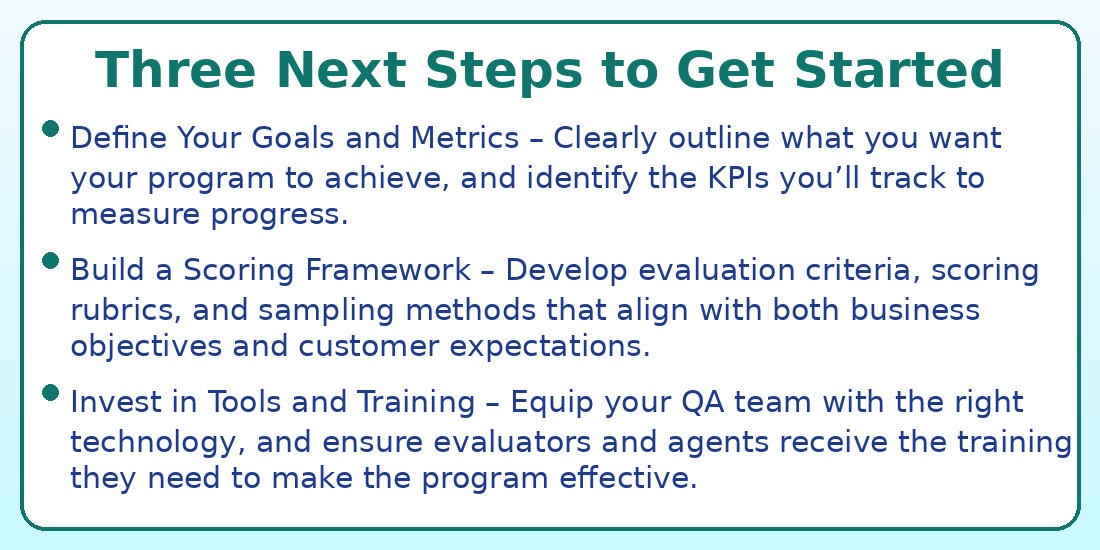
The foundation of any effective program is clarity of purpose. Are you aiming to improve first-contact resolution, enhance compliance, or boost customer satisfaction scores? Defining measurable goals keeps efforts focused. The scope should also be deliberate, for instance, deciding whether to monitor all channels or focus on those with the greatest impact on customer outcomes.
Building a Structured Framework
An effective framework should include:
- Evaluation Criteria: Target (News - Alert) behaviors and skills such as empathy, active listening, compliance, and product knowledge.
- Measurable Metrics: Make your program metrics are not only measurable, but correlate to business impact.
- Scoring Methodology: Clear rubrics that reduce subjectivity and ensure consistency.
- Sampling Strategy: A balanced mix of random and targeted evaluations to ensure fairness and address priority issues.
Leveraging Call Center QA for Consistency
Call center QA is the backbone of performance evaluation. A dedicated QA team supported by robust tools can provide unbiased, expert assessments of agent interactions. Regular calibration sessions keep scoring aligned across evaluators, and modern QA platforms can automate much of the administrative work, freeing time for deeper analysis and coaching.
Training and Calibration
Evaluators, supervisors, and team leads must understand the scoring system and service standards in depth. Regular calibration sessions, where multiple reviewers score the same interaction and compare results, reduce variability and strengthen program credibility.
Closing the Feedback Loop
Evaluation is only valuable when it leads to improvement. Feedback should be prompt, specific, and constructive. Ongoing training is essential. Using targeted coaching sessions, role playing, and microlearning modules, and other training techniques, supervisors can help agents turn insights into better performance and higher-quality customer interactions.
Integrating Customer Feedback
Post-interaction surveys, Net Promoter Scores (NPS), and customer comments add essential context. Comparing internal QA results with customer sentiment can reveal whether your standards align with customer priorities, and highlight gaps that might otherwise go unnoticed. This can also help you adjust your internal monitoring to focus on what your customers deem most important, or where they identify deficiencies.
Harnessing Technology and Analytics
Automation, speech analytics, sentiment detection, and real-time monitoring expand the reach of quality programs far beyond traditional sampling. These tools not only identify compliance risks but also surface trends, recurring challenges, and process inefficiencies, all of which provide a data-rich foundation for improvement.
Measuring and Reporting Impact
Linking QA results with broader CX metrics such as CSAT, FCR, and average handling time provides a fuller picture of program effectiveness. Clear reporting ensures leadership sees the value of quality monitoring, enabling better decision-making around training, staffing, and process changes.
Driving Continuous Improvement
A CX quality monitoring program should evolve alongside customer needs, market conditions, and organizational goals. Review and refine it regularly, positioning call center QA as not just a compliance mechanism, but as a powerful driver of customer loyalty and operational excellence.
Look at CX quality monitoring this way: Designing an effective program is an investment in your brand’s long-term health. By combining clear objectives, structured evaluation, customer input, and modern analytics, while learning from real-world successes, organizations can elevate service quality, inspire agent growth (and increase retention), and deliver the kind of experiences that keep customers coming back.
A strong program does more than correct mistakes; it builds a culture of continuous improvement, where agents feel supported, leaders have visibility into performance trends, and customers consistently receive service that exceeds expectations. As channels evolve and customer preferences shift, your quality monitoring framework should remain flexible, ensuring that every interaction, no matter the platform, reinforces trust and loyalty. Ultimately, the goal is simple but powerful: Turn every customer contact into a moment that strengthens the relationship and reinforces your brand’s promise.
Edited by Erik Linask