Convergence -- the delivery of voice, data, video, and multimedia all
over a single IP network -- promises great benefits for both enterprises
and service providers. The promise for enterprises includes lower
communication costs and ultimately new ways of doing business. For IP
network service providers, convergence promises new money-making
opportunities from high-quality, high-value interactive voice and video
communication services including IP Centrex, conferencing, unified
messaging, presence and instant communication, and more.
Convergence also entails numerous challenges. One of the huge
challenges is converging voice, data, video, and multimedia on the skinny
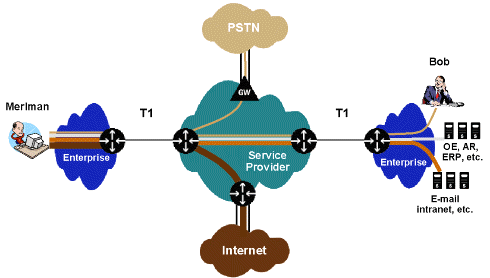
pipes between enterprise and service provider networks. Just look at the
diagram below! See that skinny pipe? It's typically an expensive T1 -- 1.5
Mbps connecting an enterprise LAN site with 100 Mbps or more bandwidth to
the service provider's network with gigabits of bandwidth. That's an
extremely tight bottleneck with two orders of magnitude less bandwidth
than the networks it ties together.
Take Merlman, Please!
To understand the types of traffic converging on this pipe, let's take the
case of Merlman in accounting. (You know Merlman -- that sniffling slacker
belittled in the Accountemps
radio commercials. Even if you're not familiar with the ad, you surely
know someone like this character.) When he is not "sick,"
Merlman spends his day producing and consuming different types of packets.
The value of these packets to the enterprise -- and consequently to the
service provider -- is indicated by the following colors in the diagram
above:
Brown -- Personal-oriented Web traffic including:
- Browsing for weather forecasts.
- Shopping for hairpieces.
- Streaming video of New England Patriots' Super Bowl highlights.
- Metallica MP3 downloads from Morpheus.
Bronze -- Business-oriented traffic including:
- Corporate e-mail.
- Intranet access for vacation balances and medical coverage
information for hair transplants.
- Intra-company IM to other accountants.
Silver -- Critical corporate data applications:
- Order processing, accounts receivable, ERP, and the like.
Gold -- Real-time interactive communications including:
- Voice calls to and from customers on credit hold.
- Voice or video call from Bob, the new CEO, demanding to know why
Merlman hasn't extended credit to a huge customer with money.
Governing Flows Through The Pipe
While Merlman may be an extreme case, these four types of packets are
produced and consumed by all organizations. To optimally converge Merlman
and everyone else through this pipe, there are five basic rules that must
govern how the pipe gets used:
- Premium interactive voice and video is king. Once a
real-time, revenue generating, SLA-guaranteed voice or video call is
accepted, it must have absolute priority over anything else. The key
word here is "accepted." See the final rule below.
- Don't starve data. Don't allow a pipe to be completely used
by voice. It's critical to allow some data, especially the silver
packets, to traverse the link.
- If the king isn't using the pipe, use all of it for data. The
full capacity of the pipe must be available for data if there is no
voice or video. Otherwise, we are still "channelizing" the
pipe and not benefiting from all the cost savings resulting from
complete convergence.
- Even the king needs limits. Call admission policies must
control and limit the maximum number of total calls, the number by
type of call (voice versus video), the number initiated from inside
and outside an enterprise location, and exceptions to these rules like
emergency 911 calls.
- If the king can't be satisfied, don't even try. If the pipe
is already congested, new call set-up requests must be rejected
(except for that 911 call). Adding just one more call to that pipe
will deteriorate not only the quality of that new call, but each and
every call on that pipe.
Fixing The Plumbing Into The Pipe
To implement these five rules, we need the right plumbing to the skinny
pipe that gives us critical intelligence and control capabilities:
- Traffic classification and prioritization. Differentiate
gold, silver, bronze, and brown packets and prioritize traffic flow
through the pipe based upon packet color.
- Pipe capacity and utilization. Understand the total bandwidth
of the pipe and the actual traffic volume flowing through the pipe.
- Call admission control. Accept or reject new calls based upon
configurable call limit policies and actual traffic flowing through
the pipe.
The right plumbing requires not only the right valves on the pipe, but
the right feeder pipes and, in some cases, dye to color different water
sources. Let's see what we have in our network plumbing bag that will give
us these capabilities.
Traffic Classification And Prioritization
To get traffic optimally out of the enterprise through that skinny pipe,
we don't even want to try to classify Merlman's brown packets. We just
want to ensure that we can classify everything else. This can be done
fairly easily for silver and bronze packets using the network address of
the various application servers.
Classifying gold packets requires more work. For IP phones and other
devices that generate only gold bits, we need to either set the ToS (Type
of Service) bits correctly on the phone and/or assign them to a VLAN
(Virtual Local Area Network) separate from data so that the router can use
the packet markings or VLAN interface for prioritization over the skinny
pipe.
For Merlman's Windows XP PC, we will have a problem. A Windows XP PC
supports all four colors of packets. We can't put this PC on the voice
VLAN, because we'll end up classifying both the brown and gold packets
from this PC as gold. We cannot rely on ToS bits either, unless the
softphone application can set them, and this brings us to our first
problem: many of today's softphones do not allow us to set ToS bits.
Once the packets leave the access router, they flow through the skinny
pipe and enter the service provider cloud via its edge router. The quality
of service (QoS) approach used in the cloud will have a major impact not
only on the packet's ability to optimally traverse the cloud and get into
the other skinny pipe, but also to get onto the right VLAN in the
enterprise. Prioritizing and routing the silver and bronze packets are
easy since the same network address rules can be used. For the gold
packets again, things are more complicated.
Packets can be prioritized and routed correctly all the way to the
enterprise VLAN only if the service provider:
- Trusts all of their customers to use the exact same ToS bit marking
scheme and correctly mark gold packets. (This is a big "if"
and is related to the problem of not all softphones setting ToS bits.)
- Does not change the ToS bits and uses ToS or MPLS in their network.
(MPLS just assigns an additional tag that doesn't change the ToS
bits.)
With networks using DiffServe, a problem may exist since ToS and
DiffServe bit markings are overlapping and might not be compatible. The
gold packets won't be able to get on the right VLAN in the enterprise if
they have been changed by the service provider.
This brings us to our second problem. If gold packet markings coming
from another network cannot be trusted, the service provider changes the
ToS bits, or DiffServe is used in the service provider cloud, the gold
packets must be explicitly marked based upon call signaling intelligence.
Pipe Capacity And Utilization, Plus Call Admission Control
The problem of understanding pipe capacity and utilization and making
admission control decisions is very challenging. Routers using ToS and
DiffServe for packet prioritization have absolutely no notion of capacity
limits and utilization. MPLS routers do, but only internal to the cloud
and not over the external skinny pipe. Even if they did, they could not
gracefully refuse a call because they do not participate in call set-up
messages. A router using any of these mechanisms will just try to cram
every packet it receives through that skinny pipe.
RSVP won't solve the problem either because it cannot be used to
establish a single reservation for a collection of related flows going in
different directions. In the case of voice or video, multiple two-way
signaling and media flows must all be accepted for the call to be started.
Consequently, it's possible that reservations for the low-bandwidth call
set-up messages would be accepted, but not for the high-bandwidth media
flows. The results cause huge problems. Bob and/or Merlman hear or see
nothing, an accounting record is created, and if the call is billable,
huge customer care and billing reconciliation costs are incurred. Lastly,
RSVP works on a first-come, first-served basis. It has no notion of call
admission policies to reserve bandwidth for data by limiting the maximum
number of total calls, the number of types of call, and exceptions to
rules like emergency 911 calls. That brings us to the last of three
problems: No routers today understand skinny pipe capacity and
utilization, and can make call admission control decisions based upon that
intelligence.
The Skinny On Solving The Three Big Skinny Pipe Problems
The key to overcoming these obstacles and successfully converging
Merlman's packets through that skinny pipe and is the tight integration of
session signaling and media flow control. A new category of equipment has
recently been introduced that specifically solves these three big
problems. They also satisfy other critical security, SLA assurance,
bandwidth policing, and law enforcement requirements for interactive,
session-oriented communications like voice and video.
These products, generically called "session directors," sit
at the edge of the service provider network where these skinny pipes
connect and complement the traffic classification and prioritization
capabilities of the service provider's edge router and the enterprise's
access router. They handle both the SIP signaling messages and the RTP-based
media packets with microsecond latency. They control call admission
gracefully based upon pipe capacity, utilization, and other policies, and
tightly control just the signaled media flows including Layer 2 and 3 QoS
marking, network address and port translation, bandwidth policing, and
other functions.
The ability to closely control packet prioritization will help
enterprises logically route our "fat," converged data through
our skinny pipes.
Jim Hourihan is vice president, marketing & product management
for Acme Packet. Acme Packet
enables network service providers to deliver premium, interactive
communications -- voice, video and multimedia sessions -- across IP
networks. The company's carrier-class equipment satisfies critical
security, SLA assurance, revenue and profit protection and law enforcement
requirements in wireline, wireless and cable networks.
|

 Internet Telephony Magazine
Click here to read latest issue
Internet Telephony Magazine
Click here to read latest issue CUSTOMER
  Cloud Computing Magazine
Click here to read latest issue
Cloud Computing Magazine
Click here to read latest issue IoT EVOLUTION MAGAZINE